

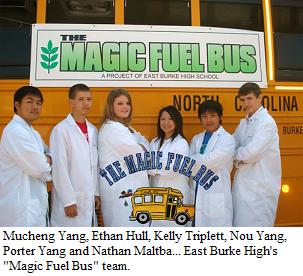
 A high school science project has turned into a way for a North Carolina school to save money, save the environment and comply with a state law requiring biodiesel use.
This story from the Burke County (NC) News Herald says East Burke High School, located between Hickory and Morganton in North Carolina, is the home of science teacher Bob Smith and his Magic Fuel Bus team of juniors and seniors Kelly Triplett, Ethan Hull, Nathan Maltba, Nou Yang, Mucheng Yang and Porter Yang have built a biodiesel refinery:
…after spending three days a week afterschool on the project, the students presented Friday morning the results and implications of the project to school board members, local biodiesel experts and parents.
The team’s first two processors failed, but the current processor, a five-gallon reactor, has produced more than 80 gallons of biodiesel fuel, Triplett said…
Porter Yang said the team started its trials in October and began testing the fuel in November.
But the team’s first successful batch of biodiesel fuel wasn’t created until January.
“We were surprised, but excited,” Nou Yang said.
With the successful batches of biodiesel, the students set forth to test the fuel in the high school’s activity and yellow school buses beginning in February, Smith said.
Nou Yang said the buses, for two weeks each, used a diesel and biodiesel mix of 5 to 15 percent biodiesel.
The biodiesel managed to improve the buses’ mileage, created less pollution and there was less friction in the engine, Nou Yang said.
The test results led the students to recommend building a biodiesel manufacturing plant in order for the schools to save money and to comply with a new state law, Mucheng Yang said.
The state law, which went into effect this school year, requires diesel school buses to use at least 2 percent biodiesel, Hull said.
School officials say they are looking at putting in a refinery to turn the area’s waste cooking oil into a steady supply of biodiesel… and the Magic Fuel Bus team aims to be part of that effort.
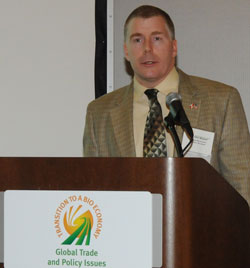 Biofuels production in Canada will impact meat trading patterns according to research by Al Mussell, George Morris Centre, University of Guelph. He says that the increase in biofuels production will turn the country into an importer of grains instead of an exporter. Al was one of the speakers at the Transition To A Bio Economy Conference.
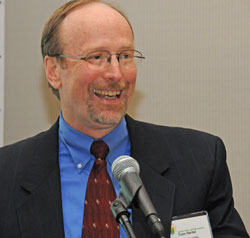 A very interesting presentation at our Farm Foundation Global Trade and Policy Issues conference had to do with the impact on poverty. Tom Hertel, Purdue University, was our presenter.
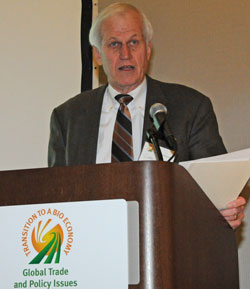 Former Texas Congressman Charles Stenholm was the moderator for our second session here at the Farm Foundation Global Trade & Policy Issues conference. I don’t think you’ll find anyone more knowledgeable about the policy side of this discussion.
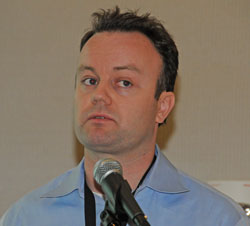 Providing us with a “Technical Global Biofuels Analysis” here at the Farm Foundation Global Trade & Policy Issues conference was Thomas Alfstad, Brookhaven National Laboratory.
 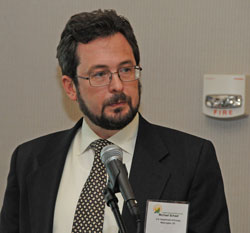 Michael Schaal is with the Energy Information Administration which is part of the U. S. Dept. of Energy. He spoke early on the program at the Farm Foundation conference about the global outlook for energy.
  Both Chrysler and General Motors (GM) reportedly did not meet the terms of their Federal loans but they will be given a second chance to restructure and survive. This news is admist General Motors Chief Executive Rick Wagoner, who led the company for nine years, stepping down at the request of the Obama administration and Chief Operating Officer Fritz Henderson taking over.
 “Let me say this as plainly as I can. If you buy a car from Chrysler or General Motors, you will be able to get your car serviced and repaired just like always,” Obama said in a speech today. “Your warranty will be safe. In fact, it will be safer than it has ever been. Because starting today, the United States will stand behind your warranty.”
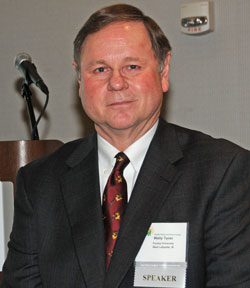 Today and tomorrow I’ll be covering the Farm Foundation,