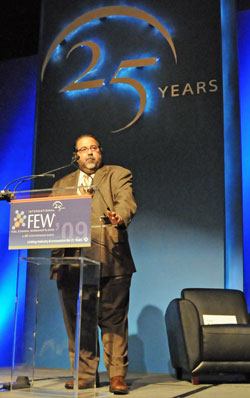
 He preached a powerful sermon this morning. He’s the Reverend of Renewable Fuels. He’s Bob Dinneen, CEO, RFA. Bob was on our program at the opening general session of the Fuel Ethanol Workshop. This is the 25th FEW and Bob has attended 21 of them now!
As always, Bob provided a very positive outlook by starting out looking at the industry’s accomplishments in the last year.
“Look at last year – in the face of a deepening economic downturn, negative 3% growth and rising unemployment, the U.S. ethanol industry grew by 34%, 0pening 31 new plants and adding an additional 240,000 new jobs!
We produced more ethanol last year than ever before, some 9 billion gallons, and we added new markets in the southeast and northwest where the RFA had worked with the oil industry and state governments to tear down regulatory barriers to blending.
As our industry grows, we are transforming our nation’s motor fuel market, and we are transforming the rural landscape of America.”
Bob touches on carbon, critics, food vs. fuel, land use, market expansion and cellulosic. He concluded by saying:
“We may have troubles, but we in the ethanol industry have a great story to tell, a compelling case to make, new opportunities to seize, and new markets to win over.
Don’t let anybody tell you that the ethanol industry is somehow responsible for despoiling rainforests and increasing carbon. We are the only way gasoline refiners can lower the carbon footprint of their product today.
Don’t let anyone tell you ethanol is a government boondoggle, we are creating new hope, new markets for farm products, new jobs for willing workers and new opportunities for entrepreneurship in communities where people need new pathways to a better life.
Don’t let anybody tell you that the world must choose between food and fuel. Our industry is helping humanity to achieve its historic dream of an affordable, and sustainable, abundance of all the necessities of life.
And don’t let anybody tell you that cellulosic ethanol is somebody’s pipe dream. It is as real as the people in this room.
If we stick together, do our work well, and stay focused on the future, our potential is unlimited – in the near-term, the long-term, and as far as our eyes can see and our minds can imagine.
Thank you all for listening, and for the honor of being one of you.
2009 Fuel Ethanol Workshop Photo Album
You can listen to Bob’s speech below:


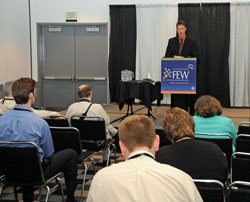 POET CEO, Jeff Broin, announced a new division for the company this morning at the Fuel Ethanol Workshop. POET Biomass will be “a division of POET devoted to managing harvest and transportation logistics for corn cobs – POET’s cellulosic feedstock – as well as waste wood and other feedstocks to be used for cellulosic ethanol and alternative energy projects at their production facilities.”
 According to the Clean Fuels Development Coalition, two timely publications addressing the environment were recently released at the Fuel Ethanol Workshop by the Ethanol Across America (EAA) education campaign.
 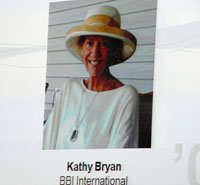 This morning, Kathy Bryan, BBI International, was presented with the FEW High Octane award for a lifetime of commitment to the industry. Unfortunately, due to health reasons, she could not be with us. It was an emotional scene as her son Tom accepted the award for her.
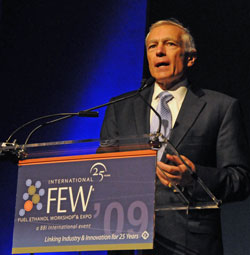 Gen. Wesley Clark,
 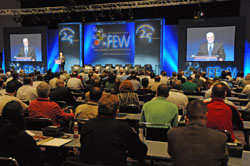 Mike Bryan, CEO, BBI International, opened the general session this morning.
 Biofuels has been compared with fossil fuels, blamed for worldwide starvation, linked to CO2 increases and decreases, and born the brunt of scrutiny for rainforest destruction (aka
  The report recommends that specific biofuel crops should be grown in certain regions. For example, corn for ethanol should be grown in states like Iowa where only one percent of the crops are irrigated, whereas significantly less corn should be grown in Nebraska where 61 percent of corn is irrigated. The report ultimately calls for more attention to the
  At the 2009 Fuel Ethanol Workshop, the
  In existence since 1996, the NEVC has assembled a broad coalition of like-minded industry and government leaders, environmentalists and consumers, and many other organizations and individuals interested in reducing oil imports, stimulating the economy, and improving the environment. The non-profit group had 1,600 members and their employees now become part of the Growth Energy team.
 The 25th Annual