ACE Conference 2026

Purdue: B20 Just As Good As Ultra-low Sulfur Diesel

John Davis

A 20 percent blend of biodiesel runs just as good as No. 2 ultra-low sulfur diesel. That’s the findings of a new study from Purdue University that showed no statistical dropoff when semis run the green fuel:
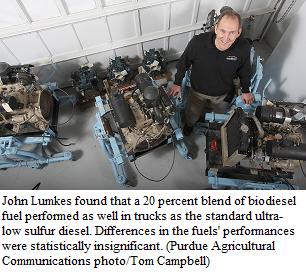
lumkes-biodiesel“In terms of performance, reliability and maintenance costs, it was basically a wash,” said John Lumkes, the assistant professor of agricultural and biological engineering who led the study. “The only differences are environmental and economic.”

The study, which compared two 10-vehicle truck fleets using the ultra-low sulfur fuel and B20, was released in the journal Applied Engineering in Agriculture. Trucks used for comparisons in the yearlong study had the same engines, similar miles already on them at the start and drove nearly the same number of miles over the year.

The only statistical difference related to the B20 was that it lowered the oil viscosity between maintenance intervals in engines slightly more than the ultra-low sulfur diesel. But even so, Lumkes said the oil still had sufficient viscosity so as not to damage engine parts.

“They were still within the range of what is acceptable before you need an oil change,” he said.

Lumkes and his researchers ran 10 trucks more than 1.5 million miles and found no appreciable difference in fuel economy, fuel test results, engine oil analysis, and service and maintenance costs. The only difference was that the B20 costs about 13 cents more per gallon than the ultra-low sulfur diesel. But Lumkes says the the real value of the test shows that engine manufacturers don’t have to worry that biodiesel will cause abnormal engine wear.

Biodiesel

Ethanol and Biodiesel Testimony Presented at EPA Hearing

Cindy Zimmerman

EPAThe Environmental Protection Agency’s public hearing on the proposed rule for the Renewable Fuels Standard (RFS) is now underway in Washington, DC.

The first testimony presented was from Renewable Fuels Association President and CEO Bob Dinneen, who expressed the ethanol industry’s major concerns about the agnecy’s attempt to measure greenhouse gas lifecycle analysis including international indirect land use changes. “There is so much uncertainty in trying to account for international impacts that it renders the regulatory process incapable of determining a specific number,” said Dinneen. “We have concerns about some assumptions EPA has made. We think they have greatly underestimated increases in yields, underestimated impact of distillers grains, underestimated or used very conservative assumptions with regard to bushels of grain per acre – all of which will have a significant impact on this analysis.”

Listen to Dinneen’s testimony here: [audio:http://www.zimmcomm.biz/rfa/epa-hearing-dinneen.mp3]

Manning Feraci of the National Biodiesel Board presented testimony at the hearing on behalf of the biodiesel industry. “We recognize that statute requires EPA to consider significant indirect emissions when calculating a renewable fuels emission profile,” said Feraci. “This does not require the EPA to rely on faulty data and unrealistic scenarios that punish the U.S. biodiesel industry for wholly unrelated land use decisions in South America.”

Listen to Feraci’s testimony here: [audio:http://www.zimmcomm.biz/nbb/epa-hearing-feraci.mp3]

The EPA hearing will continue all day today and then the agency will be holding a workshop on the RFS on Wednesday and Thursday.

Audio, Biodiesel, Energy, Environment, Ethanol, Ethanol News, NBB, RFA

Additive to Help Burn Biodiesel in Newer Engines

John Davis

chevronoronite1One of the issues with burning higher blends of biodiesel in newer diesel engines that use post-injection for controlling emissions is significant engine wear with methyl ester dilution in the engine oil crankcase.

This story from Biodiesel Magazine
says Chevron Oronite Company LLC has developed a unique engine oil additive to help combat that engine wear when using B20:

Fuel dilution has always been an issue with diesels, but never more so than with post-injection. Petrol diesel dilutes engine oil too, but it volatilizes off and eventually is released through the breather system. For biodiesel, however, the story is significantly different.

Biodiesel has a higher and narrower boiling range than petroleum diesel, and its physical properties lead to larger droplet sizes exiting the fuel injectors. This means that, while the petrol portion of the blend vaporizes and follows its destination to the exhaust stream as the piston is at the bottom of the cylinder, the methyl ester fraction—with its higher, narrower boiling range and larger droplet size—remains in liquid form collecting along the exposed surface area of the cylinder wall, and as the piston rises, much of the biodiesel bypasses the rings to enter the crankcase. Once in there, the biodiesel does not volatilize off like mineral diesel does. With the heat of the crankcase, there is concern about oxidation of the oil/biodiesel mix and engine wear resulting from the organic acids.

“In the case of biodiesel, once it gets in the crankcase and as it starts to degrade, it forms organic acids and starts to polymerize,” said Gary Parsons, global OEM and industry liaison manager for Chevron Oronite. “The organic acids can aggressively attack certain metals, particularly lead in the lead bearings. And then as it polymerizes and oxidizes, it can lead to increased deposits in the engine—in particular, deposits on the pistons.”

The engine oil additive Chevron Oronite developed is designed to counter the effect of the acids, so they don’t aggressively attack the metal; and also to prevent oxidation and formation of deposits.

The product is commercially available and marketed under the Oronite Lubricating Oil Additive trademark. The article points out that greater use of biodiesel is necessitating the additive’s greater use.

Biodiesel

Gentlemen, Start Your Biodiesel Engines!

John Davis

It’s not quite the Indy 500, but don’t tell that to the guys racing in the New Holland Celebrity Tractor Race! It’s the fourth year for the popular feature of the Country Music Association’s 2009 Music Festival, June 10-14, 2009 in Nashville, TN., and some of the participants are looking for revenge.

The race (which you can see some of last year’s race in the video above) will feature, among others, National Biodiesel Board CEO Joe Jobe, who is making his third appearance in the race that features “celebrities” from many professions driving a New Holland compact tractor through an obstacle course of road cones on June 14th:

Jobe, who placed 3rd in the 2008 race, has his eyes set on moving higher in the ratings. One of his main challengers from 2008 is his friend and biodiesel supporter Chuck Leavell, environmentalist, conservationist, author, and 27-year keyboardist for the Rolling Stones. Leavell placed 5th in 2008, but only seconds on the clock separated the two friends. His eyes are also set on placing higher. Adding to the action is country music artist Michael Peterson, also a strong biodiesel supporter, who is hosting the competition for New Holland.

“New Holland is once again taking an industry-leading role in its support of biodiesel,” said Jobe. “They have already led the industry in supporting 100% biodiesel in all of the engines they manufacture, but they are not resting on those achievements. They continue to promote the biodiesel for its benefits to the nation’s energy supply, food supply, and agricultural sector.”

Now, if you can’t be at the race, you can still see live coverage of the event over on our sister Web site, AgWired.com. The coverage begins with preliminary interviews at approximately 10:30 a.m. (Central Time) on Sunday, June 14, 2009. The race will begin at 11:30 a.m. and conclude at approximately 1:30 p.m. See you there!

Biodiesel, New Holland

USDA Meets Obama Biofuels Objective

Cindy Zimmerman

Agriculture Secretary Tom Vilsack says USDA has met President Obama’s 30-day directive to expedite and increase the production of biofuels.

Vilsack“Further developing the biofuels industry helps create jobs and stimulates rural economies, an important part of getting our economy back on track,” Vilsack announced. “President Obama and I are committed to advancing clean and renewable energy as it creates jobs domestically and boosts tax revenues at all levels of government.”

Among the objectives USDA was asked to accomplish on May 5 were biofuels provisions of the energy title of the 2008 Farm Bill, including providing loan guarantees and grants for biorefineries, expediting funding to encourage biorefineries to replace the use of fossil fuels in plant operations and encouraging production of next-generation biofuels.

USDA is also launching the Biomass Crop Assistance Program for the collection, harvest, storage, and transportation of biomass for conversion facilities.

biofuels, Energy, Government, USDA

19th Annual EPAC Conference in Bozeman, MT

epacThe 19th Annual Ethanol Producers and Consumers (EPAC) Conference, Fuel, Food and the Future, will be held at the the Best Western Grantree Inn, Bozeman, Montana June 29 and 30, 2009. This educational conference will allow attendees to network with and learn from nationally recognized authorities, and participate in discussions of the emerging technologies in first generation Biofuels, also Biofuel Co-product research and use and the Future Biofuel feedstocks and opportunities.

Monday, June 29 at 1:00 p.m. speaker presentations begin with the session “Barley as a Fuel Feedstock”. Presenters will include Craig Shealy of Osage Bio Energy, Clifford Bradley, Montana Microbial Products, Butte, and Tom Blake, MSU Research Professor. This will be followed by Biofuel Projects, Opportunities & Challenges with William Hagy, Under Secretary for Rural Development, USDA, Washington DC; John Urbanchuk, Economist, LECG, Pennsylvania. Yellowstone National Park Ranger, Jim Evanoff will then speak to Fuel Performance, Park use of Biofuels and the Clean Cities Program.

Tuesday July 30, the conference includes sessions that build on research and development of the innovative use of distillers grains. Presentations will expand discussion of distillers grains for medical and food use that was presented at the 2008 conference as well as present additional research currently being done on the beneficial value of biofuels coproducts. A biodiesel fuel session will follow with presentations from Joe Jobe, Executive Director of the National Biodiesel Board, and Camelina for Biodiesel with Alice Pilgeram, MSU Researcher and Biofuel Impact and Update for Montana by Howard Haines, MT DEQ.

The final conference session includes presentations on Biomass Energy through Anaerobic Digester, Algae Biofuel, Conversion and Advanced harvest and Collection of Biomass and Advanced Integrated Biofuels with animal production.

Conference sponsors include Abengoa Bioenergy, CHS, Fagen, Inc. KATZEN International, National Biodiesel Board, Montana Department of Environmental Quality, Montana Wheat & Barley committee and Prime Biosolutions.

For additional information and/or to register the 19th Annual EPAC Biofuel Conference, visit www.ethanolmt.org.

Biodiesel, Ethanol, NBB, News

Renew 09: Empowering the Land Conference Expo

Joanna Schroeder

renewlogo2Looking for a conference that encompasses all forms of renewable energy? Then RENEW 09: Empowering the Land Conference and Expo may be the one you’re looking for. The conference, being held on June 23-24, 2009 in Tucumcari, New Mexico is a “nuts and bolts” conference for anyone looking to prosper from the emerging renewable energy economy.

Renew 09 will feature major industry thought leaders, top governmental officials and landowners sharing best-practices for developing facility-scale and utility-scale renewable energy projects. This event is for anyone involved in, or wants to be involved in renewable energy including those in wind, solar, water, and biofuels. There will also be a free, two-day Renewable Energy Expo and attendees have the opportunity to tour a 1.5 MW wind turbine installed at Mesalands Community College, operated by the North American Wind Research & Training Center.

David Griscom, Clean Energy Program Manager with the Regional Development Corporation, and committee chair for programming for RENEW 09, says, “We have developed exciting programs and content for our RENEW 09 attendees that are solution-based and actionable. Our sessions and panels will discuss wind energy, solar energy, landowner associations, rural electric cooperatives, transmission, and even new geothermal technology to create electricity from hot, dry rock on the earth’s crust.”

If you can’t be on site, all programs will be broadcast live via the internet. For registration information, visit www.EmpoweringTheLand.com.

biofuels, conferences, Solar, Wind

OriginOil Files Patent for Its Algae Production

Joanna Schroeder

Many drivers across the country are getting frustrated as gas prices are on the rise and oil prices have surpassed $70 a barrel. Algae production may be a good replacement for oil and today, OriginOil, Inc., announced that it has filed for a Patent Cooperation Treaty (PCT) on its technology to convert algae to renewable oil. The renewable oil could be used to replace diesel, gasoline, jet fuel, plastics, and solvents.

A challenge that has faced researchers on the culturing of microalgae has been light utilization. According to a company representative, “The invention addresses challenging problems in the culturing of microalgae, including high energy utilization, fouling of light emitting surfaces, and diurnal growth cycles.” To mix metaphors, in a nutshell, this technology allows the algae to have access to the light throughout the photobioreactor, rather than just on the surface.

originoil-process-10a

The filing describes system and methods for enhancing mass production of microalgae, involving the use of light arrays. The systems and methods are useful in applications such as energy production, fuels, foods, pharmaceuticals, plastics, and CO2 fixation.  Also described are systems and methods for lysing (rupturing) cells and extracting their components, and for producing electricity with closed-loop CO2 recycling.

Vikram Pattarkine, PhD joined the OriginOil team as the chief technology officer and oversees the company’s research program. Pattarkine noted, “The pace of development at OriginOil has been extremely rapid. With this filing, we have consolidated our intellectual property protection at the international level in a number of areas of innovation at OriginOil.”

Earlier this year, OriginOil announced that it had finalized a deal with the Department of Energy’s National Laboratory to validate and commercialize the technology. The company has also been awarded Biofuels Digest’s Top 50 award as a top company changing the face of the biofuels industry.

algae, Biodiesel, Company Announcement

Oneworld Energy Expands Into U.S.

Joanna Schroeder

oneworldenergylogoThe wind and solar industry continues its rapid growth in the U.S. with the  announcement that Oneworld Energy, a company that focuses on wind and solar power installations, is expanding is presence. It will be opening an office in Melville, NY and has tapped Roger Slotkins as CEO. Melville has developed a green-tech corridor that focuses on bringing companies and employees together in the clean-tech industry. A tremendous asset to the city has been the support of Congressman Steve Israel.

Congressman Israel noted, “My goal is to see Long Island become the nation’s capital for clean energy. Oneworld is an example of the companies within the alternative energy industry we are attracting to our growing green-tech corridor. These businesses are bringing new green jobs for New Yorkers while also improving our environment and decreasing our dependence on foreign oil.”

Formed in 2003, Oneworld Energy is comprised of three divisions: Oneworld Solar, Green Breeze Energy (wind) and Composotech Structures (wind services).  In the States, Composotech Structures currently provides maintenance and repair services for wind turbine blades and is also developing a 200 MW wind farm in Oklahoma.

Mr. Allen, President and CEO of Oneworld, commented, “Given our desire to increase our presence in the U.S., Roger’s track record within the clean-tech industry will be a perfect complement.”

Company Announcement, Solar, Wind

The Irrationality of Indirect Analysis

Joanna Schroeder

branding-logo-smallThe rationale of indirect land use remains in the hot seat and the biofuels industry continues to stand its ground. Today, Robert Zubrin, author of Energy Victory and senior fellow at the Foundation for Defense of Democracies had an article published in Roll Call, a publication targeted at Washington, DC politicians. “The Irrationality of Indirect Analysis,” lays out why taking into consideration the indirect effects of biofuels production is a mistake.

Many in the biofuels industry remember when indirect land use took the country by storm: February 2008. This is when Tim Searchinger published his report claiming that while corn-ethanol may decrease carbon dioxide emissions, the process to create the ethanol may indirectly increase carbon emissions through expanded agriculture development particularly in third world countries.

zubrinsec0209091Zubrin writes, “A more cogent critique, in my view, would be a moral one, as the Searchinger argument, now apparently embraced by the EPA, presupposes that it is or should be a proper goal of American policy to restrict the economic growth of underdeveloped nations.”

The article continues to highlight how creating biofuels policies using scientifically unsound research would ultimately affect policies in all areas including health care and technological advances. He concludes, “Clearly such an absurd theory cannot be accepted as a basis for policy.”

You can read the entire article here. In addition, Zubrin will be giving a special presentation during the 25th Fuel Ethanol Workshop in Denver, Colo. on June 16, 2009 beginning at 11:30 AM.

biofuels, Indirect Land Use