

 The airline industry should shoot to have 80 percent of its fuels come from ethanol and biodiesel by the year 2050.
This post on the gas2.0.org Web site says the “Green Skies Thinking” published today by right wing think-tank Policy Exchange pushes the phase-in of an EU Sustainable Bio-Jet Fuel Blending Mandate by 2020, leading to aviation companies having to commit to a rising proportion of jet fuel from sustainable bio-jet fuels:
Crucially, the report also reckons that growing the feedstock needed for advanced biofuels would require significantly less land and be more sustainable than first generation biofuels such as bioethanol and biodiesel, generally used by road transport.
In detail, the report’s key recommendations are:
* The introduction of a EU Sustainable Bio-Fuel Jet Mandate, starting from 20% of aviation fuel in Europe being sourced from or blended with bio-fuel in 2020 and rising to 80% in 2050. The report claims this could reduce EU aviation sector carbon emissions by 60% by 2050 and save the UK £37.41 billion between 2020 and 2050.
* Minimising the cost of supplying sustainable bio-jet fuels to ensure its production cost drops to around $80 a barrel by 2030, and $70 by 2050, which the report says compared well with the average jet fuel price between 2000 and 2008 of $62.29.
* An increase in UK support for companies conducting research and development (R&D) into producing sustainable biofuels; in particular increasing the current R&D tax credit regime to include companies researching bio-jet fuels. Along with further tax support for the sector, it claims the support would cost less than £5 million a year.
* Charging the Renewable Fuels Agency, which administrates the Renewable Transport Fuel Obligation, with the task of drawing up and enforcing standards to ensure bio-jet are produced sustainably and reduce greenhouse gas emissions.
The report’s author says that if aviation emissions are not kept in check through measures such as using biofuels, they could make up a fifth of all global greenhouse emissions.
 From the guys who brought you biodiesel brewed from coffee grounds (see
  Starting next month, nine counties in Northwest Oregon will require all diesel to contain at least 2 percent biodiesel. This comes two years after all gasoline statewide had to have a 10 percent ethanol blend.
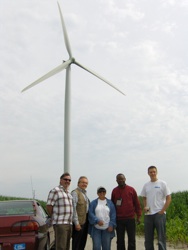 Wind energy is an up and coming technology in the U.S. and central Illinois. Attendees of the
  The
The  The
The 
 In these times of tough economic news, a new wind could be blowing opportunity into the Midwest.
 A team of 10 ISU researchers led by Hans van Leeuwen, an Iowa State professor of civil, construction and environmental engineering and president and founder of MycoInnovations, for their work to use a microscopic fungus to produce biodiesel from plant processing wastes…
 After spending the last three years in Colorado, the Collective Biodiesel Conference is being held at American University in Washington, DC. This year’s meeting features Josh Tickell, author and director of the biodiesel film “Fuel,” which used to be known as “Fields of Fuel,” winner of a Sundance Film Festival award in 2008. Tickell will give his presentation, “The Trillion Dollar Energy Breakthrough.”