

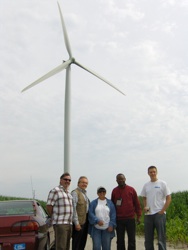
 Wind energy is an up and coming technology in the U.S. and central Illinois. Attendees of the International Farm Management Association 17 Congress (IFMA 17) got a chance to learn more about this current, complex energy issue. Andrew Young, CDO of Horizon Wind Energy, addressed the IFMA 17 Congress today in the Brown Ballroom at Illinois State University. Young’s presentation outlined the wind energy industry, the company itself and the current policies and incentives in place to help grow the industry.
Horizon Wind Energy is the company that manages the wind farm located in McLean County. The Twin Groves Wind Farm is located five miles east of the Central Illinois Regional Airport. The wind farm produces 396 megawatts of clean energy per year enough to power around 120,000 homes in Illinois. With over 240 massive turbines the Twin Groves Wind Farm is one of the largest in the country.
One of the main factors in starting a wind project is getting land owners to sign on to the project. The ideal placement for wind farms is on open range and actively cultivated farm lands, thus relevant to many of the attendees of the IFMA 17 Congress.
Young also stressed the challenges that exist to furthering the wind energy industry in the U.S. Currently, the U.S. energy grid system is not structured to support the full potential capacity for wind farming technology. Lack of connection to the grid has tabled some wind farm projects in areas that are ideal for wind technology. Also, tax credits and incentive programs are another main factor in funding and starting a wind farm project, Also, community opposition and difficulty in obtaining permits can slow a wind project.
Ultimately, tax incentives are critical to wind energy’s success. At the end of the presentation, a man from Australia wondered what the growth of wind capacity would be in the U.S. without tax incentive programs from the government. Young responded, “Very slow, since every form of energy is subsidized in the U.S., there would be no way that this industry could grow without this program.”
 The
The  The
The 
 In these times of tough economic news, a new wind could be blowing opportunity into the Midwest.
 A team of 10 ISU researchers led by Hans van Leeuwen, an Iowa State professor of civil, construction and environmental engineering and president and founder of MycoInnovations, for their work to use a microscopic fungus to produce biodiesel from plant processing wastes…
 After spending the last three years in Colorado, the Collective Biodiesel Conference is being held at American University in Washington, DC. This year’s meeting features Josh Tickell, author and director of the biodiesel film “Fuel,” which used to be known as “Fields of Fuel,” winner of a Sundance Film Festival award in 2008. Tickell will give his presentation, “The Trillion Dollar Energy Breakthrough.”
 On the last day of the Green Jobs Waiver public comment period, Growth Energy joined with tens of thousands of Americans in submitting formal comments to the U.S. Environmental Protection Agency (EPA) in favor of increasing the amount of ethanol that can be blended with gasoline to 15 percent. Growth Energy submitted its 37-page analysis which outlines the overwhelming scientific evidence that increasing the blend to 15 percent has no adverse impact on a car’s performance, maintenance or emissions.
  Already the ethanol industry has helped create and support half a million jobs across the country. Increasing the blend to 15 percent will create and support more than 136,000 new green-collar jobs.
 Volvo’s vehicles will be fueled by second generation bioethanol at the United Nations Climate Change Conference in Denmark in December. IAssisted by Partnership for Biofuels, Inbicon, a DONG Energy subsidiary, Novozymes and Danisco will help supply the straw based E85.
 The 2009
  Renewable Petroleum. “I think diesel is where we need to be,” said CEO Bill Haywood. Their feedstocks include low-carbon, natural sources of sugar such as sugar cane and cellulosic biomass. Patent-pending UltraClean™ fuels are custom engineered to have higher energetic content than ethanol or butanol; to have fuel properties that are essentially indistinguishable from those of gasoline, diesel, and jet fuel; and to be distributed in existing pipeline infrastructure and run in any vehicle. In addition, their product is price competitive at $50 a barrel.
 Amyris