

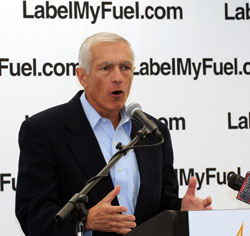
 Gen. Wesley Clark, Growth Energy, made an announcement this morning at the Farm Progress Show. The organization is calling for country of origin labeling for fuel. I would call that COOL for fuel! Hey, we do it with food, why not fuel?
General Wesley Clark, Co-Chairman of Growth Energy, today called on the United States Congress and the White House to take action to dramatically enhance the market transparency of the nation’s fuel supply by requiring a national standard of country of origin labeling (COOL) for fuel.
The Label My Fuel initiative would create a COOL standard similar to requirements already in place for common consumer items, including apples, beef, cars and coffee. The goal is to help create consumer awareness of the costs and national security implications of the nation’s addiction to foreign oil.
Clark also unveiled Growth Energy’s labelmyfuel.com, which showcases the costs of American dependence on foreign oil, and serves to rally grassroots support for Congressional action on COOL for fuel legislation.
You can find photos from the press conference in our Farm Progress Show photo album and you can listen to the press conference below:
 It’s not only the biofuels industry that has had enough.
 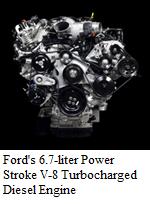 Previously, I told you about how General Motors was soon to debut a new heavy-duty, diesel engine designed to burn B20 biodiesel (see
  A Missouri plant that turns agricultural waste products into fuel pellets is the first to receive a payment from the USDA’s Farm Service Agency’s new Biomass Crop Assistance Program (BCAP).
 This investment from Waste Management and Valero will be used by Terrabon to advance the scalability of their technology. Waste Management will also assist Terrabon in securing organic waste streams, which Terrabon will use to produce high-octane gasoline using its MixAlco™ technology. MixAlco is an acid fermentation process that converts biomass into organic salts.
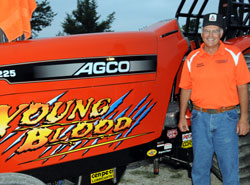
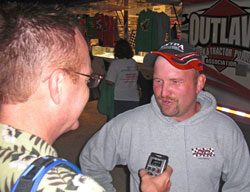 What do you think of when you hear that there’s a sled running on biodiesel? Probably not thinking tractor pull sled are you? Unless you’re a tractor pull fan. Well those big machines that the tractors and trucks pull are also diesel powered and in Jefferson City, MO there’s a company that manufactures them and runs them on biodiesel.
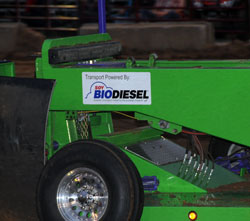 Donnie says they do over 160 shows a year around the country. At the Midwest Extreme Truck and Tractor Pull in Jefferson City he says they had two sleds in operation. He says they run B20 in them and have been for over 3 years very successfully. Donnie says they’ve had a lot of luck locating the fuel when they need it, especially at major truck stops.
 This edition of “The Ethanol Report” features comments from the
  Thanks to an invite from the