

 A newly proposed collaboration between the U.S. Department of Energy’s Argonne National Laboratory and the City of Naperville, Illinois would convert “landscape waste”—essentially, grass and leaf trimmings—into one of several different environmentally friendly fuels, including ethanol, bioelectricity and hydrogen.
This new partnership, known as the “Green Fuels Depot,” provides “a golden opportunity for Argonne to be associated with one of our neighboring communities in promoting new technologies that we have pioneered here at the laboratory,” said Glenn Keller, manager of vehicle systems in Argonne’s Center for Transportation Research.
 The depot will use a gasifier from Packer Engineering to convert grass, leaves, branches and other biomass into syngas, a gas mixture that contains carbon monoxide and hydrogen. The syngas can then be used to create cellulosic ethanol, bio-electricity or hydrogen. Although the proposal calls for trying all three fuel types, Keller said it would be more practical to concentrate on producing just one fuel when the depot is built.
Because Naperville’s official vehicle fleet currently includes flex-fuel vehicles that run on both gasoline and ethanol, any cellulosic ethanol produced by the depot could be quickly put to use. Although the pilot project will use only 3 percent of the annual landscape waste collected by the city, if all 48,000 cubic yards of Naperville’s landscape waste were used in a full-scale Green Fuels Depot, it would be enough to fuel all 300 vehicles in the city fleet.

 The Colorado Corn Growers Association, the Governor’s Biofuels Coalition, Western Convenience Stores and Southern Colorado Clean Cities in Colorado Springs are partnering to celebrate the opening of a new E85 pump location at 227 West Fillmore Street in Colorado Springs, Colorado, on August 26. This will be the ninth station selling E85 in Colorado Springs.
 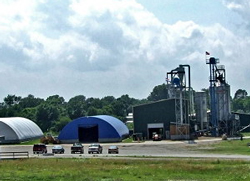 The Obama administration’s
 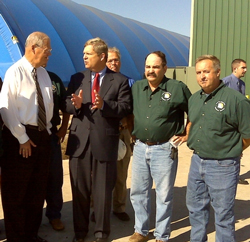 Agriculture Secretary Tom Vilsack says the biomass facility is taking wood, corn stalks and other crop residue and converting it into pellets that can be used to produce energy or a substitute for propane on the farm.
  A one-million-gallon-a-year algae-biodiesel plant could soon become a reality for Massachusetts with some help from the state and federal governments.
 The bad news is: According to
 A pair of three-year National Science Foundation grants will help the St. Louis-based Donald Danforth Plant Science Center continue its biofuel research.
 The Canadian government is putting more than $72 million into a biodiesel plant in Ontario.
 The news was also welcomed by the Canadian Renewable Fuels Association (CRFA):