RFA E-15 Ad

Book Review – Investing in Solar Stocks

Joanna Schroeder

405267I was going to begin my review with a bad cliche, “solar never sleeps,” but alas it does since it harnesses the energy of the sun. But I couldn’t think of anything else clever so I decided to run with it. This week I reviewed the book, “Investing in Solar Stocks: An Investor’s Guide to Winning in the Global Renewable Energy Market.” With our economy you might think you can’t win in any investment but according to author Joseph Berwind, Founder of Alternative Energy Investing, this is not true. You just need to learn what factors will determine the winners and losers.

Now, I’m a loser when it comes to all things financial and investing is no exception. That’s why I have “people”. That being said, I struggled with the terminology but someone who dabbles in investments will find reading this book a breeze and full of great advice.

Here are a few key points. You can tell which technologies are most promising with three criteria: cost is everything, manufacturing matters, and conversion efficiency matters. From here, Berwind explains how to determine whether the technology is promising, how to assess the success of a companies manufacturing strategy and how to determine the efficiency factors of the technology.

Bertrand also talks about the importance of legislation and subsidies and their roles in the success or demise of the industry and the companies. He has some great charts to explain this including one that includes all the U.S. states’ renewable energy mandates.

In the end, he points out that no industry, including solar, has no risk, but learning how to understand these risks will help you pick the winners.

To read this book or any book I review visit my bookstore. If you have a book you’d like me to review, email me at jomschro2071@gmail.com.

book reviews

Brazil to Have Record Breaking Sugar & Ethanol Production

Joanna Schroeder

Conab has released the results of its national crop survey and reported that the Brazilian sugar and alcohol sector will grind a record-breaking volume of sugarcane this year. Total harvest is expected to reach an estimated 629 million tons, a 10 percent increase over 2008. The increase in production is attributed to both good rains and expanded planted area, which reached 7.74 million hectares.

3064960337_eb32b8dc18Approximately 55 percent of the crop, or 438.56 million tons, is intended for ethanol production, which will generate 9.13 billion liters of anhydrous-type fuel (to be added to gasoline) and 18.68 billion liters of hydrated alcohol (to be sold as fuel at the pumps). These figures represent respectively a reduction of 9.30 percent and an increase of 12.41 percent In total, there will be 27.80 billion gallons of ethanol, or 4.22 percent more than the 26.68 billion gallons produced last season.

“Most Brazilian mills are capable of producing both ethanol and sugar, which gives the industry flexibility to opt for production of one or the other,” said Conab’s Agribusiness Information Superintendent Airton Camargo. He said the favorable price on the international market has led industries to prefer the food production.

Last week, the Energy Information Administration released the ethanol production numbers for June 2009 (for U.S. only) noting that U.S. production is on the rise with record setting production. With record ethanol production in both the U.S. and Brazil, Growth Energy announced a campaign last week during the Farm Progess Show to label ethanol’s country of origin in an attempt to gain consumer support for the fuel to be American made.

Cellulosic, Ethanol, News

Don’t Miss the Cellulosic Feedstock Summit

Joanna Schroeder

banner_cellulosicbiofuels09The 4th Annual Cellulosic Feedstock Summit is being held this year November 16-19 in Washington D.C. This year’s keynote speaker is Dr. Kristina M. Johnson, Under Secretary of the U.S. Department of Energy (DOE). In addition to the keynote, there are three key events taking place.

The Finance & Investment Forum – The Forum will convene the cellulosic biofuels industry and the financial community, as well as a variety of government funding sources, to explore the business models and financing strategies essential for the realization of the first wave of cellulosic biofuels plants.

The Cellulosic Biofuels Summit – The Summit once again brings together the major players from across the entire biofuels value chain to report on their activities, determine the next steps forward and share their perspectives on the progress in reaching the commercial production of cellulosic biofuels.

The Feedstock Supply Forum – The Feedstock Supply Chain Forum will assemble the key players committed to making the goal of ensuring the reality of a high volume supply chain that is both economical and sustainable.

Click here to learn more about the conference and to register.

conferences, Ethanol, Ethanol News

Studying New Feedstocks for Biofuels

Cindy Zimmerman

The “World’s Largest Urban Farm and Research Test Facility” is studying a wide variety of new feedstocks that hold promise for future sources of both ethanol and biodiesel.

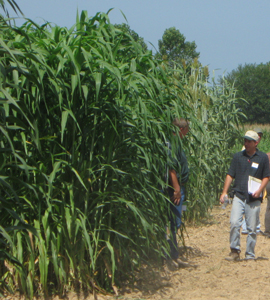
bioworksAgricenter International recently offered a closer look at the new crops being grown there by the Memphis Bioworks Foundation AgBioworks program and BioDimensions, Inc. Among the crops that were planted this season were sweet sorghum (pictured), switchgrass, castor, pearl millet and sunflowers.

“Our intent with hosting this new crops field day was to educate people on the opportunities for these crops in the region by inviting a range of speakers to talk about crops from the field to the factory and also showcase these crops in the field, “ says Hillary Spain, AgBioworks 25Farmer Network Coordinator.

Spain says about 50 farmers and other interested individuals from throughout the region attended the field day on August 15 to learn about each crop, ask questions and see the crop under actual growing conditions in the field.

Biodiesel, biomass, Cellulosic, Ethanol, Ethanol News, Farming, feedstocks, Research

EPA Officials Visit Iowa Biofuels Plant

Cindy Zimmerman

EPA officials visit REG with Sen GrassleySenator Chuck Grassley (R-IA) hosted officials from the Environmental Protection Agency last week for a tour of agriculture and biofuels in Iowa. Gina McCarthy, Assistant Administrator for the Office of Air and Radiation, and Margo Oge, Director of the Office of Transportation and Air Quality, represented EPA on the visit that included the BioCentury Research Farm in Boone, an Iowa family farm and the Renewable Energy Group‘s (REG) Central Iowa Energy plant in Newton, which included an overview and update from the ethanol and biodiesel industries.

“The EPA has tremendous power and authority, and the decisions it makes on several issues will have a major impact on the rural economy, from the family farm to opportunities in value-added agriculture industries, including renewable energy. It is absolutely essential that the government officials in charge understand the issues and the impact of their rules, regulations and directives,” Grassley said.

EPA is in the process of taking comments on implementation of the renewable fuels standard (RFS2) under the 2007 Energy Independence and Security Act. In their comments to EPA, REG chairman Jeff Stroburg said, “We firmly believe that the intent of policy makers and the administration to reduce our dependence on foreign petroleum supplies, support American agriculture, and reduce harmful greenhouse gas emission can be successfully achieved with the implementation of RFS2.”

Thanks to REG for the photo of the Grassley/EPA tour. More photos can be viewed here.

Biodiesel, Ethanol, Ethanol News, Farming, Government

Company Touts ‘Dual Fuel’ as Green Solution

John Davis

AmPowerGroupAn Iowa-based energy company is claiming that its one-of-a-kind technology is a solution America needs as the country looks to reduce greenhouse emissions and lower energy costs, while helping put people back to work.

American Power Group’s “dual fuel” blends diesel (which should have the ability to use biodiesel, right) and compressed natural gas or methane:

APG’s technology couldn’t come at a better time as customers look for ways to cope with rising fuel costs and search for solutions that will allow them to use federal stimulus monies aimed at cleaning up the environment and reduce dependency on foreign oil. The application, which perfectly blends conventional diesel fuel with compressed natural gas or bio-methane, delivers greener power to municipal vehicles, stationary generators and backup applications to name a few. While some companies are able to offer customers only a dedicated diesel fuel or natural gas fuel solution, APG’s technology is the first to allow an engine to run on both diesel and natural gas simultaneously. The technology is innovative, and it benefits are simply astounding. The dual fuel solution reduces the use of fuel by as much as 40 percent, increases the diesel fuel run time of generators by 300 percent and decreases emissions by over 40 percent. It also minimizes fuel storage space requirements by as much as 50 percent.

“Our technology is freeing up businesses to do what they know best while helping them to improve their bottom line,” said Rick Kremer, VP Sales & Marketing.

APG says one of its clients has been able to run off a generator burning the dual fuel for two week, where it would have lasted only 48 hours before. Plus, company officials claim it will work in existing engines. Check ’em out for yourself here.

biomethane, Natural Gas, technology

Sustainability Group Issues Report on Biofuels

John Davis

MNProjectA group that touts its efforts to promote “the sustainable production and equitable distribution of energy and food in communities across Minnesota” has issued a report on the renewable fuels used for transportation in this country.

The Minnesota Project’s Transportation Biofuels in the United States: An Update looks at many of the issues regarding biofuels in this country, including food vs. fuel and Indirect Land Use:

MNProject_biofuelsupdate_cover[W]e do intend for Transportation Biofuels in the United States to act as a tool to provide an overview of the current status of major developments in the biofuels industry. We highlight recent changes in biofuels production processes, biomass development, and federal level policies such as the Biomass Crop Assistance Program. We also review unavoidable issues including the food versus fuel debate and the difficult indirect land use change debate. Our intention is not to criticize, cheerlead, or otherwise deny or approve particular results or arguments. Instead, our purpose is to provide information, pose questions, and seek objective analysis of the information that is currently available. Only through an open discussion may we most effectively find root problems and appropriate solutions. We believe that through honest evaluation and analysis, this wave of biofuels will not only stay together, but carry us all in the right direction.

The report breaks down what’s going on with biofuels into three main areas: technology, policy and issues. You can download the report here.

biofuels

New Washington Biodiesel Plant Forms Partnership

John Davis

Earlier this week, I told you how Washington state-based Inland Empire Oilseeds had finished work on its canola-crushing facility to feed its biodiesel operation at the Odessa, Washington plant. Now it looks like the biodiesel brewer has a local utility to help prove the worth of its green fuel.
AvistaCorp2
This press release from Avista Corp.
says the energy company is partnering with IEO and Whitley Fuel to test biodiesel on four service trucks in an ongoing effort to “green its fleet” by being more energy and fuel efficient:

Avista began testing the use of the B20 blend of biodiesel in two flatbeds, a line truck and a bucket truck in August. Biodiesel does not require conversion of vehicles to use, and it typically costs a few cents more per gallon than regular diesel fuel. Produced with renewable resources, it is biodegradable and significantly reduces air pollutants and greenhouse gas emissions.

“This project is part of Avista’s culture of environmental stewardship and our ongoing efforts to reduce our own energy consumption,” Roger Woodworth, Vice President of Sustainable Energy Solutions for Avista, said.

Inland Empire Oilseeds in Odessa, Wash. produces the biodiesel with oil crushed from Washington-grown canola seeds. Founded in 2006 as a joint effort by Avista, Odessa Union Warehouse, Reardan Grain Growers, and Reardan Seed Company, IEO began refining biodiesel last November. With the installation of its crushing line this summer, it became the first biodiesel company in Washington to fully integrate all production steps into one.

“The fact that we process canola grown in our local region and ship our biodiesel as well as our high protein meal to customers in Washington and Oregon not only keeps our costs low, but it also reduces the carbon footprint of our product,” said Stephen Starr, General Manager. Starr added that canola biodiesel returns 4.5 times the energy used to grow and manufacture it, making it a highly sustainable fuel.

The test is part of a larger green initiative by the utility that also includes some electric-powered vehicles.

Biodiesel

MI Uses Corn Based Bags for Tourists

mi_travel-bagsAccording to the Corn Marketing Program of Michigan (CMPM), CMPM andTravel Michigan have renewed their commitment to partner for a second year to furnish all Michigan Welcome Centers with corn-based plastic bags for visitors to fill up with helpful Michigan travel information.

There are 14 Michigan Welcome Centers around the state ranging as far south as New Buffalo, and as far north as Ironwood. Each of these welcome centers serve as a tourist information hub for the entire state. Last year alone, nearly eight million visitors stopped at the Michigan Welcome Centers. Due to the positive results and huge success of the project, the CMPM and Travel Michigan have both decided to continue this program for an additional year.

“More than 80 billion pounds of plastics are produced in the United States every year, and these plastics have traditionally relied on petroleum-based feedstocks,” said Clark Gerstacker, CMPM president and National Corn Growers Association (NCGA) Corn Board member. “Essentially, anything that is currently made from petroleum can, in the future, be made from corn,” said Gerstacker. “However, this transition will not happen overnight. It takes time to build infrastructure, develop markets and educate consumers.”

The CMPM has worked to educate consumers about the benefits and availability of corn-based products. To raise awareness, CMPM board members and staff have traveled across the state attending trade shows, green fairs and grower events. With

corn

Ex-CEO Arrested for Selling Illegal RINs

Joanna Schroeder

The former CEO of biofuel company American Bio-Fuels, based in Abbeville, Alabama, was arrested yesterday for selling illegal Renewable Identification Numbers (RINs). Arnesto, “Steve” Sobrado was charged with felony first-degree theft of property. American Bio-Fuels went out of business in June.

According to an article published by the Dothan Eagle, the charge was a result of a report made by an owner of American Bio-fuels in July that claimed Sobrado was selling illegal RINS to Paquin Energy & Fuel based in Keller, Texas. Sobrado allegedly sold $54, 915 worth of the fake RINS to Paquin Energy & Fuel in June and July.

RINs are 38-digit serial numbers assigned by biofuels producers to each gallon of fuel produced. They are used by the EPA to track that the gallons set forth in the Renewable Fuels Standard each year are met. This year, the mandate set the amount of biofuels to be blended at 11 billion gallons. Each RIN is priced on average at 10 cents, so more than $1 billion worth of RINs will be produced this year.

300_Logo_2“We have the safeguards and controls in place to prevent fraudulent acts like this for producers,” says Clayton McMartin, President of CFCH and founder of the RINSTAR(r) renewable fuel registry. “Through our system, we can safeguard our clients from receiving fraudulent RINs because our due diligence enables us to discover and reject them. Serious companies need to prevent this fraud.”

According to the EPA website, they have yet to issue a violation and I have contacted the agency for comment.

Ethanol, Ethanol News