

 A group of Midwest senators led by Senator Tom Harkin (D-IA) dropped an amendment to appropriations legislation that would have prohibited the EPA from spending funds to include international indirect land use change (ILUC) emissions in the implementation of the Renewable Fuels Standard (RFS).
Sen. Harkin withdrew his amendment after receiving a letter from EPA Administrator Lisa Jackson that promised the agency would be taking a closer look at the proposed regulation regarding ILUC that would penalize biofuel production such as corn-ethanol.
 Jackson said in her letter that it is “clear that there are significant uncertainties associated with these estimates and in particular, with the estimate of indirect land use change.”
“Therefore, I have asked my staff to quantify the uncertainty associated with specifically the international indirect land use change emissions. They are working closely with USDA as well as incorporating feedback from experts who are commenting on the rule. This analysis will allow us to quantify the impact of the uncertainty on the lifecycle emissions. We will present these estimates in the final rule, and I plan to incorporate those estimates of uncertainty in my regulatory decisions.”
Harkin was pleased with the EPA administrator’s admission and promise to address the issue. “I think our amendment got EPA’s attention,” Harkin said.
 A new WWF report, “
 million tons – the equivalent of taking 4 million cars off the road.
 The first annual
  Oregon is the latest state to look to garbage for energy.
  Renewable energy was part of Barack Obama’s speech to the United Nations today, as the American president outlined his vision for the future before the world body.
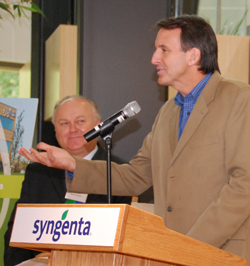 The governor who might run for president in 2012 answered several questions about ethanol from reporters after helping celebrate the grand opening of the new
  In addition, Grassley is working with Senator Nelson on an amendment that would require EPA to approve an increase in ethanol blend levels from 10 percent to 15 percent. “I still believe that the best way for this matter to be resolved is for the EPA to review the science and approve the higher blend,” said Grassley. “But the EPA needs to know that we’re watching the all-too-lengthy deliberating process that they seem to be going through, and of course their lack of action in this area. And it’s time for them, I think, to move forward.”‘
 Today,