

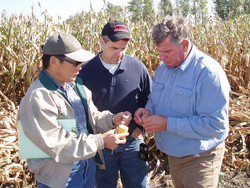
 The Department of Energy (DOE) awarded POET $6.85 million to help establish a market for corn cobs. This is the first portion of the funds which are expected to provide an additional $13.15 million next year. Cobs are the feedstock for POET’s effort to commercialize cellulosic ethanol which is officially dubbed Project LIBERTY and under construction in Emmetsburg, Iowa.
The second portion of the funds will be dedicated to helping develop the feedstock infrastructure for cellulosic ethanol production. For many months, POET has been working with equipment manufacturers to help speed the process of getting cob-harvesting technology into fields.
“DOE has shown an incredible commitment to speeding the commercialization of cellulosic ethanol,” POET CEO Jeff Broin said. “With this grant, we’ll be able to help farmers take advantage of this new revenue stream while helping our nation realize all the benefits of second-generation ethanol.”
The DOE has been a major supporter of Project LIBERTY. The two grant increases will bring the total financial commitment from DOE to $100 million. The entire project is estimated to cost $250 million and is expected to go online in 2011.
 According to Cary Sifferath, USGC Senior Director in China, drought conditions in China this year have led to high corn prices. “Those high prices have led to some opportunities for US feed grains products, specifically distillers dried grains (DDGS) products from the US ethanol industry,” Cary said. “We had roughly 8,000 metric tons of DDGS that was exported from the US into China and right now for 2009 we can easily predict 250,000 to 300,000 tons of distillers dried grains being imported by China’s feed and livestock industry, especially in the southern and coastal areas of China where DDGS has become a very competitive feed ingredient.”
 The Renewable Fuels Association has a new look and color scheme. The organization announced their new logo today but says they will supply the “same great service.”
 The regulations require large emitters of heat-trapping emissions to begin collecting greenhouse gas (GHG) data under the new program which will cover approximately 85 percent of the nation’s GHG emissions and apply to roughly 10,000 facilities. Ethanol plants were on the list when it was first proposed in March.
  “If the products sold to consumers by Big Food are as half-baked as their ethanol claims, we have a life-threatening food safety crisis in America,” stated Brian Jennings, Executive Vice President of ACE. “Never before has more corn been used to make more ethanol, and yet retail food prices have fallen sharply this year.”
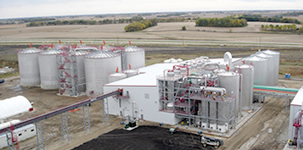 A group of farmer-owned ethanol plants in Minnesota, Iowa and Nebraska have teamed up become the guardians of a
  The grant will allow Iowa State to establish a Wind Energy Manufacturing Laboratory on campus. The lab will feature the work of four faculty researchers: Matt Frank, Frank Peters and John Jackman, all associate professors of industrial and manufacturing systems engineering, and Vinay Dayal, an associate professor of aerospace engineering. The grant will also support the research of five graduate students and several undergraduates.
 • EPA’s GHG [Greenhouse Gas] methodology relies on outdated data that artificially penalizes U.S. biodiesel. GHG emission reductions associated with biodiesel produced from vegetable oils compared to petroleum will significantly exceed the 22 percent assumed by EPA in its proposed rule if the agency relies on scientifically valid analysis and practices. Even with EPA’s assumptions and methodology, correcting the outdated data pertaining to nitrogen fixation, energy balance and co-product allocations would give biodiesel produced from vegetable oil a 62 percent GHG reduction compared to baseline petroleum. When just some of the major flawed assumptions from EPA’s indirect analysis are corrected, the GHG emissions lifecycle reduction for biodiesel from vegetable oils is 99% percent lower than diesel fuel. This number includes penalties to biodiesel for international indirect land use change.
 Biodiesel and ethanol production in Canada is expected to rise more than 75 percent over the next two years, thanks to subsidies from that country.