

 U.S. Air Force and Navy pilots could soon be flying on renewable fuels, specifically, biodiesel made from camelina and algae.
Aviation Week reports that the Air Force is working on certification for its planes to use synthetic Fisher-Tropsch (F-T) fuel by 2011 and also is launching a similar certification for hydrotreated renewable jet (HRJ) biofuels:
“We have a certification schedule for a 50:50 blend of HRJ [and conventional petroleum-based JP-8],” says Bill Harrison, deputy director of the Air Force’s new Energy Office. “We’ve learned a lot through the F-T effort and are hoping for a rather rapid and smooth certification.”
The Defense Energy Support Center (DESC), which buys fuel for the services, has awarded contracts to supply almost 600,000 gallons of renewable jet fuel for testing and certification. “That’s an unprecedented amount,” says Kim Huntley, DESC commander.
Sustainable Oils, Solazyme and Honeywell company UOP will supply 400,000 gallons of fuel to the Air Force and 190,000 to the Navy. Sustainable Oils will use camelina as the feedstock, Solazyme will use algae and UOP will use animal fat, or tallow, supplied by food producer Cargill. All three will use UOP’s processing technology.
The military is working on guidance for what the best feedstock for biofuels should be and is leaning toward cellulosic feedstocks for the long term.
 The ag policy think tank known as Farm Foundation has announced the winners of its competition to look for long-term solutions to the major questions of how to provide food, feed, fiber and fuel to a growing world, and biofuels are the subjects of at least two of the winners.
 According to a press release by
 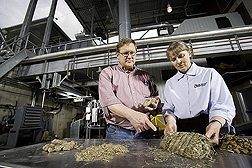 At the University of Minnesota-Morris Biomass Gasification Facility, for example, gasification researcher Jim Barbour and ARS soil scientist Jane Johnson (pictured) are evaluating potential biomass feedstocks, including pressed corn stover.
 Rep. Stephanie Herseth Sandlin (D-SD) hosted U.S. Secretary of Agriculture Tom Vilsack Monday for a Rural Issues Forum in Bath, South Dakota which was attended by an estimated 300 people who were able to ask questions about issues impacting the rural economy.
 The next time you work for a company that goes bankrupt, consider pitching them this idea to generate income: an Eco-Pod. The Eco-Pod, designed by
 What has been a symbol of failure for some of the American automobile industry could become a shining example of green jobs in the U.S. biodiesel industry.
 The Biotechnology Industry Organization (BIO) is trying to head off any possible efforts to subject biodiesel and ethanol to another set of greenhouse gas emission regulations that would effectively put the green fuels under a double jeopardy situation.
 Vehicles went through chassis dynamometer testing as part of the study. The dynamometer simulated different road and vehicle operating conditions, allowing researchers to fully measure a number of important data points to measure the performance of different ethanol blends.
 According to the company, the offering is expected to price before 9:30 am EDT on Tuesday, October 6. Lazard Capital Markets LLC is acting as the sole book-running manager for the offering.