

 The ag policy think tank known as Farm Foundation has announced the winners of its competition to look for long-term solutions to the major questions of how to provide food, feed, fiber and fuel to a growing world, and biofuels are the subjects of at least two of the winners.
Last December, Farm Foundation announced its 30-Year Challenge report that identifies six major areas of challenges agriculture will face as it works to provide food, feed, fiber and fuel to a growing world. The six areas are: global financial markets and recession; global food security; global energy security; climate change; competition for natural resources; and global economic development. This past spring, Farm Foundation announced a competition for essays to come up with some solutions for those challenges (see my post from April 30, 2009). Two different sets of researchers, Chad Hellwinckel and Daniel De La Torre Ugarte, both of the University of Tennessee, and Loni Kemp of Kemp Consulting, were named winners.
The entry from Hellwinckel and De La Torre Ugarte focused on the role of biofuels in agriculture policy:
Viewing agriculture simply as a potential source for meeting the greater economy’s fuel demand will not guarantee the necessary transition, and could even exacerbate soil destruction, increase agriculture’s input consumption and lead to food shortages. If appropriate, biofuels could be a vital part of long-term agricultural policy, but agriculture should not simply become a part of energy policy.
Biofuels demand could be a catalyst creating the right conditions for a transition to a truly regenerative agriculture, particularly if that demand moderately increases all commodity net returns. If crafted within a larger agricultural policy matrix, biofuels policy can be part of the solution.
Kemp’s entry looked at overhauling the current biofuels tax credit system:
What is missing from current tax policy is a requirement for actual performance in delivering expected environment and climate benefits. To remedy this, the mix of existing federal biofuel tax credits—including the ethanol blender’s tax credit—must be reformed into a unified performance-based tax credit. The actual level of payment per gallon would vary, according to the sustainability performance of the biorefinery.
Read More
 According to a press release by
 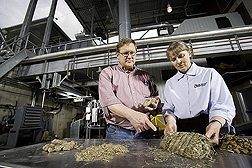 At the University of Minnesota-Morris Biomass Gasification Facility, for example, gasification researcher Jim Barbour and ARS soil scientist Jane Johnson (pictured) are evaluating potential biomass feedstocks, including pressed corn stover.
 Rep. Stephanie Herseth Sandlin (D-SD) hosted U.S. Secretary of Agriculture Tom Vilsack Monday for a Rural Issues Forum in Bath, South Dakota which was attended by an estimated 300 people who were able to ask questions about issues impacting the rural economy.
 The next time you work for a company that goes bankrupt, consider pitching them this idea to generate income: an Eco-Pod. The Eco-Pod, designed by
 What has been a symbol of failure for some of the American automobile industry could become a shining example of green jobs in the U.S. biodiesel industry.
 The Biotechnology Industry Organization (BIO) is trying to head off any possible efforts to subject biodiesel and ethanol to another set of greenhouse gas emission regulations that would effectively put the green fuels under a double jeopardy situation.
 Vehicles went through chassis dynamometer testing as part of the study. The dynamometer simulated different road and vehicle operating conditions, allowing researchers to fully measure a number of important data points to measure the performance of different ethanol blends.
 According to the company, the offering is expected to price before 9:30 am EDT on Tuesday, October 6. Lazard Capital Markets LLC is acting as the sole book-running manager for the offering.
 Richard Jundzil,