Florida to Hold FFV Rally

ffv-clubA flexible fuel vehicle (FFV) rally is being held tomorrow, October 8 beginning at 10:30 a.m. The driver education campaign will begin with a press conference at the Midway U-Gas location at 210 NW 79th Avenue in Miami, Florida. After the press conference, E85 will sell for 85 cents per gallon from 11 a.m. until noon.

The educational rally was announced in July at the Florida Farm-to-Fuel Summit by Charles Bronson, Florida Commissioner of Agriculture and Consumer Services, and Florida Governor Charlie Crist. The Clean Fuels Foundation and the FlexFuel Vehicle Club of America are the organizers of the campaign.

unicaThe campaign will help locate, educate, and motivate FFV owners to use higher blends of ethanol so the U.S. can meet the goals of the national renewable fuel standard (RFS) and pave the way for 2nd generation biofuels in Florida. Brazilian Sugarcane Industry Association (UNICA) is sponsoring the upcoming series of IndyCar Race related events which is the next phase of the driver education campaign.

Two free IndyCar Race Tickets and special parking/FFV Corral passes will be given to the first 50 FFV owners to purchase E85 at the Rally tomorrow. IndyCar Race Driver Mario Moraes will be available for autographs from 11 a.m. to 11:40 a.m.


E85, Ethanol, Ethanol News, Flex Fuel Vehicles, News

Cellulosic Ethanol Could be Made from Wastewater

Cindy Zimmerman

A cellulose product made from wastewater holds the potential of being used to make ethanol.

Qteros and Applied CleanTech have announced a joint development project for making Recyllose™, a recycled solids-based material produced from municipal wastewater, into fuel for cars.

Qteros has entered into a joint development project with Applied CleanTech (ACT), a commodities recycling company based in Israel, to use ACT’s Recyllose™-based feedstock, produced from municipal wastewater solids, for even more efficient and low-cost ethanol production. ACT’s Sewage Recycling System (SRS), a revolutionary solution for recycling wastewater solids, produces high-quality alternative energy sources for the production of electricity or ethanol, while reducing sludge formation and lowering wastewater treatment plant costs and increasing plant capacity.

The companies said they are the first to demonstrate commercial success in creating ethanol from the cellulose in municipal and agricultural liquid waste, and to offer a process that all municipalities can use to help reduce expenses.

Cellulosic, Ethanol, Ethanol News

Company Retrofitting Ethanol Plants for Biobutanol

Cindy Zimmerman

A Colorado-based company is working to develop a fleet of biorefineries based on retrofitting existing ethanol plants to produce biobutanol.

gevoLast week, Gevo, Inc. announced the start up of the first biobutanol demonstration plant designed from retrofitting an existing demonstration scale ethanol plant in St. Joseph, Missouri. The company is using the plant to demonstrate the viability of its technology for retrofitting existing ethanol plants to make biobutanol, which can be blended directly into gasoline and be used to make renewable hydrocarbons (“green gasoline”), diesel and jet fuel, chemical intermediates and biobased plastics.

This is the first time that an existing ethanol operation has been successfully retrofitted to produce biobutanol instead of ethanol. ICM’s pilot plant at St. Joseph has been designed and constructed as a reduced scale replica of a dry-milled ethanol production process. Additionally, Gevo’s biobutanol has higher energy content than ethanol and a lower Reid Vapor Pressure (RVP) – which means lower volatility and evaporative emissions. Importantly, standard automobile and small engines can run on biobutanol blended into gasoline at any ratio.

The retrofit of the pilot plant was completed in less than three months and the company says it also represents the first step along the route to produce cellulosic biobutanol which will be possible once biomass conversion technology becomes commercially available.

biobutanol, biofuels, Cellulosic, Ethanol

Registration Open for National Ethanol Conference

Cindy Zimmerman

Renewable Fuels AssociationRegistration is officially opened for the Renewable Fuels Association’s 15th Annual National Ethanol Conference “Climate of Opportunity” which will be held February 15-17, 2010 in Orlando, Florida.

Speakers and sessions will focus on the historic opportunities facing our industry. As a renewable fuel, as an industry continuing to reduce energy inputs, and an industry diversifying into new feedstocks, ethanol is poised to make a significant contribution to our planet’s environment. Climate change is a seminal focus of the Obama Administration and an increasingly important issue to the public at large, and the momentum is in our favor. With steadfast resolve to increase ethanol’s marketshare in blends and E85, and a commitment to the best science, technical knowledge and quality, we have an opportunity to improve the industry as well. It’s clearly a Climate of Opportunity for the ethanol industry.


Conference and hotel registration information is available on-line.

conferences, Ethanol, Ethanol News, RFA

IRFA and Iowa OSHA Work Together for Safety

irfa_oshaA two-year safety alliance has been formed with the Iowa Occupational Safety and Health Administration (Iowa OSHA) and the Iowa Renewable Fuels Association (IRFA). According to the IRFA, the alliance sets in place regular meetings between Iowa OSHA and IRFA’s Environmental, Health and Safety Coalition. The focus is to explore best management practices and improve the recognition and control of workplace hazards.

“The new safety alliance between IRFA and Iowa OSHA sets up an important mechanism to share cutting edge safety information – both between the organizations, but also between individual biorefineries,” stated IRFA Executive Director Monte Shaw. “The biofuels industry is very proud of its safety record, but we know there is room for improvement. This alliance is open to every Iowa biodiesel and ethanol facility that agrees with our motto: safety isn’t ‘proprietary.’ Through this venue, competitors in the marketplace come together to share new ideas and lessons learned with the goal of helping every biorefinery in Iowa be as safe as possible.”

“Iowa OSHA congratulates the Iowa Renewable Fuels Association for stepping forward and giving leadership to employee safety in the Iowa biofuels industry,” said David Neil, Iowa’s Labor Commissioner. “The industry has had a good record in employee safety but there is always room for improvement and we are proud to be a part of the ongoing effort by companies involved to improve and maintain safe working conditions for all involved. One accident is too many and therefore continued vigilance in this area is in the best interest of all.”

Iowa is the leader in renewable fuels production. Iowa has 40 ethanol refineries capable of producing nearly 3.3 billion gallons annually. In addition, Iowa has 15 biodiesel refineries with the capacity to produce over 322 million gallons annually.

Ethanol, Ethanol News, News

Duke (Energy) & North Carolina Team Up for Wind

John Davis

DukeUNCYou don’t expect Duke and the University of North Carolina to be together on too many things, especially when it comes to items on the basketball court. But in this case, it’s Duke Energy teaming up with the Tarheels on a wind energy project.

The Triangle Business Journal reports that the two are partnering to put up three wind turbines in Pamlico Sound that could become the first turbines placed in water in the country:

The project follows a nine-month UNC study completed in June for the general assembly that concluded the state has the potential to develop utility-scale wind energy production.

Duke will pay for the turbines and their installation. UNC will continue its wind energy research throughout the project.

“This project is a great example of how university research can expand our understanding of an issue – in this case, wind energy,” UNC Chancellor Holden Thorp said in a prepared statement. “Then an industry partner like Duke Energy can use that research to do what they do best and develop this on a larger scale.”

The project would join Duke’s 634 megawatts of land-based wind power it currently has in Pennsylvania, Texas and Wyoming and another 99 megawatts under construction and an additional 251 megawatts of wind projects that should start producing power next year.

Wind

Air Force, Navy On Track to Use Biofuels

John Davis

RefuelingF15U.S. Air Force and Navy pilots could soon be flying on renewable fuels, specifically, biodiesel made from camelina and algae.

Aviation Week reports that the Air Force is working on certification for its planes to use synthetic Fisher-Tropsch (F-T) fuel by 2011 and also is launching a similar certification for hydrotreated renewable jet (HRJ) biofuels:

“We have a certification schedule for a 50:50 blend of HRJ [and conventional petroleum-based JP-8],” says Bill Harrison, deputy director of the Air Force’s new Energy Office. “We’ve learned a lot through the F-T effort and are hoping for a rather rapid and smooth certification.”

The Defense Energy Support Center (DESC), which buys fuel for the services, has awarded contracts to supply almost 600,000 gallons of renewable jet fuel for testing and certification. “That’s an unprecedented amount,” says Kim Huntley, DESC commander.

Sustainable Oils, Solazyme and Honeywell company UOP will supply 400,000 gallons of fuel to the Air Force and 190,000 to the Navy. Sustainable Oils will use camelina as the feedstock, Solazyme will use algae and UOP will use animal fat, or tallow, supplied by food producer Cargill. All three will use UOP’s processing technology.

The military is working on guidance for what the best feedstock for biofuels should be and is leaning toward cellulosic feedstocks for the long term.

biofuels, Government

Farm Foundation Announces 30-Year Challenge Winners

John Davis

30-YearChallengeThe ag policy think tank known as Farm Foundation has announced the winners of its competition to look for long-term solutions to the major questions of how to provide food, feed, fiber and fuel to a growing world, and biofuels are the subjects of at least two of the winners.

Last December, Farm Foundation announced its 30-Year Challenge report that identifies six major areas of challenges agriculture will face as it works to provide food, feed, fiber and fuel to a growing world. The six areas are: global financial markets and recession; global food security; global energy security; climate change; competition for natural resources; and global economic development. This past spring, Farm Foundation announced a competition for essays to come up with some solutions for those challenges (see my post from April 30, 2009). Two different sets of researchers, Chad Hellwinckel and Daniel De La Torre Ugarte, both of the University of Tennessee, and Loni Kemp of Kemp Consulting, were named winners.

The entry from Hellwinckel and De La Torre Ugarte focused on the role of biofuels in agriculture policy:

Viewing agriculture simply as a potential source for meeting the greater economy’s fuel demand will not guarantee the necessary transition, and could even exacerbate soil destruction, increase agriculture’s input consumption and lead to food shortages. If appropriate, biofuels could be a vital part of long-term agricultural policy, but agriculture should not simply become a part of energy policy.

Biofuels demand could be a catalyst creating the right conditions for a transition to a truly regenerative agriculture, particularly if that demand moderately increases all commodity net returns. If crafted within a larger agricultural policy matrix, biofuels policy can be part of the solution.

Kemp’s entry looked at overhauling the current biofuels tax credit system:

What is missing from current tax policy is a requirement for actual performance in delivering expected environment and climate benefits. To remedy this, the mix of existing federal biofuel tax credits—including the ethanol blender’s tax credit—must be reformed into a unified performance-based tax credit. The actual level of payment per gallon would vary, according to the sustainability performance of the biorefinery.
Read More

biofuels, Farm Foundation

Propel Fuels Provides Green Job Training for At-Risk Youth in California

propelAccording to a press release by Propel Fuels, the group who is a leading retailer of environmentally-friendly, alternative fuels, has partnered with the Sacramento Regional Conservation Corps (SRCC) to provide life and jobs skills training for at-risk young men and women at Propel’s retail fueling locations. Involvement in the program provides SRCC corpsmembers training in critical skills such as job responsibility, timeliness and teamwork, while exposing them to the promising industry of renewable energy.

“Our partnership with SRCC allows us to not only help young people develop important skills that will assist them the rest of their lives, but creates a skilled workforce for the growing renewable fuels industry.” said Rob Elam, Propel’s President and Co-Founder. “We look forward to expanding this important program on a larger scale as our network of alternative fueling stations grows.”

SRCC provides an alternative to youth unemployment, incarceration and substance abuse through conservation work, education and community service. The Corps experience leads to successful post program employment, and has been found to reduce arrest rates by one third.

“The opportunities that Propel has provided for the young people in our program are invaluable and offer them a positive environment in which they can channel their energy,” said Andi Liebenbaum, Deputy Director of the Sacramento Regional Conservation Corps. “The exposure our corpsmembers are receiving to the renewable fuels industry can only help them in a future job market.”

Through its Sacramento area Clean Fuel Points, Propel has brought immediate and convenient access to E85 and biodiesel to the tens of thousands of Flex Fuel and diesel vehicles in California. The company currently operates a network of five stations in Sacramento, Rocklin, Citrus Heights and Elk Grove and aims to deploy hundreds of stations across the state over the next five years. Propel ensures its fuels are sourced from sustainable, U.S.-based feedstocks that protect our environment and reduce dependence on foreign oil.

Biodiesel, E85, Ethanol, Ethanol News

Biomass Feedstocks Research

Cindy Zimmerman

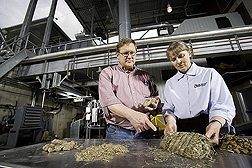
USDA’s Agricultural Research Service is studying the use of plant residues for biofuels.

biofuel cropsAt the University of Minnesota-Morris Biomass Gasification Facility, for example, gasification researcher Jim Barbour and ARS soil scientist Jane Johnson (pictured) are evaluating potential biomass feedstocks, including pressed corn stover.

The Agricultural Research Service has scientists in 18 states involved in the Renewable Energy Assessment Project (REAP) which is trying to determine the balance between how much crop residue can be used to produce ethanol and other biofuels and how much should be left on the ground to protect soil from erosion, maintain soil organisms, and store carbon in the soil.

Because corn is currently the most widely used biofuel crop, the REAP team is especially interested in determining where, when, and how much corn stover can be harvested without harming soil productivity. The work involves not only looking at how much plant residue is needed to maintain soil carbon than to control soil erosion, but also using perennial groundcover roots and shoots as alternative sources of organic material to offset the carbon lost when stover is removed.

Read more about the project here.

biomass, Cellulosic, Ethanol, Ethanol News, Research, USDA