NEC 2027

Track the Capitol Christmas Tree’s Biodiesel Journey

John Davis

XMasTreeTrackerAs you might remember from my post earlier this month, this year’s Capitol Christmas tree is making its approximately 4,000-mile trip from Arizona to Washington, D.C. fueled with biodiesel.

Now you can track the trek of the two trucks (besides the 85-foot blue spruce, they’re also hauling nearly 10,000 handmade ornaments and 80 companion trees that will be placed in offices throughout the Capitol Complex) running on B5 on this Web site.

The National Biodiesel Board
is pretty proud that the green fuel is part of this holiday event:

CapitolChristmasTree2“This is a wonderful opportunity to showcase how biodiesel is a green, sustainable part of the solution to meeting America’s energy needs,” said National Biodiesel Foundation Executive Director Tom Verry. The route was specially tailored to allow for easy refueling with biodiesel blends, and public education is planned along the way about the benefits of biodiesel…

“This is the first time Arizona has contributed the Capitol Christmas Tree, and it’s appropriate that we made this landmark trip with a biodiesel blend,” said Colleen Crowninshield, manager, Clean Cities Program of the Pima Association of Governments. “Using biodiesel reduces emissions at the same time it cuts dependence on foreign oil.”

The tree will be presented on Monday, December 30.

Biodiesel, NBB

Brazil Renews Tax Break for FFVs

brazilian_fianceministerBrazilian Finance Minister Guido Mantega has confirmed that government will extend tax breaks to flexible fuel vehicles (FFVs) and others that are “environmently friendly”. According to Reuters, the Brazilian government will allow and extension on tax breaks given to E85 compatible cars with 1-liter engines until March of 1010 and trucks until June of 2010. Reversely, taxes on traditional gasoline-powered vehicles will rise in December.

brazil_map“We want the automobile industry in Brazil to consolidate and to bring new environmental technologies to the country” Mantega told reporters at a news conference in Brasilia.

The government will lose an estimated 1.3 billion reais ($751 million) in revenue as a result of the measure. But taking into account potentially higher car sales, saved jobs, and unemployment benefits not paid, the government would come out even, Mantega said.

“If we look at the whole package, we may neutralize this (tax) loss,” Mantega said.

E85, Ethanol, Ethanol News, Government, News

An Inside View of the Brazilian Ethanol Industry

Joanna Schroeder

Brazil_DF_StoryOi from Brasil! I have spent the last three days learning about the ethanol industry in Brazil. I have been traveling with a group of 20 international journalists in the State of Sao Paulo, where 60 percent of the country’s sugarcane is grown and consequently where the majority of the ethanol is produced.

I’ll be writing a series of posts about my trip over the next week but I can sum up my experience in one sentence. Where there is a will, there’s a way. When the country of Brazil decided in the 1970s during the oil crisis that it would become energy independent, it did. Today, Brazil gets the majority of its energy, both renewable and fossil fuel based, within its boarders. In addition, the majority of the ethanol produced in the country stays in the country.

Also, unlike the U.S., Brazil produces most of its electricity needs from renewable sources as well. Today, more than 80 percent of its power comes from hydroelectricity, but this poses a problem during drought conditions and will be a bigger problem as water issues become more paramount. A solution? To sell the extra electricity from the sugar mills into the grid during the months the plants are operational, which happens to be during the dry time of the year. UNICA, the organization that represents the Brazilian sugarcane industry, predicts that sugarcane could supply 15 percent of the power by 2017.

While I don’t agree with all of Brazil’s polices and many in the country agree there have been some good and bad decisions, they offer the world demonstrable options and thus, a shorter learning curve to solid energy policies and technologies.

You can take a virtual tour via my Flickr account. Until tomorrow, Tchau.

Commentary, Energy, Environment, Ethanol, International

UC Riverside Awarded $1M Synthetic Fuel Facility Grant

Joanna Schroeder

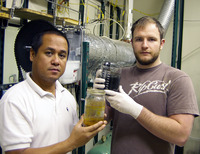
CE-CERT development engineers Junior Castillo (left) and Eddie O’Neil (right) display the results of the steam hydrogasification process that converts urban waste feedstock (rear container) into clean synthetic diesel fuel (foreground container). The fuel was produced in the lab-scale reactor behind them.

CE-CERT development engineers Junior Castillo (left) and Eddie O’Neil (right) display the results of the steam hydrogasification process that converts urban waste feedstock (rear container) into clean synthetic diesel fuel (foreground container). The fuel was produced in the lab-scale reactor behind them.

University of California, Riverside’s College of Engineering-Center for Environmental Research and Technology (CE-CERT) has been awarded a $1 million grant from the California Energy Commission to build a demonstration plant to convert biosolids to clean synthetic diesel fuel. As evaluated by the National Energy Technology Laboratory of the U.S. Department of Energy, this process is 12 percent more efficient and 18 percent lower in capital costs than all other mainstream gasification technologies.

The plant will use a steam hydrogasification process coined the “CE-CERT Process,” to convert biosolids from the the city of Riverside’s wastewater treatment facility, along with other ‘waste’  feedstocks, to produce energy. The state of California has committed to reducing its petroleum use by 2.4 billion gallons per year, and the intent for the fuel produced using this process is to be integrated into the transportation mix as a clean alternative to fossil fuels.

According to a UC Riverside news statement, California produces an estimated 83 million dry tons of biomass wastes per year, including agricultural and forestry wastes and wastewater treatment biomass that must be disposed of. Virtually 32 million dry tons of this biowaste are estimated available for fuel production.

According to researchers, the advantages of this process are many including access to a diversity of feedstocks that typically go to landfills, lower capital investment required to build a plant, and smaller plants can be located near the feedstock sources for an economic and environmental advantage.

Proof of technology of the pilot plant is the last step before full scale commercial production.

bioenergy, News, Waste-to-Energy

California Continues to Add Green Fueling Options

Joanna Schroeder

Linde North America, a member of The Linde Group, which is one of the world’s largest hydrogen energy producers, will be showcasing two of its green fueling options to California residents during the San Francisco International Auto Show, which opens on Thanksgiving day.

The first featured project highlights refuse trucks that are running on natural gas. The fuel is produced at a plant in Linde built in Livermore, and is in partnership with Waste Management. The plant captures gases from landfill garbage and coverts them to liquefied natural gas. The second project of note is with the San Francisco International Airport. Beginning in 2010, the airport will begin running a fleet of shuttle buses as well as fuel cell vehicles and Linde is building a hydrogen fueling station to meet these needs.

“Filling up the tank in California has gotten cleaner and greener in recent months,” said Mike Beckman, Linde’s Vice President, Alternative Energy. “Linde believes alternative energy technologies such as hydrogen and biogas will clean our environment, boost energy diversity, and spur economic growth. But we need to make it easy for average citizens to take advantage of these alternative fuels.”

People who attend the auto show can visit the company’s booth #1083 to learn more about both of these projects.

Hydrogen, Liquefied natural gas (LNG)

Thanksgiving Tweets for Farmers

Cindy Zimmerman

Food, feed, fiber and fuel – American farmers do it all and today is a day to give a Thanksgiving tweet for all they do.

On Twitter, many agriculture advocates are taking part in tweeting the hashtag #thankafarmer today from 10 am to 12 pm CST. Twitter users are also expressing their gratitude with a #thankafarmer twibbon.

The twitter efforts are just a small way to recognize and thank American farmers for their great productivity in providing not only safe, affordable and abundant food – but also fuel in the form of ethanol from corn, wheat and sorghum and biodiesel from soybeans – as well as the many other feedstocks that can be used for fuel, like switchgrass and jatropha. The hard work of people in agriculture have given our nation food security and decreased our dependence on foreign oil.

If you are a Twitter user and unable to tweet because of previous commitments, please sign yourself into Twuffer, a twitter service where you can time your tweets. This document contains links to different websites that are advocating for US Farmers and some tweets to get you started.

biofuels, Ethanol, Farming

Power of the Sun to Harvest Hydrogen

John Davis

SunCatalytixA Massachusetts company is working on developing a cheap catalyst that will separate water molecules to harvest the hydrogen for home use.

This story from Greentech Media
says Sun Catalytix wants to use solar power to unlock the molecules. If successful, the process could open the door for sources of water that are less than perfect:

Conventional means of extracting hydrogen requires clean water, and water purification equipment can be costly, [Bob Metcalfe, a partner at Polaris and a member of the Sun Catalytix’s board of directors] said. The startup’s catalyst, on the other hand, would use cheap, an inorganic compound that doesn’t require clean water.

“This new catalyst will take dirty water, salt water,” he said. “We’ve made hydrogen from the Boston Harbor.”

It also would have a longer lifespan by mimicking photosynthesis, where proteins in organisms convert sunlight to produce sugars. The company wants to develop a catalyst that could last five to 10 years.

“The catalyst is self-repairing,” Metcalfe said. “It’ll self deposit on the electrodes.”

Sun Catalytix has raised $3 million in capital for the project so far and is set to receive about $4.1 million from the Advanced Research Projects Agency-Energy.

Hydrogen

Clemson Gets $98 Mil for Wind Research

John Davis

ClemsonURI2South Carolina’s Clemson University is getting $98 million in federal funds for wind energy research that is expected to create hundreds of wind energy jobs and make the area a center for wind research.

This press release says the school’s Restoration Institute and its partners have received a $45 million grant from the U.S. Department of Energy, as well as $53 million of matching funds, to build and operate a large-scale wind turbine drive train testing facility at a former Navy base:

The award is the largest single grant ever received in the university’s history and represents an enormous economic development opportunity for the region.

The testing facility will be … capable of full-scale highly accelerated testing of advanced drive train systems for wind turbines in the 5 megawatt to 15 megawatt range, with a 30 percent overload capacity.

Planning and construction of the facility will begin in the first quarter of 2010 with a targeted operational date in the third quarter of 2012.

John Kelly, executive director of the Clemson University Restoration Institute and vice president of public service and agriculture, said this award will further Clemson University’s strength in research and education and support the establishment of a wind energy manufacturing cluster in South Carolina.

The project is expected to create immediately 113 temporary and 21 full-time jobs. But for the long haul, the Department of Energy believes South Carolina could gain 10,000 to 20,000 new jobs in the wind power industry over the next 20 years.

Research, Wind

Biodiesel Makers Worry About Hit During Tax Break Wait

John Davis

USCapitolBiodiesel producers are worried the wait for the renewal … or even worse, the failure of renewal … of a crucial tax credit, set to expire in just more than a month, could be a death knell for the industry.

The Houston Chronicle reports that despite efforts already underway in the U.S. House and Senate to renew the $1 per gallon biodiesel tax credit, lawmakers don’t seem to be moving this measure to the forefront:

Losing the biodiesel tax incentive would be another blow to an industry that has closed many plants this year and slashed jobs amid rising costs of raw materials, weak domestic demand and on-again, off-again backing from the government.

“It would be devastating for the national and the Texas biodiesel industries,” said Jeffrey Trucksess, a consultant to Green Earth Fuels, which is operating a 90-million- gallon-per-year biodiesel plant below capacity at the Houston Ship Channel…

Today, U.S. biodiesel plants have the capacity to produce about 2.5 billion gallons a year of the fuel. Yet more than half of that plant capacity is sitting idle amid uncertainty on several fronts…Read More

Biodiesel, Government, Legislation

Senator Grassley Pushes for E15

grassleyIowa Senator Chuck Grassley, who has always been an ethanol supporter, will push Congress to act if the EPA turns down a waiver request that will increase the amount of ethanol in fuel from 10 to 15 percent. The EPA is expected to grant or deny the request by December 1.

As Oil Price Information Service first reported, “I think Congress has to get involved if they don’t do it [approve blends up to E15] because we’re up against an E10 stone wall and we have to cross that wall or we’re not going to keep the [renewable fuel standard] mandates that are already in the law,” Grassley commented to reporters recently. “And if they don’t do what I think is very reasonable, to go to E15, then I think Congress has to intervene. But do I think Congress would intervene in the next three weeks before Christmas? I doubt it.”

But what would Congress do if E15 was approved, but oil companies wouldn’t sell it until they received liability protection or if more research was done, a local reporter asked Grassley.

“Well, I think I would go to the Congress and try to settle the issue in the Congress. And I would hope that industry would cooperate,” Grassley responded. “There are some oil companies that are very pro-ethanol, like Marathon, as an example. I don’t know what they would do, but considering the traditional ‘Big Oil’ fight against ethanol, I presume that they wouldn’t feel inclined to use what’s not available and not help us get to the mandate. I would hope otherwise, and I would be trying to do everything I could to do the otherwise,” he added.

Ethanol, Ethanol News, News