ACE Conference 2026

Pacific Ethanol to Produce Ethanol Again in January

pei_logo_topPacific Ethanol has announced that it is preparing to resume production of ethanol at its 60 million gallon per year Magic Valley facility located in Burley, Idaho. The company suspended production in February of this year at the Magic Valley facility due to extended unfavorable market conditions.

In May, the company’s subsidiaries which own four ethanol production facilities, including the Magic Valley plant, filed voluntary petitions under Chapter 11 of the U.S. Bankruptcy Code in an effort to restructure.

Since market conditions for ethanol have improved, Pacific Ethanol plans to restart the Magic Valley facility in January 2010, subject to approval by the bankruptcy court, final documentation and a number of other conditions, including rehiring and training staff and restocking corn and other raw materials.

Ethanol, Ethanol News, News

Iowa Corn Indy Renewed for 2010

Cindy Zimmerman

The Iowa Corn Indy 250 presented by Pioneer will return once again to the Iowa Speedway in 2010.

The Iowa Corn Growers Association, the Iowa Corn Promotion Board and Pioneer have renewed their sponsorship for the 4th Annual race, to be held on June 20, 2010. There were concerns that the race started specifically to highlight the United States ethanol industry might be discontinued after Brazil took over sponsorship of the Indy Car Series this year, but Iowa corn growers and Pioneer have agreed to sponsor the race for at least one more year.

“Powering Indy Cars at top speeds is the ultimate in ethanol performance,” said Tim Burrack, a farmer from NE Iowa and Chairman of the Iowa Corn Promotion Board. “Iowa Corn is at the track again this year because the cars are not only running on corn ethanol, but thousands of Iowans hear and see our messages about the power, performance, reliability, and energy independence from homegrown corn ethanol.”

Previous Iowa Corn Indy 250 presented by Pioneer races have set record attendance at the Iowa Speedway with over 40,000 fans packing the stands.

corn, Ethanol, Ethanol News, Indy Racing

China & U.S. Companies to Build Wind Turbine Plant

John Davis

APowerTwo powerful renewable energy companies are combining efforts to build a new wind turbine plant in the U.S.

TMCnet.com reports that the venture between Chinese company A-Power Energy Generation Systems, Ltd. and the U.S. Renewable Energy Group, or “US-REG,” will build highly advanced wind energy turbines for renewable energy projects throughout North and South America and comes on the heels of US-REG announcing a major wind farm in Texas:

USREGWith an estimated 320,000 square feet, the new wind turbine facility is projected to produce 1,100 megawatts of wind energy turbines annually. Additionally, after the facility is completely finished, over 1,000 individuals will be employed.

In addition to production and assembly at the new plant, the plan calls for many of the key wind turbine components to be sourced from U.S. manufacturers, further expanding the number of jobs created in the United States.

According to John Lin, director and chief operating officer at A-Power, said that there are great opportunities in renewable energy in America. “This state-of-the-art facility will be our first major step towards bringing clean, renewable energy to the world’s largest wind power country,” he added.

This agreement marks the culmination of a long process initiated in 2007 during which A-Power conducted economic analysis and sought strategic partners to enter the U.S. wind power market.

On October 29, 2009, Shenyang Power Group and US-REG announced plans to develop a $1.5 billion, 600MW wind farm across approximately 36,000 acres in Texas, for which A-Power has been designated as the turbine supplier.

No word on when the factory would be completed.

Wind

Canadian Pacific Trains to Test Biodiesel

John Davis

Locomotives north of the border will be testing biodiesel to see how well the green fuel works in cold weather conditions.

Canadian Pacific
will test four locomotives running on biodiesel on some lines between Calgary and Edmonton:

The pilot project will evaluate the cold weather application of biodiesel in real world conditions. It is the first cold weather use of biodiesel by a railroad. The pilot is a partnership with Natural Resources Canada under the National Renewable Diesel Demonstration Initiative.

CPbiodieselvideoCanadian Pacific will undertake routine detailed mechanical examinations of the locomotives in the pilot project. The information gathered will be used to evaluate whether a biodiesel mixture of up to 5% (B5) has any significant adverse effects on a locomotive or its associated systems in cold weather operation. Impact to reliability, potential changes to the overhaul or maintenance work scope and reviews of specific components on the locomotives will also be monitored.

This link is supposed to have some video … none there as I post this, but I’ll keep checking, and let you know if there’s anything to see.

UPDATE: The link now has some pretty cool video of the biodiesel-powered locomotives in action. Check it out!

Biodiesel

Duke Energy Uses Stimulus Bucks for Wind Batteries

John Davis

dukeA $22 million grant … thanks to the federal Stimulus Bill … will help Duke Energy research using batteries to store wind energy from a Texas wind farm.

This story from UPI says the North Carolina company will match the U.S. Department of Energy grant to design, build and install batteries for the storage of wind energy from its Notrees Windpower Project in western Texas:

Duke said it plans to develop a large-scale battery to store excess wind energy for the distribution of electricity when wind turbines are not in cycle.

“Energy storage truly has the potential to serve as a game-changer when it comes to renewable power,” said Wouter van Kempen, president of Duke Energy Generation Services, a Duke Energy subsidiary involved in renewable energy.

There are 95 wind turbines on the Notrees wind farm, which can produce up to 151 megawatts of clean electricity.

Wind

Northern States Get More Options for Winter Biodiesel

John Davis

Some places in the Upper Midwest will see a bit more biodiesel next winter.

MagellanThis article from Biodiesel Magazine says that petroleum distribution company Magellan Midstream Partners, L.P. has agreed to install winter biodiesel blending equipment at its Sioux Falls terminal, making more biodiesel available in the South Dakota-Southwest Minnesota region … and that pleases ag officials in both states:

[Minnesota Agriculture Commissioner Gene] Hugoson says the Minnesota Biodiesel Task Force has been working to find a company that would be willing to install biodiesel blending equipment at a major fueling terminal to serve southwestern Minnesota.

“Magellan has been a good partner for the state of Minnesota as we developed our biofuels programs,” said Hugoson. “Magellan has supported the biodiesel industry since its infancy and they have been instrumental in ensuring the safe and effective blending of ethanol and biodiesel.”

South Dakota Agriculture Secretary [Bill] Even says the facility will allow diesel consumers to gain better year-round access to quality biodiesel blends. “This decision will have positive implications for smoother distribution of biodiesel blends in South Dakota, Minnesota and surrounding states,” Even said. “This facility is another step toward reducing our dependency on foreign oil.”

Magellan’s COO, Mike Mears said “our multi-million dollar investment in biodiesel infrastructure at the Sioux Falls terminal comes at a time when our customers are looking for state-of-the-art systems that accurately, efficiently and safely blend biodiesel into diesel fuel.”

Magellan officials point out no state money went into the upgrade. The new equipment is expected to be installed sometime next year with winter biodiesel blends available next fall.

Biodiesel

Track the Capitol Christmas Tree’s Biodiesel Journey

John Davis

XMasTreeTrackerAs you might remember from my post earlier this month, this year’s Capitol Christmas tree is making its approximately 4,000-mile trip from Arizona to Washington, D.C. fueled with biodiesel.

Now you can track the trek of the two trucks (besides the 85-foot blue spruce, they’re also hauling nearly 10,000 handmade ornaments and 80 companion trees that will be placed in offices throughout the Capitol Complex) running on B5 on this Web site.

The National Biodiesel Board
is pretty proud that the green fuel is part of this holiday event:

CapitolChristmasTree2“This is a wonderful opportunity to showcase how biodiesel is a green, sustainable part of the solution to meeting America’s energy needs,” said National Biodiesel Foundation Executive Director Tom Verry. The route was specially tailored to allow for easy refueling with biodiesel blends, and public education is planned along the way about the benefits of biodiesel…

“This is the first time Arizona has contributed the Capitol Christmas Tree, and it’s appropriate that we made this landmark trip with a biodiesel blend,” said Colleen Crowninshield, manager, Clean Cities Program of the Pima Association of Governments. “Using biodiesel reduces emissions at the same time it cuts dependence on foreign oil.”

The tree will be presented on Monday, December 30.

Biodiesel, NBB

Brazil Renews Tax Break for FFVs

brazilian_fianceministerBrazilian Finance Minister Guido Mantega has confirmed that government will extend tax breaks to flexible fuel vehicles (FFVs) and others that are “environmently friendly”. According to Reuters, the Brazilian government will allow and extension on tax breaks given to E85 compatible cars with 1-liter engines until March of 1010 and trucks until June of 2010. Reversely, taxes on traditional gasoline-powered vehicles will rise in December.

brazil_map“We want the automobile industry in Brazil to consolidate and to bring new environmental technologies to the country” Mantega told reporters at a news conference in Brasilia.

The government will lose an estimated 1.3 billion reais ($751 million) in revenue as a result of the measure. But taking into account potentially higher car sales, saved jobs, and unemployment benefits not paid, the government would come out even, Mantega said.

“If we look at the whole package, we may neutralize this (tax) loss,” Mantega said.

E85, Ethanol, Ethanol News, Government, News

An Inside View of the Brazilian Ethanol Industry

Joanna Schroeder

Brazil_DF_StoryOi from Brasil! I have spent the last three days learning about the ethanol industry in Brazil. I have been traveling with a group of 20 international journalists in the State of Sao Paulo, where 60 percent of the country’s sugarcane is grown and consequently where the majority of the ethanol is produced.

I’ll be writing a series of posts about my trip over the next week but I can sum up my experience in one sentence. Where there is a will, there’s a way. When the country of Brazil decided in the 1970s during the oil crisis that it would become energy independent, it did. Today, Brazil gets the majority of its energy, both renewable and fossil fuel based, within its boarders. In addition, the majority of the ethanol produced in the country stays in the country.

Also, unlike the U.S., Brazil produces most of its electricity needs from renewable sources as well. Today, more than 80 percent of its power comes from hydroelectricity, but this poses a problem during drought conditions and will be a bigger problem as water issues become more paramount. A solution? To sell the extra electricity from the sugar mills into the grid during the months the plants are operational, which happens to be during the dry time of the year. UNICA, the organization that represents the Brazilian sugarcane industry, predicts that sugarcane could supply 15 percent of the power by 2017.

While I don’t agree with all of Brazil’s polices and many in the country agree there have been some good and bad decisions, they offer the world demonstrable options and thus, a shorter learning curve to solid energy policies and technologies.

You can take a virtual tour via my Flickr account. Until tomorrow, Tchau.

Commentary, Energy, Environment, Ethanol, International

UC Riverside Awarded $1M Synthetic Fuel Facility Grant

Joanna Schroeder

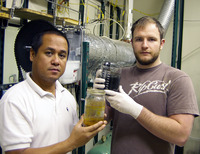
CE-CERT development engineers Junior Castillo (left) and Eddie O’Neil (right) display the results of the steam hydrogasification process that converts urban waste feedstock (rear container) into clean synthetic diesel fuel (foreground container). The fuel was produced in the lab-scale reactor behind them.

CE-CERT development engineers Junior Castillo (left) and Eddie O’Neil (right) display the results of the steam hydrogasification process that converts urban waste feedstock (rear container) into clean synthetic diesel fuel (foreground container). The fuel was produced in the lab-scale reactor behind them.

University of California, Riverside’s College of Engineering-Center for Environmental Research and Technology (CE-CERT) has been awarded a $1 million grant from the California Energy Commission to build a demonstration plant to convert biosolids to clean synthetic diesel fuel. As evaluated by the National Energy Technology Laboratory of the U.S. Department of Energy, this process is 12 percent more efficient and 18 percent lower in capital costs than all other mainstream gasification technologies.

The plant will use a steam hydrogasification process coined the “CE-CERT Process,” to convert biosolids from the the city of Riverside’s wastewater treatment facility, along with other ‘waste’  feedstocks, to produce energy. The state of California has committed to reducing its petroleum use by 2.4 billion gallons per year, and the intent for the fuel produced using this process is to be integrated into the transportation mix as a clean alternative to fossil fuels.

According to a UC Riverside news statement, California produces an estimated 83 million dry tons of biomass wastes per year, including agricultural and forestry wastes and wastewater treatment biomass that must be disposed of. Virtually 32 million dry tons of this biowaste are estimated available for fuel production.

According to researchers, the advantages of this process are many including access to a diversity of feedstocks that typically go to landfills, lower capital investment required to build a plant, and smaller plants can be located near the feedstock sources for an economic and environmental advantage.

Proof of technology of the pilot plant is the last step before full scale commercial production.

bioenergy, News, Waste-to-Energy