

 Moscow Mills, Missouri is the site of the state’s first ethanol blender pump. Warrenton Oil Company recently unveiled four new pumps at its FastLane station at 240 College Campus Drive. The blender pumps offer E20, E30 and E85 along with gasoline.
“By partnering with Missouri Corn and the Missouri Department of Agriculture, we are offering our consumers more choices at the pump,” said Dave Baker, Warrenton Oil Company vice president of sales. “We look forward to growing this new market that supports a homegrown fuel and Missouri jobs.”
 According to the Missouri Corn Growers Association, these blender pumps are part of a pilot program with the Missouri Department of Agriculture Division of Weights and Measures. “This is a great opportunity to utilize a product grown and refined in Missouri,” said Gary Clark, Missouri Corn Merchandising Council senior director of market development. “We are looking forward to the continued expansion of blender pump locations across the state. This will allow Missourians to experience the benefits of mid-level ethanol blends and support a product that is helping reduce our dependence on foreign oil.”
There are currently 114 E85 locations, including this blender pump station, in the state of Missouri.
 Canadian-based Wind Works Power Corp. has acquired half interest in six wind energy projects in Ontario with a total capacity of 80 megawatts.
  If you’ve been a reader of Domestic Fuel for any amount of time, you know how big of a supporter of biodiesel our friends at New Holland have been.
 The
The 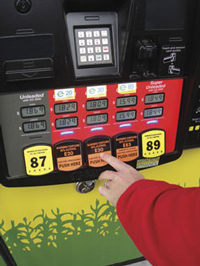 According to RFA, this “aggressive ethanol” misrepresents the fuel ethanol found in the market today. Many of compounds found in this grade of ethanol, such as gum, sulfates, and pHe, were well outside the range specified by ASTM, the international standards organization for fuels.
 An American energy company with biodiesel and ethanol operations will be buyng some of its green fuel from down under.
 California-based algae biodiesel producer OriginOil Inc. has signed a memorandum of understanding with Japan’s Research Institute of Tsukuba Bio-Tech (RITB) to develop algae-to-jet fuel technologies.
 A controversial tax imposed on some Canadians will be reduced at the beginning of the new year, thanks to biodiesel.
 The northern most E85 fueling station is now open! The Farmers Union Oil ethanol blender pump at 418 State Avenue SW in Warroad, Minnosota celebrated their opening this week.
 GE has signed a $1.4 billion deal to deliver more than 300 wind turbines for a 845 megawatt wind farm to be built in Oregon.