

 In his 2010 State of the State address, Ohio Gov. Ted Strickland focused on the state’s ecomic challenges but named ethanol as a way to create green jobs.
“I believe in Ohio because we have made a commitment to advanced energy and we are seeing results,” noted Gov. Strickland. “When I took office Ohio had the nation’s weakest advanced energy standard for electricity production. Today, Ohio has the nation’s seventh most aggressive standard. In 2007, not one drop of ethanol was produced in Ohio. Today, four ethanol facilities in Ohio are producing 295 million gallons annually. In renewable and advanced energy manufacturing projects, Ohio now ranks first among the 50 states. The Council of State Governments scoured the nation to tally the total number of new green jobs created last year. And what did they find? Ohio ranks first. We’ve made it this far, this fast on advanced energy because we pursued smart, responsible policies and we made smart, responsible investments.”
Opisnet.com reports that there are five ethanol plants in Ohio producing this renewable product in Leipsic, Fostoria, Marion, Greenville, and in Bloomingburg plant.
Gov. Strickland will be able to speak more on Ohio’s energy rich status in just over a month. He is expected to be the keynote speaker in an energy leadership forum on March 1 in Washington, D.C. The event is a gathering of national industry leaders and policy makers in the area of advanced and renewable energy.


 Biodiesel and ethanol, along with some gas/electric hybrids, are credited with helping the Illinois Department of Transportation win a sustainability award in that state.
 Some students in Minnesota will soon be breathing easier on their way to school … no, not because they won’t be hit up with that big algebra test. A school in the Minneapolis-St. Paul area is testing propane in one of its buses.
 The new Renewable Fuels Standard … aka RFS-2 … is set to be released in just the next few days. That’s why the National Biodiesel Board has extended the regular registration rates, as well as the

 Ethanol advocacy organization
  Making the announcement at the Washington Auto Show Tuesday morning were Ricardo President Kent Niederhofer (left) and Growth Energy Co-Chairman (Ret.) Gen. Wesley Clark, pictured here with the engine. “EBDI engine technology offers a uniquely American solution for a wide range of vehicle applications, combining extreme optimized flex-fuel engine technology offering high fuel economy, low emissions and uncompromised performance using a source of renewable fuel produced here in the United States,” said Niederhofer.
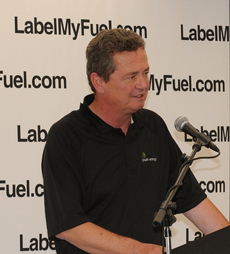 The polling data was released in conjunction with an announcement by U.S. Rep. Bruce Braley, D-Iowa, that he intends to introduce legislation mandating that all gasoline sold in the U.S. carry country-of-origin labeling (COOL). Growth Energy launched a