

 Our friends at OriginOil, Inc. have developed a comprehensive pilot system for algae growth and harvesting.
This company press release says OriginOil unveiled the system during an event at its Los Angeles headquarters:
At the event, Riggs Eckelberry, OriginOil CEO, spoke to the assembled group of core investors, celebrities and members of the press. “I’m very proud of our team that has worked so hard over the months to make our technologies work in a complete pilot system,” he said. “Until now we have been in pure research and development. Now we have turned the corner to commercialization of our technologies. It’s a historic milestone for us.”
At the heart of the new system is a series of 200-gallon tanks which can be individually configured and managed for various strains, growth strategies, and lighting geometries. The tanks are now illuminated with LED light sticks submerged in icicle-like arrays. A stirrer circulates the algae slowly around the lights.

The system uses an integrated extraction system, a combination of ultrasound generation and low-power electromagnetic pulsing, which you can see in the link of the time-lapse video on the right. It will crank out 5 gallons a minute and also uses a series of settling tanks to separate the oils and biomass. Finally, a water recycling system completes the loop so the process can start again.
See more for yourself at www.originoil.com.



 “That is an awesome success story,” said IRFA Executive Director Monte Shaw in his address at the 4th Annual Iowa Renewable Summit. “At the same time, we must not rest on our laurels. Iowa and the nation must move quickly to realize the full promise renewable fuels represent.”
 Leaders from
 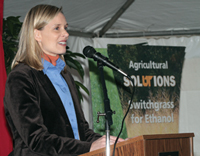 During the grand opening celebration, Kelly Tiller, CEO of Genera Energy and director of external operations for the UT Office of Bioenergy Programs, said, “The University of Tennessee Biofuels Initiative is the only fully integrated program that is working with farmers and agricultural industry to reliably supply the necessary feedstock so biorefineries can produce plentiful, affordable, renewable and sustainable fuels.” She said plans are for Tennessee farmers to place an additional 4,000 acres of switchgrass into production this spring, bringing the total production in the state to nearly 7,000 acres of the dedicated energy crop.

