

Here are this year’s National Biodiesel Board “Eye on Biodiesel Award” winners. These were presented during the last general session. Award descriptions were provided by NBB.
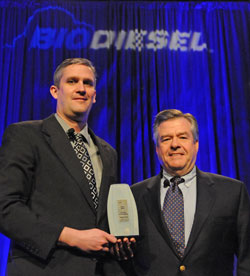 Impact: Terry Taylor, Sysco Corporation.
Sysco, North America’s leading foodservice marketer and distributor, has led the way in implementing biodiesel in private industry. The company first began using biodiesel in 2005 as part of its comprehensive sustainability program. Terry Taylor, Sr., Director ˆ National Purchasing, says he saw it as a greener alternative that was a simple way to help our country also reduce its use of foreign oil. Sysco has distribution centers across the nation and in Canada and has a company policy to use biodiesel blends, wherever possible, up to B20. The company today uses about 2 million gallons annually of blended product in its fleet of 9,000 diesel tractors and straight trucks, and 11,000 refrigerated trailers.
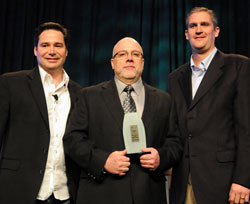 Inspiration: Wayne Hettler, St. Johns Public Schools, St. Johns, Mich.
This Michigan school bus fleet manager convinced his district to switch to B20 in 2002. It has since clocked more than 3 million miles on B20. His enthusiasm for biodiesel has helped inspire other fleets make the switch. He has talked to many school districts and other fleets from across the U.S., offering technical advice and support. Hettler also partnered with NBB to provide detailed data on maintenance. His records showed that thanks to fewer oil changes and not needing to buy fuel conditioner, his fleet saved money with biodiesel.
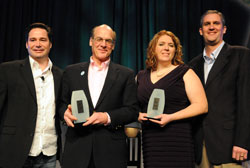 Industry Partnership: The American Oil Chemists’ Society and Gina Clapper.
AOCS is a global professional scientific society in the fats, oils, surfactants, detergents and related materials fields. In keeping with its mission to be a forum to promote the exchange of ideas, information, and experience, AOCS has provided numerous opportunities for those in the biodiesel field to share knowledge, including two international congresses on biodiesel, several publications, short courses, and technical sessions at its annual meeting. Technical Specialist Gina Clapper has been instrumental in coordinating the development and approval of new biodiesel test methods. Faster, simpler, more cost-effective tests help the industry provide high quality biodiesel meeting ASTM standards at a lower cost to consumers. Clapper also has taken leadership roles within International Organization for Standardization (ISO) activities and the Biodiesel Expert Panel of the AOCS.
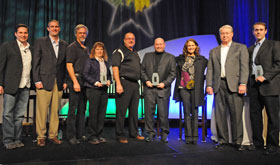 Initiative: The Iowa Soybean Association, Minnesota Soybean Growers Association, and Nebraska Soybean Association.
When NBB issued a call to action for the biodiesel industry to submit comments to EPA on its proposed Renewable Fuels Standard rules, soybean farmers answered the call. These three organizations led the way for the biodiesel industry in submitting comments into the EPA. They alone generated more than a third of the 8,000 comments biodiesel supporters submitted regarding the proposed standard. The result demonstrated biodiesel’s and the Renewable Fuel Standard’s importance to a broad range of stakeholders.
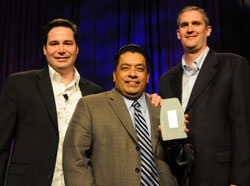 Influence: Ramiro Lopez, City of Irving, Texas.
Lopez initiated B20 in the City of Dallas in 2002. Since then he has mentored other fleets, and about a dozen fleets now use biodiesel in the area. He has also mentored fleets nationwide, and spoken at national events about his successful program. He now works for the City of Irving.
“The biodiesel industry is blessed with many champions and true believers,” said Joe Jobe, NBB CEO. “Each of these winners has helped carry the biodiesel torch, fostering understanding, mentoring others and encouraging broader use of a cleaner burning, sustainable fuel.”


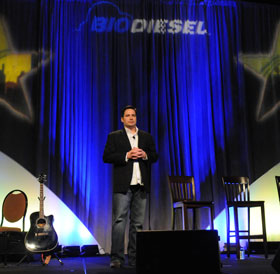 Joe Jobe, CEO of the
 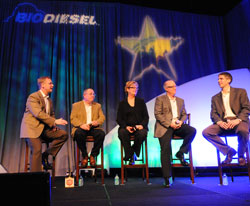 The final general session of the National Biodiesel Conference featured a panel session titled, “Feeding the Biodiesel Machine: Understanding Feedstock Realities of Today and Tomorrow.”
 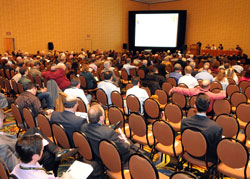 There have been three panels discussions on the new RFS-2 at the National Biodiesel Conference and they had to be moved to larger than scheduled rooms to handle all the people who wanted to hear about the new rules. The National Biodiesel Board is working on this issue and will be producing several webinars on the topic in the near future.