

Last week, I wrote a story regarding President Obama’s executive order for the federal government to reduce its greenhouse gas emissions 28 percent by 2020. One goal of this program is to get other companies to follow suit, but many companies don’t know where to start. Enter the Hondo Green Assessment Tool (HGAT). To learn more about how companies can become more sustainable, I spoke with the Hondo Group’s CEO Lynn Balinas.
 HGAT is an internet based tool for small to mid-sized companies that can measure a company’s carbon footprint, manage its carbon footprint and maintain carbon footprint goals, explained Balinas. The tool measures five categories: water, energy, transportation, materials and waste. Ultimately the tool helps companies become not only more sustainable but more profitable as well.
“People usually first think, it’s about the environment, it’s about global warming. That’s part of it,” said Balinas. “But it’s good governance and it’s actually profitable for organizations.”
A few years ago, people perceived that going green meant going broke. That is actually not the case. Going green will actually help you make more green. For example, if all small to mid-sized businesses turned off their computers and printers at night (unplug the electronics) nearly $2.1 billion could be saved annually.
Here is how it works. After 35 days of metrics based on the five categories outlined above, the HGAT will tell a company how to reduce the carbon footprint and give suggestions that a company can choose to integrate. Ultimately, the tools that are put into place will help a company manage its program and save money.
Companies can implement the program alone or partner with other small to mid-sized companies. Balinas said that the average cost to a company with less than 50 employees is around $50 per month but the return is much greater.
Listen to my interview with Lynn below to learn more about HGAT.
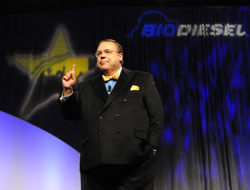 Economist Don Reynolds was the keynote speaker at the opening general session here at the National Biodiesel Conference. He appeared on stage two years ago and predicted the problems in our economy. Today he started out on a very optimistic note in part due to his belief that we’ll continue to see a growing recovery of the economy. His comments were meant to help participants define what is the “new normal” in today’s business environment.
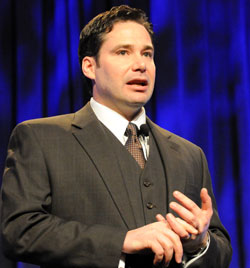 The CEO of the National Biodiesel Board, Joe Jobe, was on stage to welcome a standing room only crowd at the opening general session to the Conference. He opened up with a political theme to his remarks.
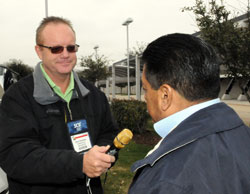 If you want to talk to a cheerleader for biodiesel then you need to meet Ramiro Lopez, Direct of Intergovernmental Services, Irvine, TX. He’s in charge of fleets and fuels and he was our guide today when we went to the media ride and drive and biodiesel plant tour.
 The headline for an article posted by the automotive organization last week reads
  It has been a busy day here at the start of the National Biodiesel Conference. After getting these posts done I’ll be heading over to the Super Bowl Reception but should have more up later this evening and tomorrow morning.
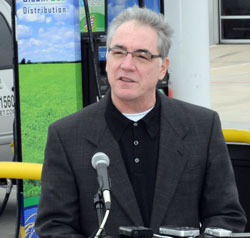 The media got to hear from Craig Eppling, Regional Communications Manager for GM this morning. He spoke at the ride and drive event which took place at Classic Clean Fuels in Grapevine. It was a brisk morning but we got through the program before some sprinkles hit the area. Afterward we toured Direct Fuels biodiesel plant and I’ll have more on that later.