

2010 National Ethanol Conference Photo Album
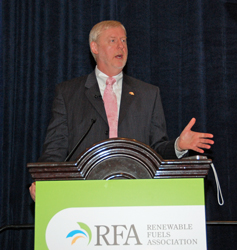 The vice chairman of Global Product Operations for General Motors told attendees of the 15th Annual National Ethanol Conference that his company will keep putting more flexible fuel vehicles on the road, but more ethanol pumps are needed to fuel them.
Tom Stephens said GM is committed to making more than half of their vehicle production flex fuel capable by 2012. “GM is spending about $100 million a year adding flex fuel capability to our vehicles,” he said. “We can’t afford to leave this capital stranded.”
He noted that the majority of flex fuel vehicles are in highly populous areas, especially the east and west coasts, while the majority of E-85 fueling stations are located in the Midwest. He advocates the use of blender pumps to allow retailers to put both mid and high level blends in the pumps so consumers can choose the right fuel for their vehicles.
However, when it comes to increasing the blend level to 15 percent ethanol, he added a note of caution. “We believe it’s critical to complete the planned testing of mid level blends to understand the impact on light duty fleet, off-road vehicles, boats and other equipment,” he said. “Until the results of these comprehensive durability tests are fully understood, we remain concerned about customers using fuels containing more than 10 percent ethanol. If ethanol gets a bad name, it will be bad for everyone.”
You can listen to or download Stephen’s speech in the player below and watch part of his talk here:
 Compared to last year,

 The mood is definitely a little brighter at this year’s
 The U.S. Grains Council is holding its