Mascoma Honored with Top Biofuels Award

Joanna Schroeder

Lux Research has recently released a new report, “Ranking Biofuel Startups on the Lux Innovation Grid, which analyzes a number of key criteria to indicate which companies are more likey to succeed as the market matures. One of the companies given top honors is Mascoma Corporation.

“We are proud to be considered a top biofuels company by Lux,” said William J. Brady, CEO of Mascoma. “This distinction validates our efforts to be a leader in the growing cellulosic ethanol industry. Coupled with this award, our strong financial backing and proven technology breakthroughs in Consolidated Bioprocessing emphasize that we are ahead of the pack on the road to commercialization.”

This is not the first award that Mascoma has received in the past few months. The company was ranked #10 in the Biofuels Digest’sHottest Companies in Bioenergy.”

The Lux Innovation Grid is used to predict which segments of the biofuels markets are poised to succeed based on selective criteria including revenue per employee, patents, performance metrics, production capacity, and other data.

Click here to get more information about the report.

biofuels, Cellulosic, Company Announcement

Text Your Way to a Fuel Efficient Car

Joanna Schroeder

The next time you are looking to buy a car, considering reserving a fuel-efficient car by texting. The Ford Fiesta, a popular car in Europe for its good gas mileage, is soon to make its way to the US. Ford is taking reservations for the car, which is estimated to get 40 miles per gallon (mpg) on the highway and 30 mph in the city. To get on the waiting list, simply text “reserve” to 4Ford.

According to the company, they already have 6,000, 2011 Fiesta’s on hold, with half coming from non-Ford owners. You can also order your car “old-school” by going online and customizing your car. Once it is virtually built, the site will tell you the price.

The cost for the Fiesta begins around $14,000 and will be available Summer of 2010.

Car Makers, Miscellaneous

Ethanol Song Parody

Cindy Zimmerman

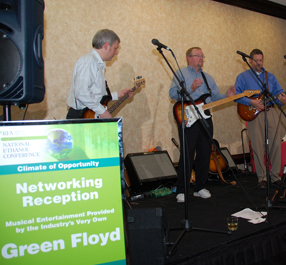
A trio of ethanol industry executives showed their creative side as the live entertainment during the Tuesday night reception at the Renewable Fuels Association National Ethanol Conference last week.

“Green Floyd” is made up of Frontline Bioenergy CEO Bill Lee, Neil Koehler with Pacific Ethanol and bioenergy consultant Paul Kamp. The group played a variety of songs from blues to folk to rock, and entertained with a couple of original parodies designed with the ethanol audience in mind. Here are the lyrics to “The Blend Wall” (to the tune of Pink Floyd’s “The Wall”) and a short video clip to enjoy.

We don’t need o-ver production
We could use some E-15
Lisa Jackson, approve our waiver
Listen to our man, Dinneen

Hey, Lisa –
Listen to Bob Dinneen!
All in all it’s just another wicked Blend Wall

(For those not in the industry, the references are to EPA administrator Lisa Jackson, the waiver to allow up to 15 percent ethanol in regular gasoline, RFA president and CEO Bob Dinneen and the blend wall faced by the industry if the allowable blend is not increased – trust us, it’s funny!)

Ethanol, National Ethanol Conference, RFA

Squeezing More Oil from Crops for Biodiesel

John Davis

The name of the game in the biodiesel biz is getting the most out of your feedstocks. Some researchers at the University of California-Davis have found a way to squeeze another 24 percent out of oilseeds such as safflower.

This press release from the school says the new process converts both plant oils and carbohydrates into biodiesel in a single process, improving the performance of the biodiesel, especially in cold weather:

Conventional biodiesel production extracts plant oils and then converts them into fatty acid esters that can be used to power engines, said Mark Mascal, professor of chemistry at UC Davis and co-author of the paper with postdoctoral researcher Edward Nikitin. That leaves behind the carbohydrate portion of the plant — the sugars, starches, and cellulose that make up stems, leaves, seed husks and other structures.

The new process converts those carbohydrates into chemicals called levulinic acid esters — at the same time and in the same vessel that the oils are converted to fatty acid esters — resulting in a fuel cocktail that performs better at low temperatures than conventional biodiesel.

The article goes on to say the process might cost a bit more, but improved fuel yields and performance would make up the difference.

Biodiesel, Research

Biodiesel Grants Go to Iowa Schools

John Davis

Two schools in the Hawkeye State have picked up Iowa Renewable Fuels Association Awards of $2,500 each.

This press release from the association says Clay Central-Everly and Galva-Holstein Schools were awarded the Biodiesel Backer Award Program grants to educate their students and communities about biodiesel and incorporate biodiesel into their school programming:

“IRFA congratulates Clay-Central Everly and Galva-Holstein on their well-deserved selections as Biodiesel Backer Award winners,” said IRFA Biofuels Manager Grant Menke. “These two northwest Iowa schools have implemented unique and impressive programs that highlight the benefits Iowa schools can realize by making the switch to biodiesel blends. Clean, renewable Iowa biodiesel is the best fuel choice for school bus fleets, and more importantly, the healthiest choice for students. IRFA encourages all Iowa schools to learn the facts about biodiesel and then try it out in their school buses.”

Galva-Holstein Community School District has been fueling its buses, tractor and skid loader with biodiesel year round since 2005, using approximately 10,000 gallons of biodiesel per year…

Clay Central-Everly Community School does not currently use biodiesel. However, that status may change very soon due to the efforts of its high school ag science class. After completing a unit on biodiesel in the classroom, this eight member group of students and its teacher set the goal of educating Clay Central-Everly’s school administration, elementary students and communities in order to convince the school to begin fueling its buses with biodiesel.

The IRFA will be awarding another four $2,500 Biodiesel Backer Awards. The application deadline is May 28, 2010. For more information, check out the IRFA Web site.

Biodiesel

U of Illinois Sponsors Biofuels Seminars

John Davis

The University of Illinois is sponsoring a series of seminars focusing on biofuels and renewable energy.

The school’s Center for Advanced BioEnergy Research (CABER) is holding the presentations, which are open to the public, Mondays at 4 pm at the U of I Urbana-Champaign campus:

“This bioenergy seminar series provides a broad range of topics from different perspectives – academia, research, government and industry,” said Dr. Hans Blaschek, director of CABER. “We welcome anyone interested in learning more about the research and technologies presented and encourage questions and participation from the audience.”

The next one will be this coming Monday, February 22 and is entitled “Environment Enhancing Energy – Synergism of algae biofuels with waste treatment for agricultural, energy and municipal applications.” Lance Schideman, Assistant Professor, Agricultural and Biological Engineering, University of Illinois at Urbana-Champaign will be the featured speaker.

As I mentioned before, the seminars will be held on successive Mondays (well, nearly every Monday) through the beginning of May at 4 pm. You can find the entire schedule here.

This seminar series is one of the required classes for students pursing a bioenergy Professional Science Master’s degree.

biofuels

DF Cast: RFS2 Talk at Biodiesel and Ethanol Conferences

John Davis

Earlier this month, the EPA finally released its new Renewable Fuels Standard, better known as RFS2. It was just in time as both the biodiesel and ethanol industries held their national conferences just days after the announcement, prompting multiple sessions at each gathering to discuss the implications of the new rules.

In this edition of the Domestic Fuel Cast, we hear from National Biodiesel Board Vice Chairman Gary Haer with Renewable Energy Group, who spoke at the National Biodiesel Conference and Expo, and President and CEO of the Renewable Fuels Association, Bob Dinneen, talking from the National Ethanol Conference in Orlando, Florida, and get their thoughts on RFS2.

It’s an interesting conversation, and you can hear more of it below.

You can also subscribe to the DomesticFuel Cast here.

Audio, Biodiesel, Biodiesel Conference, Domestic Fuel Cast, Ethanol, Ethanol News, Indirect Land Use, News

Exciting Enzymes at Ethanol Conference

Cindy Zimmerman

Three different companies announced the introduction of new enzymes for cellulosic ethanol production at this week’s National Ethanol Conference in Orlando.

Novozymes made the biggest splash with its Cellic® CTec2 for the production of biofuel from agricultural waste, but the other two are no less significant in the race towards commercialization of advanced biofuels.

VereniumVerenium Corporation‘s new introduction into the enzyme mix is called Xylathin, which is specifically designed to improve the economics of fuel ethanol production from cereal grains. According to the company, “Xylathin rapidly breaks down xylan, a compound found in cereal grains such as wheat, rye and barley and significantly reduces mash viscosity. This faster acting enzyme allows producers to shorten retention times and reduce enzyme dose. Xylathin also reduces grain water retention lowering grain drying energy requirements.”

GenencorAt the same time, Danisco’s Genencor introduced Accellerase® DUET, a step up from Accellerase® 1500. “Accellerase® DUET employs a whole broth formulation, which provides nutrients for fermentative organisms and lowers the chemical load introduced into our customers’ processes. Higher performance at lower dose will lead to significant improvements in enzyme cost in use for producers, which is critical to enable the cellulosic biofuels industry.”

Representatives from all three companies, as well as others in the field, made presentations at two different sessions during the National Ethanol Conference to talk about advanced biofuels technology and the path to commercialization. If you attended the conference, those presentations are now available on-line.

Cellulosic, Ethanol, Ethanol News, National Ethanol Conference, RFA

CME Announces Ethanol Co-Product Futures Contracts

Cindy Zimmerman

The futures hold a new climate of opportunity for corn, ethanol and livestock producers.

CME Group this week announced the launch of Distillers’ Dried Grain agricultural commodity futures contracts, scheduled to begin trading April 26. Information about the new contract was released during the Renewable Fuels Association’s National Ethanol Conference in Orlando where CME Group was a sponsor.


Distillers’ Dried Grains, a byproduct of corn-produced ethanol, is used for animal feed, including livestock and dairy cows. The electronically traded and physically delivered futures contracts can be used by livestock and ethanol producers, commercial corn interests and others to lock in the price of feed or to hedge their ethanol refining margin in combination with corn, natural gas and ethanol futures.

The contracts will be listed with the Chicago Board of Trade and more information is available on the CME Group commodities website.

corn, Distillers Grains, Ethanol, Ethanol News, National Ethanol Conference, RFA

First Station in NW Alabama Offers E85

The newly reopened Shell Quik Mart at 532 East Second Street in Muscle Shoals, Alabama now offers E85. For the first time, flexible-fuel vehicle owners and operators looking to refill their tanks in Muscle Shoals will have a choice to refuel with traditional gasoline grades or E85.

“We are pleased to be the first and only station, not only in Muscle Shoals, but all of Northwest Alabama, to offer a renewable fuel alternative for conscientious consumers,” said Edwards Oil Company’s President, Jonathan Edwards. “Our customers who own flexible-fuel vehicles have been asking for it, and now they have a choice to refuel their vehicles with a product that reduces air pollution, lowers our dependence on foreign oil, and helps support American farmers.”

Officials with the Alabama Clean Fuels Coalition, which is the principal coordinating point for alternative fuels in the state, say they have seen a dramatic increase in the development of ethanol infrastructure and use in Alabama.

“In 2006, we had zero stations in Alabama offering E85 ethanol, very few entities that had flex-fuel vehicles, and only a handful of people looking for creative ways to implement ethanol,” said Mark Bentley, Executive Director of the Alabama Clean Fuels Coalition. “Today, we have the first station in the Shoals to offer ethanol, our state government and many local communities utilize flex-fuel vehicles, we were part of the nation’s first biofuels clean corridor along Interstate 65, and the City of Hoover, Alabama, was the first in the country to turn yard clippings and wood debris into ethanol to fuel their municipal vehicles. What a difference a few years makes!”

Edwards Oil Company owns and operates forty-one Shell Quik Mart Convenience Stores, fourteen of which are located in Northwest Alabama (Colbert, Lauderdale, Lawrence and Limestone Counties) with the other 27 located in the south-central portion of middle Tennessee.

Ethanol, Ethanol News, News