RFA E-15 Ad

R4R – Research for Renewables Event Launched

Joanna Schroeder

Everyone needs an excuse to go to Italy and now you have one – Solarexpo. Solarexpo in an international conference and expo on renewable energy and distributed generation. The event will be held on May 5-7, 2010 in Italy and as part of the event, is launching the R4R – Research for Renewables event.

R4R is a “research consortium” of sorts representing Italy’s entire range of renewable energy technologies. Organizations involved in research, technology developments, university spinoffs and innovative startups have the opportunity to be involved. The concept has been developed and managed in partnership with Galileia, a spinoff from the engineering faculty of the University of Padua that specializes in the energy sector.

“With the R4R project, Solarexpo is building on its innovative approach and continuing to create new spaces in which the vast worlds of renewable energy can come together. R4R is our way of engaging with parts of the renewables sector that would only be marginally interested in a traditional exhibition event: the world of research and new companies in the renewable energy field,” said Luca Zigale, scientific director of Solarexpo. “This is an environment that is evolving rapidly and is full of new talents, ideas and projects, but isn’t very visible for more established companies and public sector decision makers.”

Another interesting twist of the R4R is that is will have a dedicated hall in Solarexpo and 20 of the most promising startup companies will be selected to exhibit at no charge. In conjunction with the expo, a series of networking events, informational sessions and workshops will take place around two themes: “Research Day” and “Green Financing Day”.

But what may be the coolest thing about 4R4 is its support of young, innovative companies that have great ideas but not enough funding. This event will give these companies that audience they need to attract investments and bring these cutting-edge technologies to market.

You can learn more about the conference by clicking here.

conferences, International, Solar, Wind

Ethanol Takes A Bite out of Crude

Joanna Schroeder

Ethanol is taking a bite out of crude oil, this according to a recent OPEC report. An article published in The National, says that rising ethanol use in the United States is dampening demand for petroleum based fuels and this will be felt even more during the next few months.

Next week, OPEC ministers are getting ready to meet in Vienna, and last month OPEC participated in a preliminary report that estimates that $500 billion a year could be spent yer year on fossil-fuel based subsidies. In its latest monthly oil market report issued two days ago, the organization’s secretariat drew attention to an eight-fold increase in U.S. ethanol consumption since 2000. This use should grow as the E15 waiver, which allows consumers the choice to use up to 15 percent ethanol in conventional cars is expected to pass by late summer.

“With the continued rise in US [petrol] stocks and surging ethanol volumes in the [petrol] pool, as well as ample idle refinery capacity, any seasonal upwards movement in the [petrol] market is likely to be limited,” the OPEC report said as quoted by The National.

OPEC also noted in its report that its projected demand for crude oil continues to be less than production leading to an oversupply situation that amounts to around 1.5 million barrels per day (bpd). Typically, stocks begin to dwindle after the first of the year but this year, stocks actually increased. Regardless of the current surplus, OPEC raised its prediction of global oil demand by 100,000 bpd from last month’s report. On Wednesday, a barrel of oil sold just shy of $80.

Ethanol, Ethanol News, Oil

Novozymes Achieves Cellulosic Enzyme Breakthrough

Joanna Schroeder

Each day, cellulosic gets closer to becoming commercially viable in the marketplace. Two weeks ago, a major hurdle was overcome with the announcement that Novozymes’ enzyme Cellic® CTec2, used for cellulosic ethanol production with feedstocks such as corn stover and corn cobs, is now 50 cents per gallon. I had the opportunity to learn more about this breakthrough when I sat down with Thomas Videbaek, Executive President of Novozymes BioBusiness, at Commodity Classic.

Videbaek explained that Cellic is the first commercial product for cellulosic ethanol. With Cellic, you’ll be able to produce cellulosic ethanol using an enzyme cost of about 50 cents per gallon. “With this, we think that the enzyme part of producing cellulosic ethanol has been cracked,” said Videbaek. “Now we need to get out and starting producing it and we’re really, really excited about that.”

Novozymes is a partner with POET’s Project Liberty which will produce ethanol from corn cobs. I asked Videbaek for an update and he believes that with the enzyme breakthrough they will be able to produce cellulosic ethanol for around $2.35 per gallon. However, the expectation is that once Project Liberty is up and running, the cost will be reduced to around $1.90 per gallon. This will be monumental in that it will break the $2.00 per gallon barrier challenge of producing cellulosic ethanol.

This was a massive project for Novozymes who has been working on it for more than five years. “It’s the biggest project we’ve ever carried out,” said Videbaek. There were more than 150 people working on it in the past year alone.

In addition to corn stover and cobs as a feedstock, they are also working with wheat in Europe and have an operational pilot plant in Denmark. In addition, they are working with Brazilian ethanol producers to develop an enzyme to break down the bagasse.

You can learn more about Cellic by listening to my full interview with Thomas below.

Audio, Cellulosic, Commodity Classic, corn, Ethanol, Ethanol News

NCERC – Corn Ethanol Still Has Room to Grow

Joanna Schroeder

“Some people believe that corn ethanol is an old technology. We believe just the opposite,” said John Caupert, the Director for the National Corn-to-Ethanol Research Center (NCERC) during an interview with me at Commodity Classic. “We feel the corn ethanol industry is still in its infancy and through technological advancements, there’s much more to learn and prove in corn ethanol production.”

In the last two-to-three years, Caupert noted that there has been a major emphasis on technological improvements such as corn fractionation, and aneorbic digestion, things that would incorporate capital upgrades or capital investments in the ethanol plant. In terms of corn ethanol production, a lot of focus has been dedicated to advancements in fermentation ingredients such as enzymes and various strains of yeast.

The NCERC has also played a role in the debate over indirect land use. Caupert explained that they have done a lot of research that focuses on the value of how co-products improve the greenhouse gas footprint of fuel ethanol production.

“I think more often than not, we forget about the fact a corn ethanol plant in addition to producing fuel ethanol, also produces this high value livestock feed called distillers grains,” said Caupert.

They will continue to look at this data and make recommendation about how the co-products should add value to corn ethanol in the indirect land use arena.

Listen below to hear my entire interview with John.

Audio, Commodity Classic, corn, Ethanol, Ethanol News

Growth Energy Offers Funding for Blender Pumps

Cindy Zimmerman

Growth Energy’s Market Development team is now offering funding to retailers to assist in ethanol blender pump infrastructure. Grants of $2,500 and $5,000 are now available on a first come, first serve basis to vendors who wish to install new or convert existing equipment for ethanol fueling. These grants are in addition to any Federal or state grants or incentives a retailer may be eligible.

“There are over 8 million flexible fuel vehicles across the country with more being produced in each model year. Unfortunately, of the 161,000 gasoline stations in the U.S. only 2,200 offer E85 where FFVs may fuel up with a high level blend of domestic, renewable fuel such at 85% ethanol……….another 132 offer mid-level blends,” said Growth Energy Market Development VP, Phil Lampert. “Growth Energy is pleased to offer this assistance to retailers across the nation and we hope that they avail themselves of this unique opportunity.”

Growth Energy can also offer pump imaging and technical assistance along with the grants. You can find the two page outline of the Infrastructure Development Program by clicking here. To apply for the funding, click here.

blends, Ethanol, Growth Energy

Ethanol Producer Plans to Cut Water Use

Cindy Zimmerman

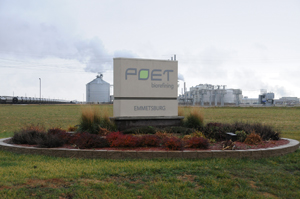
poet plantThe world’s largest ethanol producer plans to decrease water use in the production of ethanol by 22 percent over the next five years, which would result in a savings of one billion gallons of water per year.

In a presentation to employees today, POET CEO Jeff Broin said the company is committed to producing ethanol as sustainably as possible and minimizing its impact on natural resources.

poetWater reduction is the first goal of Ingreenuity, POET’s new initiative to improve the environmental performance of ethanol. The reductions will come primarily through installing a proprietary process developed by POET engineers that recycles cooling water rather than discharging it. The process has recently been installed in three POET Biorefining locations which now average 2 to 2.5 gallons of water per gallon of ethanol.

To kick off the initiative, Broin announced that the POET Foundation has committed more than $420,000 to the non-profit Global Health Ministries (GHM) over the same five-year period as POET’s water reduction goal. A portion of the funds will help GHM repair, construct and maintain 90 wells in Nigeria that that will give more than 300,000 people access to pure water.

Ethanol, POET

Big Oil Exec Talks Natural Gas, Electric Cars, Biofuels

John Davis

The CEO of one of the world’s biggest petroleum companies says his company will soon produce more natural gas than oil and is investing more than ever in biofuels.

And this article from the Wall Street Journal says that Peter Voser of Royal Dutch Shell says he expects in the next 40 years, 40 percent of the world’s cars will be electric:

Mr. Voser sat down with The Wall Street Journal’s Alan Murray and Kimberley Strassel to talk about the future of climate-change legislation, the company’s push beyond oil, the prospects for electric vehicles and more…

MR. MURRAY: What percentage of your capital spending goes to renewable energy sources, roughly?

MR. VOSER: It is not the capital intensity that drives renewable energies and alternative energies. It’s what you spend in technologies and in innovation. Roughly 25% of our budget at this stage goes into what we call alternative energies from an R&D point of view.

MR. MURRAY: And of the 25% of your R&D budget that you spend on renewables, what in that portfolio do you personally think is the most promising?

MR. VOSER: We are focusing a lot on biofuels at this stage.Read More

biofuels, Electric Vehicles, Natural Gas, Oil

Imperium Re-Opens Washington State Biodiesel Plant

John Davis

They’re back up and running at Imperium Renewables’ Grays Harbor, Washington biodiesel plant.

This company press release says Imperium re-opened the facility after a glycerin tank rupture idled operations last December:

“We are thrilled to be producing again,” said John Plaza, founder and CEO of Imperium Renewables. “We have replaced the damaged equipment and re-designed the glycerin neutralization system to ensure such a rupture won’t happen again.”

The first of more than 40 rail cars containing millions of gallons of vegetable oil from canola grown in the Northwest arrived yesterday at the Imperium Grays Harbor facility. Imperium will convert the oil into biodiesel, which has been shown to reduce carbon emissions by 78 percent compared to petroleum fuel. The fuel will be distributed and consumed within the Pacific Northwest as well, embodying the preferred approach recently recommended by President Obama’s Biofuels Interagency Working Group.

The re-opening comes just in time as nearby British Columbia had a new biodiesel mandate go into effect at the beginning of this year, while in the U.S., biodiesel prospects have brightened in the wake of the U.S. Senate’s passage of the $1-a-gallon federal tax incentive and the EPA’s issuance of the new Renewable Fuel Standard, better known as RFS-2, which mandates the consumption of 1.15 billion gallons of biodiesel nationally in this year.

Biodiesel

Biodiesel Credit Clears Senate, On to House

John Davis

As expected, the federal $1-a-gallon biodiesel tax incentive has cleared the U.S. Senate on the back of the current jobs bill.

The 62-36 vote now moves the measure into a reconciliation phase with the House’s version of the bill.

I caught up with Michael Frohlich, the director of federal communications for the National Biodiesel Board’s office in Washington, D.C. earlier this evening. He says final passage of this important measure can’t come soon enough.

“It’s an immediate need for the industry at this point,” says Frohlich, pointing out that biodiesel has been without the credit since the beginning of the year. Fortunately, if the bill does pass and is signed into law, it will be retroactive back to January 1, 2010.

But Frohlich is worried that biodiesel will be back in the same boat next December 31st as it was last December 31st, because this version of the tax credit expires at the end of this year.

“Although it’s slightly a bit of a hollow victory in the sense that we’ll have to go back to the drawing table once this gets enacted to make sure that it continues to get enacted again next year, it is traditional that [Congress does] pass these extenders, and we haven’t seen any objection from any senator or House member.”

He says last year, the Senate got so caught up in the health care debate, lawmakers worked on Christmas Eve … and that never happens … and the incentive got left by the wayside. Frohlich doesn’t expect that the biodiesel credit will get left behind again, but it has reinforced that the NBB’s number one legislative priority is to get a multi-year tax credit into effect.

And hopefully, there won’t be a health care debate that stops all business.

You can hear all of my conversation with Michael below.

Audio, Biodiesel, Government, Legislation, NBB

Register Now For Process Optimization Seminar

Chuck Zimmerman

It may be a little late in the day for this reminder but you can still go online to register for a spot in the upcoming Process Optimization Seminar being hosted by Phibro Ethanol Performance Group, along with Fremont, Fermentis and Novozymes.

The Seminar is targeted to plant managers, operations managers, technical managers, lab managers and general managers. This interactive seminar is focused on helping ethanol plants increase their efficiency and profitability through learning about new technologies available for the fermentation process. This two half-day seminar is being held in Indianapolis, Indiana on March 30-31 and the early registration deadline is March 10 (uh, that’s today!).

Click here to get registered.

Domestic Fuel is happy to be the media partner for this event.

Education, Ethanol, Ethanol News