Changes in Law Make Biodiesel Conf. Must Attend Event

John Davis

The recent renewal of the federal $1-a-gallon biodiesel tax incentive, along with the newly enacted Renewable Fuels Standard (RFS2) that will require 800 million gallons of biodiesel to be used in 2011, make it more important than ever to attend this year’s Biodiesel Conference & Expo, Feb. 6-9, in Phoenix, Arizona.

National Biodiesel Board officials say they’ll have a wide variety of government experts and EPA officials on hand at this year’s conference to explain the changes and what they mean for biodiesel producers and users. NBB CEO Joe Jobe says:

The uncertainty surrounding the biodiesel tax credit and the implementation of the Renewable Fuels Standard-2 made 2010 tough on all of us, to be sure. But we have high hopes that this conference will be the springboard to greater opportunities. In fact, 2011 has the potential to be a banner year for biodiesel production. The RFS2, now that it is fully implemented, will be the driving force behind biodiesel demand in 2011 and beyond. NBB recognizes that this relatively new legislation is still unclear to many in the industry. That’s why we are offering a comprehensive workshop, free with your full registration, which will dive into the “nuts and bolts” of the RFS2, featuring some of the top experts on the issue. This is truly a “can’t miss” event if you plan to be part of the biodiesel industry moving forward.

Don’t forget, the deadline for lodging at the conference is Jan. 10, 2011. More details are available at the conference website.

Biodiesel, Biodiesel Conference, NBB

Environmental Watch List of 2011

Joanna Schroeder

Environmental Watch List of 2011. The 10 environmental hot topics range from issues like oil spills and offshore drilling to breakthroughs in wind and solar energy and the military’s increased use of renewable energy. The full report evaluates 10 judicial, legislative and other actions that the top-ranked law school considers to significantly affects humans and the natural world.
“We can continue our short-sighted addiction to fossil fuels or we can adopt innovative, healthier, more sustainable practices,” said VLS Dean Jeff Shields. “The Environmental Watch List will help improve public understanding of how to use the law to take action on the critical issues of our time.”

The 2011 Watch List:
1. Congressional failure to enact climate change legislation – will states take over where federal failed in 2011?
2. The nation’s worst oil spill – Deepwater Horizon Disaster
3. First U.S. greenhouse gas rules – Will the EPA’s efforts to restrict global warming pollutants survive judicial and political challenges?
4. Climate change in the courts – Supreme Court case that would allow public nuisance lawsuits against major air polluters.
5. California’s climate law dodges a bullet – Voters kill Prop 23 in November elections
6. EPA clamps down on mountaintop removal coal mining – Looks at the EPA’s crackdown on the coal industry’s practice of tearing off mountain peaks
7. Wind and solar projects make breakthroughs – Including offshore wind and solar projects on public lands
8. Supreme Court reviews genetically modified crops – Looks at the Supreme Court’s first ruling on so-called Frankenfoods
9. EPA’s water transfer exemption remains in force – Conflict over transferring polluted water from one water body to another.
10. U.S. military going green – Looks at how the military is reducing its dependence on fossil fuels

You can learn more about each issue and delve into the debate on their dedicated Environmental Watch List 2011 website.

biofuels, Environment, global warming, Solar, water, Wind

Ethanol Groups Propose Alternative E15 Labels

Joanna Schroeder

Last year, the U.S. Environmental Protection Agency (EPA) proposed an E15 label to support their ruling that cars manufactured after 2007 had the option of fueling with the 15 percent ethanol, 85 percent gasoline blend. The ethanol industry was not too happy with the result and the Renewable Fuels Association (RFA) said yesterday in a letter to the EPA their version of the label “will do little, if anything, to promote the successful introduction of a new fuel to the marketplace.”

The letter continued, “The label shortcomings include leading, unscientific statements, confusing technical information and unwarranted warnings. The label as written will seriously impair long-term progress towards achieving the country’s stated goals for renewable fuels. It unnecessarily will promote skepticism and concern over any future broader approval for E15 and create the false perception that E15 is an inferior fuel.”
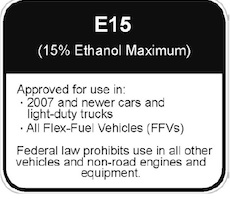
One area of the label that offended the ethanol industry was the use of words such as “Warning,” “Danger,” or “Caution,” and the RFA states these words are reserved to alert consumers to possible physical danger but are not warranted with E15. The association also supports the ability for gasoline marketers to have some flexibility in determining the size, color and shape of label to best fit their marketing programs. In addition, they would like to see one label for E15, not two and believe that no label should be required for E10.

In light of these concerns, the RFA has proposed an alternative label (black label) that they believe will more accurately provide consumers with the information they need without additional alarm. The label contains the four elements the EPA is requiring for the final label: 1) an information component; 2) a legal approval component; 3) a technical warning; and 4) a legal warning.

You can view the RFA’s complete comments about the proposed E15 label here.

*UPDATED POST*

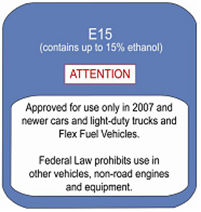
Growth Energy, the organization that officially filed the E15 waiver back in 2009 also submitted an alternative E15 label for consideration today (blue label). In their letter to the EPA, the organization said, “Growth Energy supports label content and design that provides information to consumers necessary for an informed fuel choice. Growth Energy believes the label should be simple and informative and should state at the top “E-15 (contains up to 15% ethanol).” Further, the label should provide that E-15 is “approved for use only in 2007 and newer cars, light–duty trucks, and Flex Fuel Vehicles.” Finally, the label should provide “Federal law prohibits use in other vehicles, non-road engines and equipment.”

blends, Ethanol, Growth Energy, RFA

BIRD Energy Grant Awarded to Virent, HCL CleanTech

Joanna Schroeder

A $900,000 BIRD Energy grant has been awarded to Madison, Wisconsin-based Virent Energy Systems, Inc. and Isreal-based HCL CleanTech from the BIRD Foundation along with the U.S. Department of Energy and the Isreali Ministry of National Infrastructures. BIRD Energy is a program for the U.S. and Isreal to jointly develop renewable energy.

Virent and HCL have partnered on a $2.1 million project that combines HCL’s proprietary lignocellulosic conversion technologies that produce cost competitive non-food sugars with Virent’s BioForming technology that converts plant sugars into hydrocarbon molecules similar to those now refined from petroleum. These sugars can then be used as chemicals or as “drop-in” fuels for cars, trucks, trains, and aviation that can be transported using existing pipelines.

“Economically converting plentiful cellulosic biomass into renewable, fungible hydrocarbon fuels and products will enable broad market acceptance and is the most realistic alternative to displace petroleum and create a clean energy transportation sector in the coming years,” said Lee Edwards, Virent CEO. “Virent has proven it can transform cellulosic, non-food sugars into environmentally superior hydrocarbon fuels with the same energy content and performance as petroleum fuels. “Utilizing HCL CleanTech’s cost-effective biomass hydrolysis technology to provide inexpensive cellulosic sugar feedstocks may be a key component of a complete and sustainable biofuels solution.”

The sugars will be processed at HCL CleanTech’s demonstration plant operating at Southern Research Institute in Durham, North Carolina and will then be sent to Virent’s facility in Madison, Wisconsin for conversion into biofuels and biochemicals.

“We expect to have the sugars ready for Virent before the New Year [2012] and are confident the integration with Virent and the leading biopolymer producer will create new opportunities in the bio-fuels and bio-products space,” said Eran Baniel CEO of HCL CleanTech.

As part of the BIRD project, HCL CleanTech will also provide pine sugars to a leading biopolymer producer for evaluating fermentation into hydrocolloids that historically are produced from cane or corn sugars for use in a broad range of personal care, food and beverage applications.

Bob Jansen, head of HCL CleanTech Engineering noted that the company built the demo unit at a size that will allow them to scale up directly to a small commercial facility. If all goes as planned, it will be integrated into a paper mill by the end of 2012.

biofuels, Cellulosic, Ethanol, International

IRFA Elects 2011 Officers

Joanna Schroeder

The Iowa Renewable Fuels Association (IRFA) has elected its 2011 Board of Director Officers and Executive Committee. New officers were elected during the organization’s annual meeting and will service a one-year term during the 2011 calendar year. The IRFA was formed in 2002 to represent Iowa’s ethanol and biodiesel producers.

“Congratulations to the newly elected officers,” said IRFA Executive Director Monte Shaw. “There are several opportunities for growth in 2011 but there are also serious challenges. The renewable fuels industry appreciates these individuals for stepping up to lead during this crucial time.”

2011 IRFA Board of Directors Officers
President, Walt Wendland, Golden Grain Energy, Mason City, Iowa
Vice President, Brad Albin, REG, Ames, Iowa
Treasurer, Rick Schwarck, Absolute Energy, St. Ansgar, Iowa
Secretary, Steve Bleyl Green Plains Renewable Energy, Shenandoah/Superior, Iowa
Executive Director, Monte Shaw

IRFA Officers on the Executive Committee for 2011
Past President, Bill Couser, Lincolnway Energy, Nevada, Iowa
At-Large, Bruce Rastetter, Hawkeye Renewables, Ames, Iowa
At-Large, Tom Brooks, Western Dubuque Biodiesel, Farley, Iowa
At-Large, Brian Cahill, Southwest IA Renewable Energy, Council Bluffs, Iowa

Biodiesel, Company Announcement, Ethanol

Ethanol Report on the Year Ahead

Cindy Zimmerman

Ethanol Report PodcastNow that 2010 is just a memory and Congressional leaders are returning to Washington this week to open the first session of the 112th Congress, what does the future hold for ethanol?

bob dinneen In this edition of “The Ethanol Report,” Renewable Fuels Association president and CEO Bob Dinneen gets out his crystal ball and talks about the year ahead for the ethanol industry.

Dinneen discusses the future for ethanol policy in the new Congress, what the EPA needs to do yet as far as getting E15 on the road, the next step in the challenge to California’s Low Carbon Fuel Standard, and plans for the 16th annual National Ethanol Conference, February 20-22 in Phoenix.

Listen to the Ethanol Report here: Ethanol Report on 2011

Audio, Ethanol, Ethanol News, Ethanol Report, RFA

Protec Fuel Opens Three E85 Sites in Atlanta

Cindy Zimmerman

Protec Fuel along with Indore Oil Company announce the opening of three new E85 sites in the Atlanta, Georgia vicinity. The three facilities will assist in fueling the nearly 25,000 flexible fuel vehicles (FFVs) in the area.

Indore Oil partnered with Protec Fuel to offer E85 through the group’s turnkey E85 infrastructure program. “Over the past three years we at Indore Oil Company have been working in concert with Protec Fuel to give customers in the Atlanta, Georgia and surrounding areas the option of having E85 as a renewable fuel source for their flexible fuel vehicles,” said Mihir Patel, General Manager of Indore Oil Company. “The relationship with Protec and the people that make everything possible within the company such as Steve Walk are wonderful and a joy to work with. It is a pleasure and fulfilling to think we are working together to provide a renewable source of fuel that will help reduce our dependence on foreign oils and help the environment at the same time.”

“Protec Fuel has been working with Indore Oil for several years starting with the opening of the very first public E85 station in the metro Atlanta area,” said Executive Director of Protec Fuel, Steve Walk. “I am excited to see how our relationship has grown to having over a dozen successful E85 outlets throughout the city allowing customers the option to fuel their respective vehicles with clean, alternative fuel, at a discounted price to gasoline. It has been Protec’s unique teaming network with Indore Oil, Testing LLC, GM and many others, that make all these stations a long term success.”

The new E85 Chevron stations are located in Sandy Springs, Lithia Springs and Newnan, Georgia.

E85, Ethanol, Ethanol News

Happy New Year Survey Winner

Cindy Zimmerman

The new year is starting off a little greener for the latest winner in our ZimmComm publication survey drawing.

The winner for December is Michelle Stahlhut, an Agwired reader and crop farmer from Indiana. Michelle actually filled out her survey in November and since we put all the entries back in the pot for the next month, she was the lucky pick today and will be receiving a check for $250 from us.

Here are a few interesting notes about our Domestic Fuel readers that we have learned so far from the survey:

Occupation –
14% Existing Biofuels Producer
10% Consultant
14% Advertising/Marketing/PR
7% Consumer/General Public

Topics of most interest –
84% Ethanol
60% Biodiesel
34% Wind
34% Natural Gas
33% Solar

What you would like to see more coverage about?
Mostly policy issues, also next generation biofuels and feedstocks, E85 and blender pumps.

The survey continues through January, so please fill it out before the end of the month, if you haven’t done so yet. All entries received so far will be entered to win in the last drawing for $250, which will be held on February 1.

Domestic Fuel Survey

Company Announcement

CAFOs Could Commercialize Algae Biofuels

John Davis

Confined Animal Feeding Operations (CAFOs) could be the key for algae-to-biofuel operations becoming commercial-scale… that according to Thomas Byrne, president and CEO of Byrne & Company LLP, a renewable energy project developer.

This article from Biorefining Magazine says the potential is greatest in northern climates, where anaerobic digesters that use microbes to break down the organic forms of nitrogen and phosphorous into inorganic forms… usable by algae:

“The methane produced by the anaerobic microbes is burned in a generator to produce an export of electricity and also waste heat that can be utilized to raise algae year-round,” Byrne says. “Bioreactors to grow algal species are well suited to take both the inorganic forms of nitrogen and phosphorous from the digester, as well as the waste heat and carbon dioxide (CO2) from the generator, to produce ideal inputs for algal growth.”

While the idea of co-locating an algal biomass growing facility with an established CAFO is a very real possibility, Byrne notes that the amount of algae grown for commercialization on a CAFO is limited by the availability of the CO2, nitrogen and phosphorus. “The limitations are both from what the CAFO produces, and what is needed from other operations of the CAFO.” Some bioreactor technology, like that of Algaedyne’s, which uses a process that controls photosynthesis by injecting only Photosynthetic Active Radiation into the depth of algae vessels, would make the process more feasible.

Byrne will be talking about the feasibility of a CAFO and algal biomass operation at the 2011 Pacific West Biomass Conference & Trade Show, Jan. 10-12 in Seattle.

algae, biofuels, conferences

Gene Opens Up More Potential Biomass for Biofuels

John Davis

Researchers in Oklahoma have discovered the gene responsible for how dense of material a plant grows, and that discovery could open the door to more biomass for biofuels grown in the same amount of land.

This press release from the Samuel Roberts Noble Foundation says making denser plants allows farmers to increase the amount of biomass without increasing their agricultural footprint:

“This is a significant breakthrough for those developing improved plants to address pressing societal needs,” said Richard Dixon, D. Phil., director of the Noble Foundation’s Plant Biology Division. “This discovery opens up new possibilities for harnessing and increasing the potential of crops by expanding their ranges of use. These plants will be part of the next generation of agriculture which not only impacts food, but many other vital industries as well.”

Huanzhong Wang, Ph.D., a postdoctoral fellow in Dixon’s lab, found a gene that controls the production of lignin in the central portions of the stems of Arabidopsis and Medicago truncatula, species commonly used as models for the study of plant genetic processes. Lignin is a compound that helps provide strength to plant cell walls, basically giving the plant the ability to stand upright. When the newly discovered gene is removed, there is a dramatic increase in the production of biomass, including lignin, throughout the stem.

Research targeting plants that are grazed by animals has historically focused on reducing lignin production within the plant. However, increasing lignin in non-food crops, such as switchgrass, may be desirable for increasing the density of the biomass and producing more feedstock per plant and, therefore, more per acre.

“In switchgrass, as the plant matures, the stem becomes hollow like bamboo,” Dixon said. “Imagine if you use this discovery to fill that hollow portion with lignin. The potential increase in biomass in these new plants could be dramatic. This technology could make plants better suited to serve as renewable energy sources or as renewable feedstocks to produce advanced composite materials that consumers depend on every day.”

Research with the University of Georgia has also shown that removing that gene can increase the cellulosic ethanol and butanol potentials of a plant. Officials say the overall discovery is a significant breakthrough that will help redefine the research.

biofuels, biomass, Cellulosic, Ethanol, Ethanol News, News