ACE Conference 2026

Cimarron Solar Facility Begins Commercial Operation

Joanna Schroeder

The Cimarron Solar Facility is online in New Mexico and is now powering nearly 9,000 homes with solar energy. The project is a partnership between Southern Company and Ted Turner (Turner Renewable Energy) and the power is being supplied through a 25-year power purchase agreement to member electric cooperatives of Denver-based Tri-State Generation and Transmission Association. First Solar developed and constructed the facility and will continue to operate and maintain the site.

“This is a key milestone for Southern Company as we steadily incorporate more renewables into our energy portfolio,” said Southern Company Chairman, President and CEO Tom Fanning. “Renewables, along with new nuclear, increased energy efficiency, 21st century coal technology and additional natural gas, all will be crucial to meeting this nation’s growing energy demand.”

The 364-acre plant site is located within the service territory of Tri-State member system Springer Electric Cooperative in Colfax County, New Mexico and is adjacent to Turner’s Vermejo Park Ranch. The partners acquired the project from First Solar back in March of 2011. Initially expected to go on line by the end of 2010, the facility was completed in eight months and began commercial operation in early December.

Turner said of the project, “We are very excited to see this project completed and producing clean solar energy to power homes and businesses in New Mexico. Large-scale solar generation is among the fastest growing energy sources in the world, and we’re pleased that we can be a part of that growth.”

Frank De Rosa, Senior Vice President of Project Development for First Solar concluded, “The Cimarron Solar Facility demonstrates First Solar’s capabilities in utility scale projects. Integrating technology, manufacturing, project development and engineering, procurement and construction expertise enables First Solar to be a leader in sustainable energy development.”

Electricity, Solar

Endicott Biofuels to Build Texas Biodiesel Plant

John Davis

Houston, Texas-based Endicott Biofuels has inked a deal with KMTEX Ltd. to build a 30-million gallon-per-year biodiesel plant in Port Arthur, Texas.

This Endicott press release says the refinery will use the company’s proprietary technology, and construction is to begin later this month:

“Our extensive specialty chemical processing capabilities in Port Arthur are well-suited to complement Endicott’s unique production of biodiesel,” said Artie McFerrin, President of KMTEX. “We are excited to begin this fruitful long-term relationship.”

G2 Clear is Endicott’s high-purity, high-quality biodiesel made from waste fats, oils and greases. This patent-protected process is capable of consuming any waste fat or oil in any proportion. EBF will use inedible feedstocks to help the U.S. meet the renewable fuel targets defined in the federal Renewable Fuel Standard and reduce dependence on foreign sources of crude oil.

“We are extremely pleased to establish this new business relationship with KMTEX and with the opportunity to locate our biorefinery here in Port Arthur,” said EBF’s CEO David Robinson. “Our G2 Clear™ has demonstrated the ability to exceed ASTM specifications for biodiesel using 100 percent waste materials and will have sub-60 second cold soak performance and very low carbon intensity, which means a fuel that is both reliable and environmentally cleaner than its competitors.”

Biodiesel

EDTA Releases “Driving Forward” Report

Joanna Schroeder

The Electric Drive Transportation Association (EDTA) has released an action plan to help accelerate the growth of hybrid, plug-in, battery and fuel cell vehicles in the U.S. “Driving Forward: An Action Plan for the Electric Drive Era,” encourages public-private sector collaboration, encourages electric vehicle (EV) infrastructure development and outlines policies to speed up EV adoption.

“The nation is at an energy policy crossroads. Electric drive technologies – those available today and those on the horizon – can help the U.S. increase its energy security, spend more of its energy dollars domestically, expand competitiveness and create jobs – while creating a healthier environment, “ said EDTA President Brian Wynne. “The policies we are recommending will accelerate the opening of the electric drive era and ensure U.S. leadership in the effort.”

EDTA’s next-step policy recommendations will:

  • * Reduce market hurdles to speed deployment of electric drive vehicles.
  • * Educate consumers, communities and stakeholders about these new vehicles and charging options.
  • * Ensure U.S. leadership in electric drive manufacturing.
  • * Standardize regulatory policies for electric drive vehicles and infrastructure.
  • * Accelerate technology breakthroughs.

Many experts believe that within the next 40 years, EV’s could have a solid hold on the marketplace. But to get there, more policies will need to be put in place to ensure both the infrastructure is in place as well as a variety of vehicles are available and on the road. EDTA is specifically recommending policies that will ensure these two things happen at an accelerated pace.

Other barriers to greater EV adoption include price and the EDTA encourage polices that will aid consumers in the purchase of EVs. These policies will also help manufacturers reach economies of scale in vehicle and component production, a necessity to drive down costs. In addition the plan call for legislation that will help the U.S. keep its current competitive advantage, which also keeps manufacturing and R&D jobs in the U.S., and finally the action plan asks for more coordination between regulators, technology leaders and stakeholders to ensure growth.

Electric Vehicles

Bacteria Turns Biodiesel By-product Into Butanol

John Davis

Researchers at the University of Alabama in Huntsville have found a strain of bacteria that could turn glycerol, a by-product of biodiesel production, into another alternative fuel … butanol.

This story from the school’s news website says the research is being done by a graduate student with funding from the National Science Foundation:

Disposing of glycerol has been a problem for the biodiesel industry, according to Keerthi Venkataramanan, a student in UAHuntsville’s biotechnology Ph.D. program. “Many companies have had problems disposing of it. The glycerol you get as a byproduct isn’t pure, so it can’t be used in cosmetics or animal feeds. And purifying it costs three times as much as the glycerol is worth.”

The volume of glycerol produced is also daunting: About 100,000 gallons of glycerol is produced with every million gallons of biodiesel manufactured from animal fats or vegetable oils. (In 2009 more than 500 million gallons of biodiesel were produced in the U.S. while more than 2.75 billion gallons were produced in Europe.)

He is working with the Clostidium pasteurianum bacteria, which “eats” glycerol and produces several potentially useful byproducts.

“This strain is found deep in the soil,” he said. “It was originally studied for its ability to ‘fix’ nitrogen from the air.”

The bacteria uses glycerol as a carbohydrate source. From that they produce three alcohol byproducts — butanol, propanediol and ethanol — plus acetic acid and butyric acid. Butanol is a particularly interesting byproduct.

“Butanol is a big alcohol molecule, twice as big as ethanol,” Venkataramanan said. “You can use it as an industrial solvent and it can be used in cars, replacing gasoline with no modifications. It doesn’t have some of the problems you have with ethanol, such as rapid evaporation. And ethanol is a two-carbon molecule, but butanol is a four-carbon molecule so its energy value is much higher. In fact, there are plans to use it for jet fuel.

The article says that the bacteria also turn glycerin into a chemical used to make plastics. Plus, since it is non-pathogenic, the bacteria are better for the environment.

biobutanol, Biodiesel

Several Groups Disappointed with E15 Decision

Joanna Schroeder

Not everyone is happy with the latest E15 ruling from the Environmental Protection Agency (EPA). Last Friday, the EPA ruled to allow consumers who drive conventional vehicles or light duty trucks manufactured between 2001-2006 to use E15, a blend of 15 percent ethanol, 85 percent gasoline. In October of 2010, the EPA allowed the use of E15 in the model year 2007 or newer.

One group who is disappointed with the decision is the National Pork Producers Council (NPPC). “It’s very disappointing that the administration made this decision given the rising price of corn and the lower estimate for this year’s corn harvest that recently was announced,” said Randy Spronk, a hog and crop farmer from Edgerton, Minn., who serves on NPPC’s board of directors and is chairman of the organization’s Environment Committee.

Last week, the USDA announced the final corn harvest numbers, down 5 percent from previous estimates. The report states that corn stockpiles were the lowest on record and that the national “carryover is now expected to be less than three weeks’ worth. The ethanol industry found that the lower number would not negatively affect any industries that use corn.

NPPC “strongly opposes” raising the blend rate because they claim it will put further upward pressure on corn supplies, increasing pork producers’ cost of production and reduce supplies. The ethanol industry denies that this will be a result of allowing E15. NPPC is one of several livestock groups that filed a lawsuit in federal court last November against the EPA over the E15 decision.Read More

blends, Ethanol, Ethanol News, food and fuel

Researchers Develop Self-Healing Bio Polymers

John Davis

Researchers at Iowa State University are developing polymers made from vegetable oils that repair themselves.

This press release from the school says Michael Kessler, an Iowa State University professor and an associate of the U.S. Department of Energy’s Ames Laboratory, is working on the technology:

“If successful, the results of this research will provide biorenewable alternatives to petroleum-based resins,” says a summary of Kessler’s research project. Successfully developing the concept “should have a huge impact economically and environmentally.”

Kessler’s research project is supported by a five-year, $400,000 grant from the National Science Foundation’s Faculty Early Career Development Program…

The technology has evolved into a system that embeds catalysts and microcapsules containing a liquid healing agent within a composite. As cracks develop in the composite, they rupture the microcapsules and release the healing agent. The healing agent contacts the catalyst and reacts by forming 3-D polymer chains that fill the cracks. That increases material lifetimes and reduces maintenance.

Kessler has collaborated with fellow Iowa State and Ames Laboratory researcher Richard Larock, who has invented and patented a process for producing various bioplastics from inexpensive natural oils, which make up 40 percent to 80 percent of the plastics.

biochemicals, Government, Research

Biofuels Key to US Winning Alt Fuel Race with China

John Davis

As Chinese President Hu Jintao wraps up his visit to the United States, a new report details how America can use biofuels to compete in the alternative energy field for vehicles.

This article on CNET.com says the Accenture report, entitled “The US and China: The Race to Disruptive Transport Technologies,” says the Chinese have a decided edge in government commitment to electric vehicles ($10 billion over the next 10 years to the EV industry alone) and rich deposits of lithium, a key ingredient in EV batteries. But American biofuels could be the great equalizer:

So what does the U.S. have to compete against China’s lithium, money, and government control? To put it succinctly: brainpower, strong intellectual property laws, and agricultural expertise.

The Accenture report predicts that rather than one alternative fuel reigning supreme, the world will see an increase in transport fuel diversity.

Unlike China, the U.S. has strong intellectual property laws and a record of upholding and protecting intellectual property rights, which encourages private investment in research and development, something the report says has a direct effect on innovation.

Biofuels are a good illustration of that point. The U.S. currently has a strong biotechnology industry that is improving biomass and biofuels technology and is developing a proven track record of success. It’s leading to lucrative licensing of the technology, expansion of U.S. biotech companies, and international investment from foreign companies, according to Accenture.

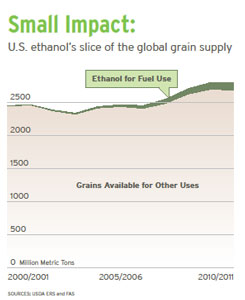
The U.S. also happens to be the largest producer of corn in the world with an estimated 30 percent of its yield going into ethanol production. Yield improvements and domestic surpluses are even expected to rise in coming years due to recent agricultural innovations.

The article goes on to say that the U.S. is more diverse in its biofuels package, including biodiesel made from diverse feedstocks, such as algae. China seems to be focusing on cellulosic ethanol to replace gasoline.

Biodiesel, biofuels, Ethanol, Ethanol News, International, News

Book Review – What Environmentalists Need to Know About Economics

Joanna Schroeder

This week I took a stab at learning a little about economics and its role in the various environmental issues including global climate change, air pollution and over fishing. “What Environmentalists Need to Know About Economics,” by Jason Scorse, is a book that, using various economic theories, analyzes the three most important sources of environmental problems: market failure, the tragedy of the commons, and the underprovisioning of public goods.

One of the things that I found interesting was that Scorse explained that one of the first principles of free markets is that for them to work effectively, the full costs of an activity must be borne by the involved parties. For example, many types of air and water pollutants exact a significant price on human health and or degrade ecoysytems, but these costs are not factored in the cost of production or at the consumer level. These costs are known as externalities and these lead to market failure. This is a common argument you hear when people talk about the “true cost of oil.”

Scorse notes that if we lived in a world where prices fully captured environmental costs, our entire economies would look vastly different. He writes, “…we would have different modes of transportation, different layouts for our cities and towns, different dietary habits, and consumer goods would likely contain much less toxic material. Prices of environmentally harmful goods would rise and much more R&D would go into alternatives, thereby decreasing their price. In such a world society’s resources would be invested in those things which bring the greatest social value.”

In a section of the book, Scorse discusses in detail how two current proposed U.S. environmentally polices would work: cap and trade or an environmental tax. While people are inherently opposed to either scenario, he does a great job explaining how each scenario would work, the pros and cons, and the possible outcomes of each. I should note that cap and trade is already at work in the utility industry so the mechanism is already in place for cap and trade for GHG emissions, or as I like to call it, crap and raid.Read More

book reviews, Environment, Ethanol

Growth Energy: “Tear Down that Blend Wall”

Cindy Zimmerman

Growth EnergyGrowth Energy CEO Tom Buis says the decision by EPA today to allow up to 15% ethanol blends in 2001 and newer vehicles “knocks a bigger hole” in the blend wall, but they’re not going to give up until they completely “tear down that blend wall.”

Buis held a telephone press conference today immediately after the announcement was made, along with Growth Energy co-chairman Wesley Clark, Todd Becker of Green Plains Renewable Energy (GPRE), Kent Satrang of Petro Serve USA and Rob Sjkonsberg of POET.

Clark expressed his appreciation to the administration for the decision. “I think they made a very wise decision in moving to bring this extra fleet of cars in,” said Clark. “It’s a huge step forward for national security.”

Addressing concerns about increasing amounts of corn used to make ethanol, Todd Becker with the Nebraska-based GPRE says the industry is getting more ethanol per bushel of corn. “A small improvement in yield in 2011, we believe, will add an additional 100-150 million bushels of corn to the carry-out, more than is expected today.”

Fuel retailer Satrang says they are ready to start using E15 as soon as possible. “This is great and significant news for America’s gas stations,” he said. “We intend to put E15 in 8 of our 20 store chains as soon as the required labels are available.” He says those are stores that have blender pumps already.

Listen to the Growth Energy press conference here. Growth Energy on New E15 Decision

Ethanol, Growth Energy

RFA Responds to EPA Action on E15

Cindy Zimmerman

The Renewable Fuels Association (RFA) is pleased with the Environmental Protection Agency decision to allow the use of up to 15 percent ethanol blended gasoline in vehicles 2001 and newer, but says more can and should be done to allow E15 in all cars and pickups.

bob dinneen “EPA’s decision today is a sound one, but it doesn’t address the issues that still remain regarding a segmented market place and the introduction of a new fuel,” said RFA President Bob Dinneen. “The RFA will continue to work with EPA and other regulatory bodies to expand ethanol use beyond even 15%. Simultaneously, we will continue our dialogue with lawmakers to develop and implement sound, tax-based policies that provide the proper incentives to grow ethanol use across a variety of blending levels.”

In an interview with Domestic Fuel this morning, Dinneen also speculated on when E15 might actually be commercially available. “I think you’ll see it in 2011 on a limited basis,” he said, mainly in states where there are not as many regulatory barriers. “Clearly there are going to be some marketers who are going to want to give consumers this important choice.”

As to those groups who are opposed to even limited E15 approval, Dinneen says, “I think the same folks that filed a lawsuit to stop the use of E15 in 2007 and newer vehicles will most certainly object to this ruling as well and may likely file more lawsuits. I don’t think they will be successful. I think EPA is on solid legal and technical grounds.”

Listen to or download my interview with Dinneen here: Bob Dinneen on New E15 Decision

Ethanol, Ethanol News, RFA