ACE Conference 2026

Ethanol Leader Challenges EIA Reporting

Cindy Zimmerman

The Energy Information Administration predicts only very modest production of cellulosic ethanol by the year 2022, but the industry is more optimistic.

rfa bob dinneenRenewable Fuels Association president Bob Dinneen challenged some of the reporting and assumptions the EIA made in the latest energy outlook, which administrator Richard Newell presented at the 4th International Biomass Conference in St. Louis this week. EIA is predicting that in 2022, cellulosic ethanol will contribute only 3.5 billion gallons to the nation’s liquid fuel supply. “We see far greater potential for cellulosic ethanol much sooner than does EIA,” Dinneen said during an industry roundtable when asked to comment on the agency’s forecast.

Dinneen also notes that the way EIA reports data marginalizes the important role that grain ethanol is already playing in the marketplace. “At the end of all the number crunching that EIA does, you’re left with a pretty pessimistic view of what grain ethanol can do for our nation’s fuel supply and energy security,” Dinneen said, pointing out that EIA reports ethanol as being just four percent of the U.S. fuel market, instead of being nearly ten percent of the gasoline market.

EIA predicts ethanol blending in gasoline will increase from 13.1 billion gallons in 2010 (about 9 percent of the gasoline pool) to 17.8 billion gallons in 2020 (about 12 percent of the gasoline pool).

Listen to an interview with Bob at the Biomass Conference here: Bob Dinneen Interview

Audio, biomass, Cellulosic, Ethanol, Ethanol News, RFA

Davis Off to a New Adventure

John Davis

My Dear Friends,

For the past four-and-a-half years, I’ve had the distinct pleasure of blogging about this nation’s and world’s efforts to wean itself from non-renewable energy. It’s been an absolutely fantastic experience, taking me down the blogging highway, sometimes from the comfort of my own living room chair. But, sadly, I will not be able to continue writing for this blog.

I have been offered a once-in-a-lifetime opportunity to go to Afghanistan to help the Afghans start a radio journalism/production program, so they can get good information to the people of that country and not just what some mullah wants to tell them. Don’t worry about my safety; I’ll be warm and safe and dry in the cozy confines of Kandahar Air Base, protected by the finest collection of fighting men and women the world has ever seen. I only hope that my efforts will make their jobs a little easier and help Afghanistan recover from decades of war and strife.

In the meantime, I hope to check in from time to time and give you a glimpse of our efforts there.

I can’t tell you how much I have appreciated Chuck’s and Cindy’s efforts and opportunities they have afforded me. They are true friends. I also feel confident that between them and their pool of talented, sophisticated freelance journalists, they’ll continue to spread the good news of renewable energy.

I thank you for reading my posts and providing comments. Even when (and probably especially when) we disagreed, I think it made for some great conversation … the real key to solving this nation’s energy issues. Keep reading Domestic Fuel, and keep putting in that great feedback!

Until we see each other again, take care!

John

Company Announcement, Miscellaneous

Improving Seed Traits

Chuck Zimmerman

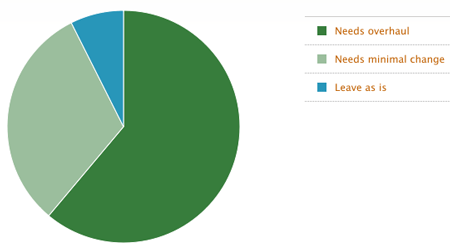
Improving nitrogen/nutrient utilization (45%) was the top choice in answer to the ZimmPoll question, “What should the next seed traits focus on?” That was followed by drought tolerance at 23%, improve food/fiber profiles 14%, improve current traits 9% and other 9%. If you selected “other” what would you suggest? So there you go researchers. Let’s get with it and bring on some new traits!

Our next ZimmPoll is now live and asks the question, “Do you believe in man made climate change?” I was going to use the term global warming but now we have found out that cooling is going on too so the current buzz term on this is climate change. Let us know what you think and thank you for participating.

And if you have any questions you want to suggest for future ZimmPolls please let us know.

ZimmPoll is sponsored by Rhea+Kaiser, a full-service advertising/public relations agency.

ZimmPoll

Turning Plants Into Products

Joanna Schroeder

A new report from the Milken Institute, “Turning Plants Into Products: Delivering on the Potential of Industrial Biotechnology,” examines the challenges facing the industrial biotechnology sector and identifies market and policy based responses. In particular, the report found that biotech could play a significant role in the reduction of fossil fuel use, but struggles due to petroleum’s price advantage. The report is a accumulation of the Institute’s Financial Innovations Lab’s results derived from discussions with experts and stakeholders on how the US could facilitate a better flow of private capital into companies focused on the production of bio-based products.

“There is much appeal for policymakers to invest in expanding the biotech-derived chemical industry. In the long term, it has environmental advantages and offers an alternative to foreign oil,” said Joel Kurtzman, executive director of the Milken Institute Center for a Sustainable Energy Future. “In the short term, it offers the immediate benefit of rural employment opportunity.”

Industrial biotechnology uses living materials such as plants, algae, marine life, fungi and micro-organisms and biosolids to produce a wide range of products from chemicals to plastics to cosmetics. But unlike the petrochemicals industry, the industrial biotech industry is not well established and doesn’t have the advantages of economies of scale and established operating efficiencies. So to encourage further development the industry will need an organized cooperation of local, state and federal governments along with support from the investment community, trade organizations and academia.

Turning Plants in Products suggests several courses of action to mitigate current challenges and increase the chances of success: establish concrete, long-term government policies; create prize forums; utilize established resources; and create innovative securitization.

Kurtzman added, “The industry needs to find the momentum to get companies past the funding gaps and on to commercial-scale production. This will require continued investment in R&D, supported by the government and public-private partnerships, to make the investment less risky and to increase the efficacy of the technology. We believe the results will be greatly worth the effort.”

The Financial Innovations Lab that led to the development of the Institute report was funded in part by the Office of Energy Policy and New Uses at the U.S. Department of Agriculture.

biochemicals, biofuels, biomaterials, bioplastics, Research

Off Shore Wind Park in Germany Powers Up

Joanna Schroeder

Germany has inaugurated its first offshore wind farm located in the Baltic Sea. Now that the project is operational, it is the country’s second offshore wind farm to go online. To commemorate the achievement, German Chancellor Angela Merkel was onsite to mark the occasion. The 50 megawatt (MW) wind part is expected to generate up to 185 gigawatts hours of electricity each year, enough to power about 50,000 average sized German homes. This wind farm project is part of the country’s offshore wind “gold rush” in the North Sea and Baltic Sea and marks another project that will get Germany closer to its renewable energy goals.

“Germany’s offshore wind industry is taking off. Two parks off two very different coasts have been completed and others are in development. A pipeline is already in place to serve Europe’s largest market and political backing for wind energy is strong. This recipe has led to manufacturers, suppliers and researchers lining up along the country’s coastlines,” said Anne Brautigam, wind energy expert at Germany Trade & Invest in Berlin.

The EnBW Baltic 1 wind farm is comprised of 21 turbines, at a water depth of 50-60 feet, located 10 miles from Germany’s Baltic Coast. The power generated by the wind turbines are connected to the grid via several 410 feet tall transmission lines and the German grid operators covered a large share of the wind farm costs.

Germany generates 17 percent of its electricity needs via renewable energy with a majority coming from wind. Offshore park alpha ventus (60 MW) in the North Sea began operating last year and served as a cooperative test project for utilities, installers and manufacturers. In development is the BARD Offshore 1 (400 MW) project in the North Sea as well as several other projects including Baltic 2, Dan Tysk, (each 288 MW) Nordsee Ost (295 MW), and Amrumbank West (300 MW).

Electricity, Energy, Wind

Biofuels Center of North Carolina Awards $1.6M in Grants

Joanna Schroeder

In an effort to accelerate the commercialization of renewable fuels, the Biofuels Center of North Carolina has awarded $1.6 million to 15 different projects located within the state. The monies for the awards came from the 2011 Statewide Biofuels Development Grants Program. The center received 58 pre-proposals from 23 organizations with funding requests totaling more than $5.2 million.

“The juncture of new energy and new agriculture requires smart ideas and practical commercial outcomes,” said Steven Burke, CEO of the Biofuels Center. “The 15 awarded projects-encompassing rural communities and woody biomass, technology and municipal solid waste-verify the competence, scope, and remarkably rapid development of this new sector statewide.”

Within the Center’s legislative and policy mandate is the need to strengthen and fund projects leading to biofuels commercialization. These objectives also help the state meet its renewable energy goal of having 10 percent of its liquid transportation fuels by 2017 produced from locally grown biofuels feedstocks and produced in the state.

The program sought projects targeting three areas: county or regional analyses of assets available for site location of biofuels companies; needs analyses and plans for the conversion of municipal waste into biofuels; and the growing of energy grasses in the North Carolina Piedmont region. The awarded projects will impact 60 counties and will in various ways address biofuels ranging in variety from biogasoline and bioethanol to FT diesel, and biomass-derived jet fuel.

Click here for a full list of award recipients.

biofuels, feedstocks, Waste-to-Energy

Iowa State to Run Buses on Waste Grease

Joanna Schroeder

As a graduate of Iowa State University (ISU), I couldn’t pass up this story. Several students are launching a project to recycle used vegetable oil from campus cafeterias into biodiesel. The fuel will then power campus buses, known as CyRide.

One of the drivers of this project is Bernardo de Campo, a co-chair of the organization Next Generation Scientists for Biodiesel, an organization that creates a virtual network for young scientists to work together and with the biodiesel industry. Students from various fields have collaborated to install a processor that will turn the waste grease into biodiesel. They have already produced their first batch and are now involved in a 3 week field trial to ensure they can meet the ASTM D6751 biodiesel spec.

Once the BioBus club has achieved this goal, they will start producing and donating the biodiesel to the university who will use the fuel to power one bus with a B20 blend. From there, ISU plans on expanding the B20 blend to additional buses.

Another cool element of the project? It was featured in a recent issue of U.S. News & World Report.

I know what CyRide bus I’ll be riding when I got back to ISU this fall for a football game….

Biodiesel, NBB

Biomass Industry Execs Discuss Future

Cindy Zimmerman

biomass conferenceAll energy of the bio variety – biomass, biogas, biodiesel and biofuels – were represented at the 4th International Biomass Conference and Expo on Monday during a panel featuring executives of seven different industry organizations.

Moderator Tom Bryan, Vice President of BBI International, asked the panel was what the top priorities for their organizations are this year.

“Just getting parity for algae,” said Algal Biomass Organization Executive Director Mary Rosenthal. She says they are also working on educating lawmakers about algae and keeping the funding they currently have for development from departments of energy, agriculture and defense.

Charlie Niebling with the Biomass Thermal Energy Council said they would like to see thermal incorporated into a true federal Clean Energy Standard. “We still face real challenges in just making sure people understand the role that thermal plays in addressing energy challenges in our country,” he said.

Biomass Power Association CEO Robert Cleaves says they support the development of a federal Clean Energy Standard as well and they want to retain the USDA Biomass Crop Assistance Program (BCAP). “BCAP for existing facilities may be the only game in town as a bridge to somewhere,” he said.

Inclusion and parity are also important for biogas, as well as working on a fundamental change in waste management. “Discontinuing policies that simply take all this organic matter, put it in a hole in the ground and create environmental issues. Instead we need to create policies to divert that to higher, better and multiple uses.” said Norma McDonald of the American Biogas Council.

For members of the Renewable Fuels Association, president Bob Dinneen says what is most important is education and certainty. “We’re looking at a situation where our tax incentive expires the end of this year,” Dinneen said. “What we’re trying to do is get to some reform of the existing incentive that reflects the fact that the industry has indeed grown, that will allow the industry to continue to grow and evolve, but do so in response to fiscal realities in Washington DC now.”

“The biodiesel industry is an example of what can happen when you have total policy failures in Washington DC,” said Joe Jobe with the National Biodiesel Board, referring to the non-renewal of the biodiesel tax for a year that caused many plants to shut down. Jobe says the industry is going strong again and plants are re-opening but they would like to see the tax credit extended again at the end of this year. “We just need a little more time to get a little more mature.”

Finally, Advanced Biofuels Association president Michael McAdams stressed the importance of keeping the Renewable Fuels Standard in place. “The RFS2 is the single most important public policy in the United States for first, second and third generations biofuels,” he said.

Listen the panel talk about priorities here: Biomass Conference Panel

algae, Biodiesel, bioenergy, biofuels, biogas, biojet fuel, biomass, Ethanol, Ethanol News, NBB, RFA

EIA Administrator Keynotes Biomass Conference

Cindy Zimmerman

The head of the U.S. Energy Information Administration is anticipating a significant expansion of biomass in the nation’s energy system within the next 25 years.

energy richard newellDr. Richard Newell told attendees at the 4th annual International Biomass Conference in St. Louis on Tuesday that includes liquid biofuels and electric power working in combination. “You have advanced biofuels made from cellulose and other feedstocks and in the process of producing these advanced biofuels, you also produce electricity,” he said.

Newell was impressed with the attendance at the conference and the great variety of potential energy feedstocks represented. “While corn ethanol has already seen significant expansion, we’re seeing expansion in biodiesel, there’s a lot of other potential pathways that we could be seeing in the future and I think over the next 5-10 years we’ll know a lot more than we do now about exactly where biomass is going to go in the U.S. energy future.”

Listen to a brief interview with Newell here: Richard Newell at Biomass Conference

Audio, Biodiesel, biomass, Ethanol, Ethanol News

Heliae – Measuring Algae by the Barrel

Joanna Schroeder

Sun and algae go together like peanut butter and jelly. Just ask Karl Seitz, Co-Founder of Heliae. I sat down with Seitz during the Advanced Biofuels Leadership Conference in DC to learn a little more about his company and their technology. The first unique attribute of the company is their name. Heli is Greek for the sun and the ae was added for algae so their name is the combination of the sun and algae.

Heliae was formed about four years ago when the team met two professors at Arizona State University (ASU) who told them about a new process by which they could take algae and turn it into jet fuel. The more they heard and understood about the technology, the more hooked they became.

“We looked in to it more and what was of particular interest to us was that their particular strains of algae grew very rapidly, doubled its weight every day, it was high in oil content, greater than 30 percent, and it had the right oil components,” said Seitz. That means it has a component of carbon that goes from C8 to C16 and that happens to be roughly the same carbon string that kerosene has. Kerosene is the main component of aviation fuel.”

Another pro of algae, said Seitz, is that not only can you produce fuel, but also food.

Listen to my full interview with Karl Seitz: Heliae - Measuring Algae by the Barrel

I asked Seitz about their technology and how they were going to go from pilot to commercial scale. “We’re going to start off with our proprietary strains of algae and improve upon them. We do not use a GMO strain. We use a strain that has been chemically altered and provides us with higher oil content and a faster growth rate,” said Seitz. “We also combine that with our closed photobioreactor and then we use our proprietary and patented extraction formulas and techniques to get the fuel out as well as the protein and carbohydrates.”

Seitz said the other issue they are focusing on is developing algae strains that are suited for different parts of the country or different regions around the world.

There are still questions about whether or not algal fuels and products can be competitive with petroleum based fuels and products. Seitz said their initial goal was to produce one barrel per day per acre and at that rate they think they can be competitive. And while many other companies are measuring success by the liter or the gallon, Heliae is measuring success by the barrel. The reason is that the world needs billions of barrels of renewable fuels to replace just aviation fuels. So in the future, Heliae hopes to play a major role in helping the world achieve that goal.

Click here to view the Advanced Biofuels Leadership Conference flickr photo album.

advanced biofuels, algae, Audio, biojet fuel, conferences, food and fuel