Book Review – Climate Wars

Joanna Schroeder

The first book on my 2012 La Nina Reading List was “Climate Wars” by Gwynne Dyer. The premise of this book is that global warming is happening and will continue to happen and as the world overheats, the result will be a range of “climate wars”.  One of his hypotheses is that the climate will change and affect different regions and countries differently but all countries will be negatively affected in multiple ways.

First, claims Dyer, the globe will experience a crisis in the food supply. Dyer writes that another major factor in the world’s future is that today a number of great powers are already using climate change scenarios to plan military strategy. To prove his hypothesis Dyer created eight future scenarios based on published science and current or past events with each ranging from worst-case to moderate case.  Each scenario focuses on one or two countries and their reactions to climate change.  After each scenario is presented, and written as if the events had already occurred, he then reviews the science and events used to create the scenario.

A reader asked the question, “What does climate change have to do with DomesticFuel?”  Everything, I argue because of you buy into the concept of climate change or global warming, the largest contributor to warming is carbon.  The largest generator of carbon are fossil fuels and fossil fuels are used to create energy and electricity – the crux of this blog. The theory would then be, if you reduce or replace the carbon generated by fossil fuels with lower or no carbon alternative energy sources, then the reduction would help to help to stave off the heating of the planet.

So how does Dyer portray fossil fuels and alternative energy in his scenarios?

Not with much hope.Read More

book reviews, Environment

Encourage the EPA to Support Biofuels

Joanna Schroeder

A new petition has been launched today to help encourage the Environmental Protection Agency (EPA) to support biofuels development. The petition is sponsored by Frontiers of Freedom, who says that advanced biofuels allow America to reduce its dependence on foreign sources of oil while simultaneously exploring next generation biofuels. Frontiers of Freedom also say that renewable energy can and should be produced in the U.S. and production would create jobs.

“When we fill our cars with gasoline, we contribute to the global demand for petroleum and give money to our enemies,” said Frontiers of Freedom President, George Landrith. “As a nation committed to liberty and freedom, we must find alternatives to foreign oil.”

In a statement from the organization, producing biofuels domestically will keep our energy dollars at home. In addition, the U.S. sends an estimated billion dollars a day oversees to import oil from the Middle East and other parts of the world. “It is time to return that money into our back pockets and keep it out of the hands of the world’s worst tyrants,” said the statement.

Frontiers of Freedom believes that in a short time, American innovation will create energy that is cheaper and more plentiful than oil. However, the only way to achieve this is to remain committed and invest in advanced biofuel technologies, and “this journey begins with the EPA exhibiting the courage to promote and advance biofuel development.”

Click here to sign the petition.

advanced biofuels, Energy

Butamax and Gevo Need to Resolve Issues

Cindy Zimmerman

Yet another press release came out this week regarding the Butamax/Gevo legal battle over isobutanol technology patent infringement and frankly, we are sick of hearing about it.

This spat started over 16 months and dozens of press releases ago. There is no question that patents are important, but the fact is that both of these companies are holding up critical technology by arguing about it.

butamaxThe two have been filing dueling lawsuits over patents since January of 2011 and the trial date for the first lawsuit is not scheduled now until April 2013.

Granted, business is business, but if these two companies are truly interested in furthering the energy independence of this country by taking advanced biofuels to the next level, they would get together and collaborate to commercialize this fuel. Until then, hold the press releases unless there is a technical breakthrough or big news that will advance biofuels.  That would be interesting.

advanced biofuels, isobutanol, Opinion

Hughson Nut”s” for Solar

Joanna Schroeder

Hughson Nuts, a California based almond processor, has completed a 586 kW solar photovoltaic (PV) system at its 50,000 square foot almond facility. The system has the capacity to produce more than 970,000 kilowatt hours of energy each year and will be used to power the blanching, dry roasting, and cutting lines for producing sliced, slivered, diced and milled almonds. The system was installed by Cenergy Power who says that the energy produced from the solar system will be equivalent to offsetting 730 tons of CO2 from the atmosphere. This is the second solar project Hughson Nut has undertaken.

Cenergy Power did a great job on an initial 504 kW solar project for a related nut hulling business over a year ago so we were very confident in their capabilities on this second solar project,” said Martin Pohl, principal of Hughson Nut. “They were a company of their word, which really helps us meet our dual goals of environmental sustainability while reducing energy costs for the benefit of our growers and partners.”

As part of the solar arrangement, Cenergy Power will be providing 10 years of scheduled operations and maintenance for the system, that includes touch-free panel cleanings, preventive maintenance & repair, and overall system warranties.

Electricity, Solar

2012 Farm Bill Doubtful

Chuck Zimmerman

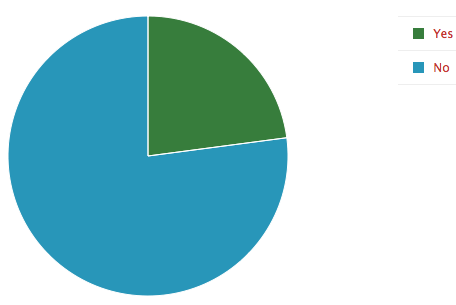
Our latest ZimmPoll asked “Will we have a farm bill by end of 2012?” Is it any surprise to you that 77 percent of our respondents said No and that only 23 percent said Yes? The farm bill is a big deal to anyone who eats or produces food but in reality it’s only about 2% of federal funding. It touches a lot of nerves though since it directly impacts everyone.

Our new ZimmPoll is now live and asks the question, “Where are best job opportunities in agribusiness?” The outlook for ag jobs seems very positive according to an AgCareers.com analysis. Job postings were up last year. What area holds the most promise right now in your opinion? If you attend next week’s Agri-Marketing Conference you’ll run into some very qualified and motivated young folks, many of whom are looking for their ag career opportunity!

ZimmPoll is sponsored by Rhea+Kaiser, a full-service advertising/public relations agency.

ZimmPoll

Mobilize the Earth – Earth Day 2012

Joanna Schroeder

Earth Day snuck up on me this year which is surprising considering all that people can talk about is the hot weather in the Midwest caused by “global warming”. Think what you will about that statement, Earth Day is April 22nd coined “Mobilize the Earth,” and because I can’t come up with new ideas (it must be the unusual heat) I’m going to review four environmental books and one movie leading up to the big day.

Inevitably, I’m going to get both applauded and ostracized for what I’m about to do – two of the books will be pro climate change and two of the books will be anti-climate change. Someday I may be drowning off the coast of Iowa and I will go under screaming and flapping my arms that you can’t learn and move forward if you don’t educate yourself about an issue as a whole – and that means all sides of the issue should be heard.

My review of books and movies is not an endorsement of the author’s beliefs – the point of the review is to let you know what the author thinks to determine if it’s a book you want to read in your lounge chair on the beach of Council Bluffs this summer.  And without further ado…My 2012 La Nina Reading List:

  • Climate Wars by Gwynne Dyer
  • Roosters of Apocalypse by Rael Jean Issac
  • Eaarth by Bill McKibben
  • Climategate by Brian Sussman
  • Carbon Nation

Well I’m off to the scuba shop to buy gear for my qwest to find the Hollywood sign….

book reviews, Energy, Opinion

Propane Industry Celebrates 100 Years

Joanna Schroeder

The propane industry is about to celebrate its 100th anniversary and as part of industry events, there is a Propane Centennial Celebration and Propane Clean Air Rally & Autogas Parade beginning on April 14, 2012. The rally and parade will kick off at 12:00 noon on April 14th in Centennial Olympic Park and will include a Blue Bird school bus and a Ford pickup truck both featuring the ROUSH CleanTech liquid propane autogas fuel system. There will also be vans, taxis, forklifts, lawn movers and more, all powered by propane autogas.

Propane was discovered in 1910, yet it wasn’t until 1912 that propane was first used in a commercial application. Shortly thereafter, in 1913, propane was used to fuel a vehicle. Thus, 2012 marks propane’s 100th birthday and according to ROUSH CleanTech, now fuels more than 17 million vehicles.

“Propane has seen many changes along its 100-year journey to what we call propane autogas today, both in application and acceptance by fleet managers, lawmakers and automobile industry leaders like ROUSH,” said Joe Thompson, president of ROUSH CleanTech. “This domestically produced, abundant fuel offers so many economical and environmental benefits to vehicle operators, and we’re pleased to celebrate its birthday and its bright future.”

The parade will kick off the 2012 National Propane Gas Association (NPGA) Southeastern Convention & International Propane Expo beginning on April 14th at the Georgia World Congress Center. On April 15, one lucky person will win a propane autogas fuel system installed in a 2012 F-250 donated by ROUSH CleanTech and raffled at 4:00 PM EST in booth 309.

Thompson added, “Propane is as American as baseball and apple pie, and that’s something to celebrate. This is a major milestone in American history as we look toward the next 100 years of propane achievement.”

Propane

Early Planting Fuels Corn Production Speculation

Cindy Zimmerman

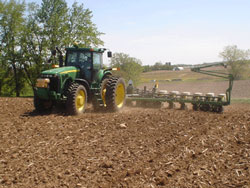
Corn planting is running well above normal across the country, fueling speculation that this year’s crop could be huge.


The crop progress report
this week shows that seven percent of the nation’s corn crop is now planted – more than double normal for this time of year. Progress in some Midwestern states has already hit double digits. Missouri has 23% of the crop planted compared to the five-year average of 8% and Illinois is at 17% where just 3% is normal. Huge gains were seen from the previous week in states like Tennessee, which jumped from 15 to 46% planted in a week, while Kentucky went from 5 to 32%. Normally, only 10 of the 18 top corn states have corn in the ground by this time of year but right now only North Dakota and Wisconsin have nothing to report.

Doing the math on the USDA Prospective Planting report predicting almost 96 million acres of corn this year and using only the five year average corn yield of 154.3 bushels per acre, there is the potential for a 14.8 billion bushel crop.

“Certainly if we have a trend yield, we’ll see record production and we should see substantial rebuilding of stocks,” said USDA chief economist Joe Glauber. “We were calculating with even 94 million acres we would see almost a doubling of stock yields.” That, he says, should moderate corn prices considerably which would provide some relief for both livestock and ethanol producers. The newest World Agricultural Supply Demand Estimate projects season-average corn prices at $6.00 to $6.40 per bushel.

The report also notes that corn to produce ethanol in 2011/12 is unchanged again this month at 5 billion bushels, while the latest monthly data from the Energy Information Administration (EIA) indicates that average daily ethanol disappearance fell to a 23-month low in January pushing ethanol stocks to a new record high. Weekly EIA ethanol production data suggest average daily ethanol production during February and March has continued to fall hitting its lowest level since early last fall.

corn, Ethanol, Ethanol News, Farming, USDA

Ethanol Co-Product Gains Foothold in Oil Country

Cindy Zimmerman

The livestock feed that is a co-product of ethanol production is gaining a foothold in the country that is synonymous with oil, thanks to the efforts of the U.S. Grains Council (USGC).

Saudi Arabia has always been the oil capitol of the world, but when Venezuela took the number one spot last year, the Saudis began to focus on diversifying into new revenue streams, like agriculture, and started to satisfy feed demand for dairy and livestock with the ethanol co-product distiller’s dried grains (DDGS).

Saudi Arabian group tours U.S. ethanol plant to see DDGs being made

The USGC launched the effort to expand market access for DDGS into Saudi Arabia through such activities as taking officials on tours of ethanol plants in the United States so they could see how the product was made. It was difficult at first to overcome the Saudis’ mistrust of ethanol as competition for petroleum, not to mention the fact that it is alcohol, which is prohibited in that country. But the Council ultimately succeeded in getting DDGS on the Saudi’s “feed ingredient subsidy list” which allows financial support for importers to aid them in bringing foreign feed ingredients to the market in order to reduce water consumption.

To gain placement on the list, the Council addressed various obstacles through an aggressive marketing campaign focused on stimulating demand and improving market access and is now introducing programming to educate traders and nutritionists about the tremendous benefits of DDGS. With 16,000 tons of U.S. DDGS already entering the Saudi market, the Council anticipates the demand to grow along as increased emphasis is placed on expanding the agricultural sector.

Distillers Grains, Ethanol, Ethanol News, Exports, International, USGC

First Sorghum Renewables Summit This Month

Cindy Zimmerman

The Sorghum Checkoff is hosting the first ever Sorghum Renewables Summit April 19-20 in Denver.

SorghumThe summit will bring together the industry’s leading researchers and companies for an event focused on agronomics, composition, technology, corporate governance and more related to using sorghum as a feedstock for renewable fuels.

National Sorghum Producers chairman Terry Swanson, a grower from Colorado, says about one third of the sorghum crop is now used to make ethanol. “Biofuels are very important to us,” said Swanson. “We are helping with the security of our country.”

The event will include a number of speakers and panels as well as a tour of the National Renewable Energy Laboratory (NREL) in Golden, Colorado on April 19.

Get more information about the 2012 Sorghum Renewables Summit on the Sorghum Checkoff website.

biofuels, biomass, Ethanol, Ethanol News, sorghum