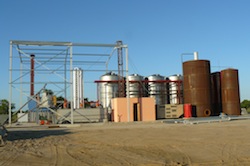
In December 2013, Brazilian bioenergy company GraalBio will start producing 82 million liters (22 million gallons) of advanced biofuels per year at a new factory in the Brazilian state of Alagoas. The plant will produce cellulosic ethanol from sugarcane bagasse and straw, and Novozymes will supply the necessary enzyme technology while Beta Renewables and Chemtex, both part of Italian chemical group Mossi & Ghisolfi (M&G), will provide other process technologies and engineering. 
“This announcement from GraalBio is fantastic news for the ethanol industry and for Brazil and it clearly signals the continuation of the green path Brazil has taken on biofuels,” says Peder Holk Nielsen, Executive Vice President of Novozymes. “We are thrilled to supply the enzymes to the first advanced biofuels facility in Brazil and proud to help GraalBio succeed.”
Advanced biofuels in the form of cellulosic ethanol is produced from biomass such as energy crops, agricultural residues or industrial and household waste. Enzymes are a key component of the production process, turning the biomass into sugar which can be fermented into ethanol.
As the advanced biofuels industry in Brazil scales up over the coming years, demand for enzymes is expected to follow and Novozymes has therefore begun searching for locations for new enzyme manufacturing plants in Brazil.
“The advanced biofuels industry is taking off in Brazil and we remain confident that cellulosic ethanol will play a significant role in Brazil’s energy future,” says Peder Holk Nielsen. “To support this, we are looking to establish new enzyme production facilities in Brazil, dedicated to making enzymes for the biofuels industry. The location of new plants will, among other things, depend on where the industry is expected to scale up, where Novozymes’ partners are located, and where the best framework conditions exist.”
Demand for ethanol is growing in Brazil and globally. Brazil expects to double its output of ethanol by 2020 to meet the growing demand from both domestic and export markets.Global production capacity of advanced biofuels is expected to reach 57 million liters (15 million gallons) in 2012 and for 2014, 945 million liters (250 million gallons) are under planned construction. A recent study from Bloomberg new Energy Finance estimates that the advanced biofuels industry has the potential to create jobs, economic growth, and energy security.
 Obama spoke to workers at TPI Composites, a company that makes blades for wind turbines and employs more 700 people. “If Congress doesn’t act, companies like this one will take a hit,” he said. “Jobs will be lost. That’s not a guess, that’s a fact. We can’t let that happen.”
 There are over 300 locally and independently operated FS FAST STOP and FAST STOP Express locations so GROWMARK Renewable Fuels Product Manager Brigette Harlan says they are carefully researching all the steps that need to be taken to offer E15 to guide them. “We’re working very closely with the
  Harlan says they recently updated their Biodiesel Quality Program, which has been in place since 2007. “It includes a specification that we require of all of our suppliers that’s tighter than the ASTM specifications, and also includes storage and handling and appropriate blending guidelines,” she said. “We just want to make sure that we are putting out there the best quality product that we can.”
 Aviation and clean technology leaders have joined together to launch the

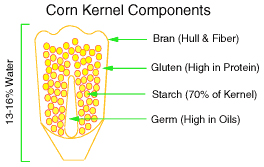 “This research is demonstrated proof of the viability of ‘generation 2.0 ethanol,’” NCERC Director John Caupert said. “By utilizing existing technologies readily available in the commercial marketplace, the Center was able to produce a biofuel that builds upon the strengths of conventional corn ethanol and the promise of cellulosic ethanol, thus making bolt-on cellulosic ethanol a reality.”