RFA E-15 Ad

Child Nutrition Should be Parents Responsibility

Chuck Zimmerman

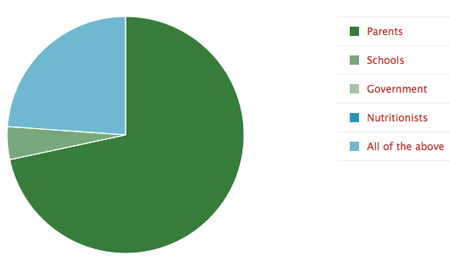
Our latest ZimmPoll asked the question, “Who should be responsible for child nutrition?” I am all for good food nutrition for our children. But who is responsible? It seems like the government thinks it should have some control. I’ve heard and read lots of people saying we need more nutrition education. But don’t we have more than enough of that? How long has USDA made good nutrition information available? But we still see the problem of overeating. So, here’s what our poll found. 72% said Parents! I say, amen to that. Of course then you might ask why aren’t parents doing a better job of controlling what their kids eat. 24% said All of the above and 4% said Schools and no one chose specifically Government or Nutritionists. Interesting results.
Our new ZimmPoll is now live and asks the question, “Which group should restaurants consider experts on animal care?” This past weekend many folks in agriculture participated in an online thank you campaign for Domino’s Pizza. Why? Because the restaurant chain made a decision based on good humane animal practices and did not give in to the demands of the animal activist group HSUS. So, let us know your thoughts on this question. We appreciate it.

ZimmPoll is sponsored by Rhea+Kaiser, a full-service advertising/public relations agency.
ZimmPoll

Cellulosic Ethanol From Corn Kernels

Cindy Zimmerman

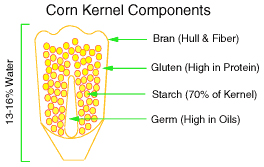
Researchers at the National Corn-to-Ethanol Research Center (NCERC) recently announced the successful production of ethanol from the cellulosic portion of the corn kernel.

“This research is demonstrated proof of the viability of ‘generation 2.0 ethanol,’” NCERC Director John Caupert said. “By utilizing existing technologies readily available in the commercial marketplace, the Center was able to produce a biofuel that builds upon the strengths of conventional corn ethanol and the promise of cellulosic ethanol, thus making bolt-on cellulosic ethanol a reality.”

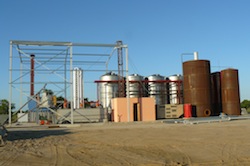
Caupert added that the potential for cellulosic ethanol has significant immediate and long-term impacts on the biofuels industry generally and the ethanol industry specifically. “Any of the 211 existing ethanol plants in the United States could be retrofitted with existing bolt-on technologies to produce cellulosic ethanol from corn without the need to build new facilities,” Caupert said. “This translates into opportunities for jobs and economic development, particularly in rural areas.”

On average, 8 to 9.5% of the corn kernel is fiber, of which about 5% is in the pericarp. NCERC Assistant Director of Biological Research Sabrina Trupia will be presenting more information about the new development at the Fuel Ethanol Workshop June 4-7 in Minneapolis.

The NCERC at Southern Illinois University, Edwardsville is a nationally-recognized research center established through federal and state initiatives, with support from the Illinois and National Corn Growers associations, and dedicated to the development and commercialization of biofuels, specialty chemicals, and other renewable compounds.

corn, Ethanol, Ethanol News, NCGA, Research

State Tax Credit Helps Iowa Biodiesel Production

Biodiesel production in Iowa has remained strong during the first quarter of 2012 despite the expiration of the federal biodiesel tax credit. According to figures released by the Iowa Department of Revenue (DOR), 10 Iowa biodiesel plants produced 41.9 million gallons from January through March.Iowa RFA

In 2011, the Iowa Legislature enacted a short-term, modest biodiesel production tax credit to help Iowa’s biodiesel community compete against states that provide large biodiesel incentives. The Iowa program went into effect on January 1, 2012 – the same day the federal biodiesel program expired.

“Despite losing the federal tax credit, biodiesel production in Iowa remains on pace with 2011 production, although down from year-end levels,” said Iowa Renewable Fuels Association (IRFA) Executive Director Monte Shaw. “This is a clear sign that Iowa’s new biodiesel production tax credit is having a positive impact. With additional production set to come on line in Iowa, we hope to see these numbers increase throughout the year.

“We knew there would be a transition period in 2012 and it was important to give the 7,000-plus jobs tied to Iowa biodiesel production a chance to survive and thrive,” added Shaw. “The initial DOR biodiesel numbers are a sign Iowa is headed in the right direction. Tax credits are only earned if biodiesel is produced –meaning jobs are sustained and the economy is strengthened.”

A study released earlier this year by economist John Urbanchuk, technical director of Cardno ENTRIX, found that biodiesel production supported 7,350 Iowa jobs; boosted Iowa GDP by nearly $600 million and generated $350 million in additional Iowa household income.

For more details, read the complete study.
###

Biodiesel, Iowa RFA, Production

Ethanol Plant Begins Operations in Mozambique

Joanna Schroeder

An integrated food, energy and forest business, CleanStar Mozambique, has gone online. Located in Dondo, the ethanol component of the facility will produce fuel from cassava, sourced from the local communities. The cooking fuel will be sold to residents of Maputo. American-based ICM, who has experience with food and fuel integrated biorefineries, helped to design and construct the plant. Last week, CleanStar held a ribbon cutting ceremony and representatives from ICM joined the biorefinery employees and community for a celebration.

Dave Vander Griend, CEO of ICM, attended to ceremony. “ICM is honored to be among the key partners involved in this historic milestone of launching the world’s first sustainable cooking fuel facility. The extraordinary level of commitment demonstrated by CleanStar Mozambique/CleanStar Ventures, Novozymes, and Bank of America Merrill Lynch made our decision easy when it came to supporting the project.”

The project had strong support because the biorefinery was designed to reduce poverty and environmental degradation and improve the health of families in Africa. Many in the country spend a large percentage of their income on purchasing charcoal to burn for fuel and burning charcoal causes health issues. A portion of the burden will be reduced because the fuel produced from biorefinergy will provide community members with a lower cost fuel.

The facility also provides a new income source for local farmers. The farmers will be able to sustainably grow the crops while the facility will produce fuel in a safe and sustainable method.

“Growing up on a farm, it was taught that wealth comes from the ground, crops are cultivated – nourishment is provided and the promise of agriculture is unleashed through producing more food and a stronger local economy,” continued Vander Griend. “We believe passionately in improving the health, wealth, and environment of the Mozambique people. Through unique collaborations like this, we can come together to improve African agriculture and potentially replicate this model throughout other developing countries in the world,” he concluded.

advanced biofuels, biofuels, Ethanol, International

Next Steps for E15

Joanna Schroeder

The Nebraska Corn Board recently hosted some meetings, sponsored by the Blend Your Own (BYO) ethanol campaign, to discuss the roll-out of E15. Nearly 75 people attended the meetings ranging from producers, fuel retailers and petroleum marketers to representatives of the ethanol and agricultural industries. Director of Market Development for the Renewable Fuels Association (RFA), Robert White, offered information on the next steps needed to bring E15 to pumps across the country.

“There is a lot of misinformation about E15 such as requirements for ethanol plants and fuel retailers that is coming from various sources. This meeting was necessary to get the right information to the right people,” said White. “We want to see E15 introduced legally and safely.”

Several requirements were put into place by the EPA before the fuel became legal this year. An E15 label had to be approved. A fuel survey had to be conducted. In addition, the ethanol industry, working with the fuel retail industry, was required to devise a misfueling mitigation plan as well as create a consumer education campaign designed to tell consumers what vehicles could safely use E15. These requirements were discussed as well as data on health effects and incentives available to assist retailers with the installation of E15 pumps.

Curt Friesen, District 3 Director on the Nebraska Corn Board, concluded, “It is crucial that all the necessary steps are taken before offering E15 at the pump. The Nebraska Corn Board is pleased to take a leading role in the introduction of E15 in Nebraska.”

biofuels, blends, Ethanol, RFA

Subcommittee Hears Support for Energy Programs

Cindy Zimmerman

The House Agriculture Subcommittee on Conservation, Energy and Forestry was urged to reauthorize Farm Bill energy programs and provide them with mandatory funding during a hearing on “Formulation of the 2012 Farm Bill: Energy and Forestry Programs” on Friday.

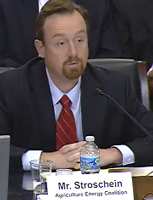
“American agriculture is the key to the successful development and commercialization of clean, abundant, renewable, domestic energy and biobased products in this country, and the ‘core’ Farm Bill energy programs provide American farmers, ranchers and entrepreneurs with the tools they need to make it happen,” testified Ryan Stroschein, co-director of the Agriculture Energy Coalition (AgEC).
“Although relatively new, the Farm Bill energy programs already have had a tremendous positive impact on economic and job growth in rural America, and they can do so much more,” said Stroschein. “USDA estimates that the BCAP and Biorefinery Assistance programs alone have the potential to create more than 700,000 new jobs as a result of increased cellulosic feedstock production and the construction and operation of new biorefineries.”

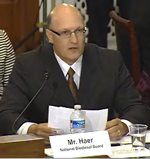
National Biodiesel Board chairman Gary Haer with the Renewable Energy Group highlighted the biodiesel industry’s growth and diversity, pointing out that more than half of the lawmakers on the panel have at least one biodiesel production plant in their districts.

“NBB estimates that those plants and others like them across the country supported more than 39,000 jobs in all sectors of the U.S. economy in 2011,” Haer testified. “Most of the more than 200 biodiesel production facilities in the U.S. are located in rural areas, and a majority of the feedstock used to produce biodiesel is grown or originates in rural areas.”

Haer specifically called for the committee to continue funding for the Biodiesel Fuel Education Program and the Bioenergy Program for Advanced Biofuels, programs that are critical to raising awareness of biodiesel and stimulating new production. The programs are succeeding, he noted, pointing out that they helped the industry produce a record of nearly 1.1 billion gallons of fuel last year.

advanced biofuels, Biodiesel, Cellulosic, Ethanol, Ethanol News, Government, NBB

New Sorghum Renewables Program Director Named

John Duff has been named renewables program director for The United Sorghum Checkoff Program (USCP).
Duff, a native of Levelland, Texas, has previously served as an intern for U.S. Representatives Randy Neugebauer and Kevin Brady, as well as with Combest, Sell and Associates. Duff also held an internship for USDA’s Economic Research Service where he managed data on a project examining the impacts of bilateral free trade agreements on agricultural trade.

Duff’s family farms near Levelland and remains involved in Levelland/Hockley County Ethanol LLC.

“Renewables have become a valuable sector of the sorghum industry,” said Bill Greving, USCP board member and chair of the Renewables Committee. “John’s leadership as renewables director will help create more opportunities for producers as this program moves forward. John will be a great asset to the Sorghum Checkoff as he brings with him a good deal of experience in working within the industry.”

biofuels, sorghum

Republicans Tell Military to Stop Buying Clean Energy

Joanna Schroeder

This week Republicans, led by Rep. Conaway, submitted a proposal that will prohibit the Defense Department from buying alternative fuels that cost more than traditional fuels. This has come at a time when the Defense Department is moving full speed ahead with the testing of renewable fuels in various military equipment including planes, boats, helicopters, and other military vehicles. The military is also researching the use of solar and wind energy and partnering with American companies to develop and deploy the technologies.

While it is true that in most cases advanced biofuels cost more per gallon than traditional petroleum based fuel, the only way to reduce the per gallon cost of advanced fuels is to bring them to market at commercial scale – something many groups are fighting tool and nail.  The same is true in reaching per watt parity with solar and wind energy.

In response to this proposed action, Operation Free sent a letter to the Senate Armed Services Committee calling on Congress to support the military’s efforts as it leads the way in development of advanced biofuels and renewable energy. The organization criticized members of Congress who advocate for policies that have already proved to be failures. The letter states, “We must change how we use energy in this country — and the military is leading the way. ”

Danger Room’s Noah Shachtman summed up the ramifications of the proposal well, ” If the measure becomes law, it would make it all-but-impossible for the Pentagon to buy the renewable fuels. … And it might very well suffocate the gasping biofuel industry, which was looking to the Pentagon to help it survive.”

advanced biofuels, biofuels, Opinion, Solar, Wind

Algasol Renewables Partners with OriginOil

Joanna Schroeder

Algasol Renewables, based in Palma De Mallorca, Spain, has agreed to work with OriginOil on the development of an integrated algae growth and harvesting system. Algasol has a patented technology for low-cost cultivation of micro algae for biofuels and byproducts. By bundling their products, the companies hope to achieve new levels of cost and performance in micro algae cultivation for biofuels and bioproducts.

NASA and Lawrence Berkley are working with Algasol to refine their technology, and also collaborates and maintains a close relationship with Arizona State University’s Center for Algae Technology and Innovation.

Miguel Verhein, executive director of Algasol Renewables said, “With customer demand for an integrated algae production process rising, we need to offer our customers a means of harvesting as well. We plan to recommend OriginOil’s field-proven chemical-free, high flow and low-energy harvesting system, and once available, the integrated biocrude system they are developing with the Department of Energy.”

Algasol’s floating bags or photobioreactors (PBRs) can operate in the ocean or in land-based salt water ponds, and have received a patent in 70 countries. Because they float, Algasol believes their PBRs achieve optimal light exposure with strong productivity results and avoid the high temperature and excess salinity often encountered in solar growth systems.

“Algasol’s patented system focuses on how to grow algae in floating bags, and their testing has indicated this can be much more efficient than other cultivation methods,” said Riggs Eckelberry, OriginOil’s CEO. “Now with NASA and Lawrence Berkley working with Algasol, we are excited and eager to contribute our own breakthrough harvesting system to help us collectively achieve a cost breakthrough in the race to compete with petroleum.”

advanced biofuels, algae, biomaterials

U.S. Solar Industry Sets its Sites on China

Joanna Schroeder

This week U.S. Senators Sherrod Brown (D-OH) and Charles Schumer (D-NY) launched a proposal aimed at reducing China’s hold on the global solar panel market. The proposal would bar Chinese-made solar panels from qualifying for the 30 percent tax credit that U.S. individuals and businesses receive for purchasing and installing solar panels. U.S. installations of solar panels has grown 70 percent per year since 2008, but the majority of these panels were manufactured in China.

The new legislation would reduce the scope of solar panels eligible for the existing 30 percent tax credit. To become eligible, 70 percent of the parts of the qualifying solar panel must be made in America. If the final point of manufacture is in the U.S, then only 50 percent of the parts would need to be American made.

“We can’t trade our dependence on foreign oil for a dependence on Chinese-made solar panels,” said Senator Brown. “We went from a solar trade surplus with China to a solar trade deficit in a matter of years. Ohio workers can compete with anyone in the world, but they deserve access to a level playing field. When the Chinese government provides direct export subsidies to its solar manufacturers, that’s not competing – it’s cheating. And it’s costing American jobs in solar manufacturing.”

“The American tax code should not make matters worse by encouraging the purchase of Chinese-made solar panels. Our plan will ensure that American tax incentives support American solar panel manufacturers,” added Brown.

Chinese companies, according to Brown and Schumer, have been able to take hold of the solar industry at a rapid rate, in part because they have taken large, government-subsidized loans from banks. This has led to plunging prices for U.S. wholesale solar panel makers. Today, prices are around $1 a watt of capacity today, down from $1.80 in January and $3.30 in 2008.

Electricity, Energy, Solar