 The boat, Earthrace, is set to make another attempt at circumnavigating the globe fueled by biodiesel.
You might remember that Earthrace’s attempt fell short last year after it ran into problems, including hitting a Guatamalan fishing boat, killing one man. But this story in Motor Boat & Yachting says there’s another try to start on March 29th:
The international crew, led by New Zealander Pete Bethune, leave Sagunto, near Valencia, hoping to beat the 75-day mark set by British boat Cable and Wireless Adventurer in 1998.
They need to be back in Sagunto by 10 June.
The over-riding aim of the project is to raise awareness of the potential of biofuels and encourage people to lead more sustainable lives. The boat is run on biodiesel donated by SGC Energia in Portugal; the fuel is derived from waste cooking oil, as well as soya and canola oils.
To back up the sustainable message, the boat has been made using “environmentally friendly components”, such as hemp, and the project claims to maintain a carbon neutral status through the purchase of carbon offsets from www.downwithcarbon.org which uses the income to fund a sustainable biofuel project in Egypt.
The offsets account for any CO2 produced through transportation of the biofuel to the different fuel stops, the biofuel itself, and all travel undertaken by the ground crew, it is claimed.
You can follow the boat’s round-the-world progress at www.earthrace.net.


 US BioEnergy‘s Marion, South Dakota ethanol plant has officially started production.
 I’d like to thank all the people who completed our annual visitor survey and were entered into a drawing to win an iPod Nano. Your feedback and participation is very helpful.
 The
The  Biodiesel producers in Pennsylvania are in a tough spot these days, and unless the state steps in to help them, their industry could go bust by the end of the month.
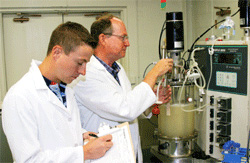 A process using the bacteria, developed by University of Maryland professors Steve Hutcheson and Ron Weiner, is the foundation of their incubator company Zymetis. When fully operational, the Zymetis process could potentially lead to the production of 75 billion gallons a year of carbon-neutral ethanol.
 If you have a video camera and/or a computer, plus a little creativity and some time, you could win $10,000 and the chance to have your creativity seen by millions.
  At last week’s Washington International Renewable Energy Conference (WIREC) 2008, Agriculture Secretary Ed
  Eligible applicants may seek loan guarantees to cover up to 50 percent of a project’s cost up $10 million and grants are available for up to 25 percent of a project’s cost, not to exceed $250,000 for energy efficiency improvements and $500,000 for renewable energy systems. USDA Rural Development has invested $674 million in more than 1,763 renewable energy and energy efficiency projects since 2001 including ethanol, biodiesel, wind, solar, geothermal, methane gas recovery systems and biomass.
 Coming up this week in Omaha is the
  The first large-scale ethanol plant in Texas will hold its grand opening this weekend near Hereford.