RFA E-15 Ad

Sapphire, Linde Partner to Turn Algae into Crude Oil

John Davis

SapphireLindeSan Diego-based Green Crude – oil made from algae – producer Sapphire Energy, Inc. and German gasses and engineering company The Linde Group have partnered to commercialize a new industrial scale technology to turn algae biomass into crude oil. The five-year deal is to go through the development of Sapphire Energy’s first commercial scale, algae-to-energy production facility.

“Sapphire Energy is very pleased to build upon its already successful strategic partnership with Linde to build a commercial oil upgrading process designed to increase yield and lower the cost of crude oil production,” said Cynthia ‘CJ’ Warner, CEO and chairman of Sapphire Energy. “Large energy projects like we are building require very significant partnerships to fund the development of new technologies and make available engineering resources needed to bring these projects on line at commercial scale. We think Linde is a perfect partner to help Sapphire achieve this goal.”

“We have been working with Sapphire Energy for two years to develop a cost-efficient CO2 delivery system for commercial algae production. We have become confident with the company’s expertise and its capability to produce a low carbon and economic energy source from algae. After the positive experience gained, we decided to intensify our cooperation with Sapphire,” said Professor Dr. Aldo Belloni, Member of the Executive Board of Linde AG. “Based upon our profound engineering expertise, we will contribute to further develop and scale up Sapphire’s algae-to-crude-oil technology.”

Linde and Sapphire Energy energy have been working on a low cost, CO2 management system for open pond, algae-to-fuel production, since May 2011.


algae

Corn Growers Talking RFS in DC

Cindy Zimmerman

ncga-dcMembers of the National Corn Growers Association (NCGA) from across the country are in Washington this week to discuss policy issues and visit with lawmakers about a number of topics, including the Renewable Fuel Standard (RFS).

“The question our members are asking the legislators is ‘Do you support the RFS in its form, yes or no?’ and we want an answer,” said NCGA President Pam Johnson of Iowa.

Johnson says a gas station in her little community of Floyd, Iowa boasts the lowest price of fuel in the United States right now. “And it’s E85 and the price is $2.24 a gallon,” and she would like to see consumers nationwide have the opportunity to buy cheaper gas blended with renewable fuel. “Giving them the option at the pump to choose, not letting the oil industry choose whether they get to use that fuel or not,” said Johnson. That is the reason she believes keeping the RFS in place is so important to the country. Interview with NCGA President Pam Johnson

Audio, corn, Ethanol, Ethanol News, Government, NCGA, RFS

Interest in Online Ag TV Programming

Talia Goes

Before we get to our new ZimmPoll let’s look at the results of our latest one which asked the question, “ Do you watch or want to watch live or recorded ag news television programs online?” The results indicate that there is an interest in online agricultural television programming.

Our poll results: Thirty-nine percent said Yes, I Currently Do, thirty-six percent said Yes, Need To Find Them, and twenty-five percent said No, Don’t Have Time or Interest. Online activities have become the way of the present and future. With technology making jobs more time efficient it allows for extra minutes to be spent catching up on the latest.

Untitled

Our new ZimmPoll is now live and asks the question, “What use would you have for an Unmanned Aerial Vehicle?” That would be UAV for short – better known as drones, but the industry doesn’t like to use that word because it has a negative connotation. Nevertheless, we’re talking about small, remote-controlled aircraft that can be used to get a bird’s eye view of the land, capturing either still photos or video or both, or even live streaming. Is that something you could use on your operation? Let us know.

ZimmPoll is sponsored by New Holland Agriculture.

ZimmPoll

Biodiesel Research Looks at Jatropha Genes

John Davis

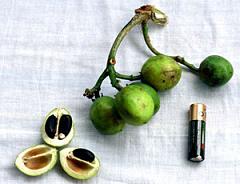
jatrophaJatropha plants with their high oil content are seen as potentially a good alternative to some food crops as a feedstock for biodiesel. But the shrub’s nature makes it just as intensive to raise as a food crop, as well as having issues with drought resistance. Researchers at Penn State University believe they have found the gene that will help them discover a way to allow the plant to be grown with less maintenance in more desert-like conditions.

“It is thought that Jatropha’s future lies in further improvement of Jatropha for large-scale production on marginal, non-food croplands through breeding and/or biotechnology,” said John E. Carlson, professor of molecular genetics at Penn State. “The more that is known about the genetic basis of Jatropha’s key attributes such as drought tolerance, the more readily Jatropha improvement will progress.”

Researchers looked at a little known gene — JcPIP1 — because a similar gene in the model plant Arabidopsis is known to play a role in drought response. They also examined JcPIP2, a potential drought response gene in Jatropha identified in 2007 by researchers at Sichuan University. They reported their findings today (July 15) in the Journal of Plant Physiology.

The JcPIP genes code for membrane channels called aquaporins, which are responsible for transporting and balancing water throughout the plant, though exactly how each gene affects aquaporin behavior under environmental stress remains unclear. However, researchers have found that JcPIP1 and JcPIP2 are expressed at different times during a stressful situation, which hints at what roles they play in response and recovery.

The researchers found that JcPIP2 was mostly active in the early stages of stress while JcPIP1 expression was greater during recovery. The timing indicates that JcPIP1 might be crucial in helping Jatropha recover from damage while JcPIP2 could play a role in prevention.

Biodiesel, Research

Chem Students Use Syrris for Biodiesel Research

John Davis

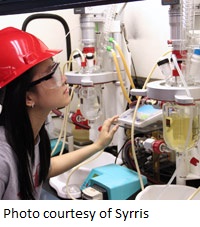
SyrrisWPUstudent1A group of chemical engineering students in Massachusetts have used technology from UK-based Syrris to investigate the production of biodiesel. Syrris officals say the Worcester Polytechnic University students used Syrris’ Globe jacketed reactor system that allowed for a safe project:

“As part of their senior thesis, some of our undergraduate students suggested a ‘green’ experiment; converting vegetable oil into biodiesel. This base-catalyzed process uses methanol and potassium hydroxide, which is not that simple a reaction or particularly safe,” [said Professor William Clark from the Chemical Engineering Department at WPU].

“To implement this process in an undergraduate teaching laboratory, we needed a computer-controlled mini pilot plant that could run the reaction safely at different temperatures; the Globe system was ideal.”

“Globe enables the biodiesel reaction to be performed under computer control, eliminating manual transfer of reagents and allowing the experiment to be carried out safely, which is paramount.”

The students were able to design a small chemical factory of two Globe reactors and a Globe Reactor Master Module that integrates balances, pumps, temperature probes, stirrers, a temperature bath and a pH meter, using Globe Reactor Master Software.

Biodiesel, Research

California Court Rules Against LCFS

Cindy Zimmerman

A California appeals court this week overturned a regulation implementing the state’s Low Carbon Fuel Standard.

poetCalifornia’s Fifth District Court of Appeal issued its decision in POET, LLC v. California Air Resources Board (ARB) on Monday, ruling for POET on every one of its substantive challenges and reversing the decision of the Superior Court affirming the LCFS. The Court also ruled that ARB must, among other things, re-evaluate the LCFS’s overall environmental impacts, and allow public comment on several controversial issues including the carbon intensity values attributed to ethanol based on the theory of indirect land use change.

South Dakota-based ethanol producer POET issued the following statement about the ruling:

“We are pleased the court recognized the fundamental flaws in ARB’s process for implementing the Low Carbon Fuel Standard. The Court ruled in our favor on every challenge we raised on appeal, each of which went to a different problem with the approval process. The Court has also made clear that ARB must re-evaluate the LCFS’s recognized potential to increase smog-forming pollutants, recirculate its environmental document evaluating the impacts of the LCFS and, significantly, allow public comment on several controversial issues, including the carbon intensity values attributed to land use changes.”

The Court ruling allows ARB to continue to enforce the LCFS regulation at the moment, but prohibits the agency from ramping up enforcement of the regulation beyond the current 2013 levels

Ethanol, Ethanol News, Growth Energy, POET

Oil Industry Blames RFS for Gas Prices

Cindy Zimmerman

With gas prices on the rise again, the Senate Energy Committee held a timely hearing today on domestic oil production and fuel prices, and representatives of the oil industry used it as an opportunity to blame the Renewable Fuel Standard (RFS) for volatile prices.

gas-prices-valeroValero Energy CEO Bill Klesse noted in his testimony that his company supports ethanol production and owns ten ethanol plants, but he blames the RFS system of buying biofuels credits, called Renewable Identification Numbers (RINS) for fuel price volatility. “The Renewable Fuel Standard is out of control. It is broken. RINS are going up as we speak,” he said. “The RFS must be fixed. This cost is just skyrocketing.”

Klesse and other witnesses also challenged the use of E-15 as a way of increasing the use of ethanol. “We are not supportive of E-15 for all the reasons that have been stated – car warranties, pumps, everything that goes with it,” he said. Klesse RFS Comments

gas-prices-stabenowCommittee member Debbie Stabenow (D-MI), who chairs the Senate Agriculture Committee, questioned the panel about support for blender pumps to allow higher blends of ethanol in the marketplace. Petroleum Marketers Association of America President Dan Gilligan claims other types of infrastructure are needed. “We spend a lot of time talking about making dispensers capable of E15, we’re concerned about all the stuff under the ground – storage tanks, piping, glues that were used – how will those perform with a higher level of ethanol?” he asked. “It’s a real tangled web of issues.”

Stabenow pointed out the need for competition in the marketplace. “I’m all for competition and I’m anxious to make sure that we have the opportunity for lots of different choices for fuel at the pump,” she concluded. Senator Stabenow Q&A

Audio, Energy, Ethanol, Ethanol News, Government, Oil, RFS

UFOP: Sustainability Ups Biodiesel Content Choices

John Davis

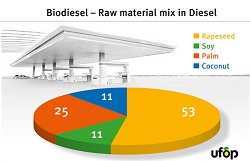
UFOPgraphic1A study from a group in Germany says sustainability certification systems have opened up market access for vegetable oils from countries outside the European Union. The study from the Union zur Förderung von Oel- und Proteinpflanzen e.V. (UFOP) surveyed 60 filling stations across Germany and found that rapeseed oil remains the most important raw material source for the production of the green fuel in that country, making up more than half (53 percent) of the feedstock for biodiesel there. Palm oil was next at 25 percent, with coconut and soybean oil each contributing 11 percent.

In the years 2010 and 2011, German agriculture benefitted from the fact that practically only certified rapeseed from domestic production was available after the immediate national implementation of the Renewable Energies Directive. The raw material mix now determined reveals that the certification systems approved by the EU Commission have now also been introduced in countries outside the EU such as Argentina, Brazil as well as Indonesia and Malaysia. In other words, the supply of sustainably certified raw materials for biofuel production has meanwhile become globalised, according to UFOP.

It is a stipulation of the international laws that market access may not be denied if the specified ground rules are complied with. Nevertheless, the UFOP has serious misgivings and believes that closer attention must be paid in respect to the quality of the national implementation and the certification introduced in the sense of fair competition, but also nature and environmental protection locally.

UFOP went on to urge the the EU Commission to maintain its strict rules for the certification of the origin of biodiesel feedstocks.

Biodiesel, International

Vital Signs: Volume 20 Released

Joanna Schroeder

The Worldwatch Institute has released Vital Signs: Volume 20, the latest compilation from the Vital Signs project. The report finds that in 2012, global oil consumption reached an all-time high and physical water scarcity affected nearly 1.2 billion people. The Vital Signs report provides insight on many of the most critical global concern and provides data and analysis on significant global trends such as fossil fuel subsidies, agricultural commodities and rapid urbanization in the developing world.

Worldwatch Institute Logo,jpg“Our recent economic systems and theories are programmed to squeeze ever more resources from a planet in distress,” said Michael Renner, Worldwatch senior researcher and director of the Vital Signs project. “A mixture of population growth, consumerism, greed and short-term thinking by policymakers and business people seems to be inexorably driving human civilization toward a showdown with the planet’s limits.”

Some of the trends are positive. For example, within the agriculture sector, efficient irrigation methods have increased more than sixfold over the last two decades. In addition, socially sustainable ways of doing business continue to emerge.

“There is no shortage of alternatives to change the destructive trajectory that humanity finds itself on,” continued Renner. “Renewables and efficient irrigation are two practical options among many others. But we need to get serious about these tasks instead of consigning them largely to the margins.”

biofuels, Climate Change, Environment, Renewable Energy

Tennessee State to Take Biodiesel Maker on Road

John Davis

Tennbiodieseltrailer1Researchers at Tennessee State University hit the road this week with a mobile demonstration lab to convince more farmers to brew their own biodiesel. This school news release says unit will also be on display at the university’s Small Farm Expo this Thursday, July 18th.

The eye-catching mobile lab is the showpiece of the University’s pioneering alternative fuels program. Funded with $250,000 from the USDA Capacity Building Grant program, the mobile lab takes biodiesel fuel education right to working farmers, and has all the equipment necessary for producing the alternate fuel.

“This region has a modest oil seed production rate by area farmers,” said Dr. Jason de Koff, assistant professor of agronomy and soil sciences in the College of Agriculture, Human and Natural Sciences. “We want to be able to show them something they might not have thought about. With as much oil seed production taking place in the state, we want to explain the production of biodiesel fuel from vegetable oil is a viable process that can replace traditional fuel used in existing diesel engines.”

According to de Koff, a typical farm uses around two to six gallons of diesel fuel per acre every year. Depending on the oilseed crop and yield, a farmer could devote one to 15 percent of farm acreage to producing oilseed crops strictly for biodiesel fuel production.

“It is possible they could become totally self-sufficient in diesel fuel use,” added de Koff. “As a clean-burning, renewable energy source, biodiesel fuel offers a number of built-in advantages that regular diesel fuels simply can’t match.”

The mobile demonstration unit has all that’s needed to produce biodiesel, including an oil seed press and biodiesel processor. Supporters hope to show how easy the process can be not only to farmers but to area lawmakers, 4H clubs and schools.

Biodiesel, Research, University