ACE Conference 2026

From Toilet to Tank

Joanna Schroeder

The All-gas project, funded by the European Union, has achieved a milestone: successful crop of algae biomass at its site in Chiclana in Southern Spain. The goal of the project is to develop low-cost biofuel from algae grown in wastewater. The All-gas project proposes using this wastewater, as well as CO2, generated in biomass boilers from residuals such as garden waste or olive pits to feed the algae, which in turn are converted into biogas. A part of the biogas is CO2, which gets separated from the biomethane and recycled.

According to a news release, the algae crop has produced outstanding results – the biomass obtained shows a particularly high energy potential relative to its digestibility level, with a methane production capacity of around 200-300 litres of gas per kilogram of biomass processed by anaerobic digestion. The microalgae also successfully purified wastewater.

Launched in May 2011, the five-year project has already completed its pilot phase (the first two years) in a 200 square meter facility. The plans for the construction of the biomass plant are on schedule, and a one-hectare prototype is under construction. The project’s final phase will span 10 hectares – the equivalent of ten football fields – believed to be the largest in the world.
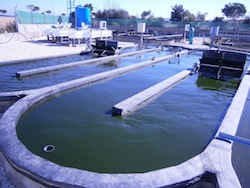
All-gas ProjectIt is expected that by 2016, the biofuel produced by the All-gas project will be enough to power 200 vehicles. When the project reaches its demonstration phase, the biogas produced will be used to power public buses and garbage trucks in the region of Cadiz.

According to Frank Rogalla, Project Coordinator and FCC Aqualia’s Director of Innovation and Technology, “This original new approach to bioenergy means that Spain’s 40 million population could power 200,000 vehicles every year with a single toilet flush. The All-gas project is going to change the face of wastewater treatment by generating a valuable energy resource from what was previously considered undesirable waste.”

As Nicolas Aragon, Chiclana’s environmental councilor, adds, “This is not only an R&D project, but also a way of reducing costs and investing in the protection of our natural environment. Chiclana is a worldwide tourist destination and from now on, we will show that along with attracting visitors with our sunshine and beaches, we can also grow sustainable biofuel with our natural resources.”

The All-Gas consortium is led by FCC Aqualia, and comprises five other organisations, from Germany (Fraunhofer – Gesellschaft), Austria (BDI), the Netherlands (Feyecon y Hygear) and the UK (University of Southampton).


advanced biofuels, algae, biogas, biomass, Waste-to-Energy

GEA Seeks Entries for Best in Geothermal

Joanna Schroeder

gea_logoThe Geothermal Energy Association (GEA) is in search for nominees for its GEA Honors 2013. Nominations will be accepted until Friday, Sept. 6, 2013 for the awards program. Applications may be submitted for more than one award category. This year, awards will be given to GEA member companies in the following categories:

  • Technological Advancement: Awarded to an individual or company that has developed a new, innovative or pioneering technology to further geothermal development.
  • Environmental Stewardship: Awarded to an individual or company that has fostered outstanding environmental stewardship through the use of geothermal systems. This award will be presented in conjunction with the Environmental and Energy Study Institute (EESI).
  • Economic Development: Awarded to an individual or company that has made a substantial contribution to the development of local, regional or national markets through the development of geothermal systems.
  • Special Recognition: Nominations will also be accepted for special recognition of individuals and companies for outstanding achievement in the geothermal industry. These awards are open to GEA members, as well as non-member companies and individuals.

“After two successful years of honoring the best in the business, we are pleased to have the opportunity to again recognize the inspiring innovators and developers in the geothermal industry over the past year,” said Geothermal Energy Association Executive Director Karl Gawell. “Honorees will exemplify the great accomplishments and potential for the geothermal energy industry in the United States.”

Finalists will be named at the GRC Annual Meeting & GEA Geothermal Energy Expo on Monday, Sept. 30. Winners will be announced in December.

Alternative energy, Electricity, Energy, Geothermal, Renewable Energy

Corn Farmers Look to Produce Fertilizer from Wind

John Davis

MNwindmillFarmers in Minnesota soon could be turning wind energy into fertilizer. Research funded by the Minnesota Corn Growers Association is developing a way to have the wind turbines put up in corn fields produce the very nitrogen fertilizer that helps those same crops grow.

“We take water, and we separate the hydrogen and oxygen. We pull nitrogen from the air and combine the hydrogen and nitrogen to form anhydrous ammonia, the predominant nitrogen fertilizer source farmers use,” explains Mike Reese, the Renewable Energy Director for the University of Minnesota at the school’s West Central Research Station in Morris, Minn.

This first-in-the-world research project still uses the tried-and-true process of producing ammonia for fertilizer… but hopefully more locally and efficiently. Reese says they need to figure out how to make this wind-powered process commercially scalable.

“Right now, anhydrous ammonia and nitrogen fertilizer is produced on a massive scale in central locations. What we’re trying to do is make this so we could have community production or co-op facilities to produce the nitrogen fertilizer locally,” he said.

Reese added that there are enough resources in Minnesota to make all the fertilizer needed for the state’s entire corn crop, a possible $400 million industry that is now done completely out of the state.

Wind

BioEnergy Bytes

Joanna Schroeder

  • BioEnergyBytesDFAdmirals Bank, has opened a Renewable Energy Lending Business Development Center in San Francisco, CA. This marks the Bank’s second major initiative following the launch of their new division, Admirals Alternatives, earlier this year.
  • Principal Solar, Inc has announced the appointment of Jeff Heller, former vice chairman of Electronic Data Systems, Inc. (EDS), to its Board of Directors.
  • JA Solar Holding has announced that it will supply 38.6 MW of solar modules to Phoenix Solar for the Simon Solar Farm in Georgia.
  • Omitek Engineering Corporation has announced the appointment of Tallman Truck Centre, based in Kingston, Ontario, Canada, as an authorized installation center for its diesel-to-natural gas engine conversation systems in the region.
  • Vivint Solar, a full-service residential solar integrator, has announced it has secured two new tax equity funds worth $200 million. The funding will be used to continue delivering simple, affordable solar solutions to homeowners inside and outside of Vivint Inc.’s 775,000 home automation customers.
Bioenergy Bytes

Study: E85 Can Help Break the Blend Wall

Joanna Schroeder

According to a new analysis by the Center for Agricultural and Rural Development at Iowa State University, the so-called ethanol “blend wall” can be overcome and Renewable Fuel Standard (RFS) requirements can be met in 2014 and beyond through increased use of attractively-priced E85. The analysis is titled “Price It and They Will Buy: How E85 Can Break the Blend Wall.”

Card E10 blend wall study“Pricing E85 low enough to generate fuel cost savings has the potential to quickly increase ethanol consumption, perhaps by three billion gallons over the next year or two,” write the study’s authors, Profs. Bruce Babcock and Sebastian Pouliot. “Rather than being a physical barrier to increased ethanol consumption, the E10 blend wall is an economic barrier that can be overcome by increasing the incentive for drivers to use E85 to fuel their vehicles.”

The analysis demonstrates how the RIN market works to lower the effective cost of E85 at the retail level, and explains the interaction among corn, ethanol, gasoline and RIN prices.

“Current RIN (Renewable Identification Number) prices are high enough to achieve modest increases in ethanol consumption above 13 billion gallons and to create incentives to increase the ability to consume lower-carbon ethanol in 2016 and beyond,” the authors write. “Current high RIN prices create a large incentive for oil companies to increase consumption of E85 because expansion in E85 consumption will decrease RIN prices.”

The authors conclude that it will be less expensive for oil companies to invest in E85 infrastructure than it would be to continue to pay high RIN prices.

The authors also point out that the current fleet of flex fuel vehicles (FFVs) has the capacity to conservatively consume 6.6 billion gallons of ethanol annually and more FFVs are on the way. Further, they found that more than one-third of FFV owners have access to E85 within five miles from their home.Read More

biofuels, E85, Ethanol, Flex Fuel Vehicles, Research, RFA, RFS, RINS

“More B for Me” Biodiesel Messages Greet Fair Goers

John Davis

Biodiesel Billboard-2Visitors to the Iowa State Fair will be greeted with a message promoting the use of biodiesel. The Iowa Renewable Fuels Association (IRFA) announced the “More B for Me” billboard campaign aimed at increasing the use of biodiesel in the state, particularly on farms. In addition, farmers could win $1,000 worth of biodiesel:

The IRFA is delivering the biodiesel message on 12 billboards throughout the Des Moines area, focused on routes to the state fairgrounds. The campaign urges the public to increase its use of biodiesel, and encourages farmers to enter for a chance to win $1,000 in biodiesel at www.MoreBforMe.com.

“Iowans greatly benefit from increased biodiesel production and use, especially Iowa’s farmers,” stated IRFA Communications Director T.J. Page. “Biodiesel production boosts an Iowa farmer’s bottom line by increasing the value of soybeans and animal fats, while decreasing the costs of animal feed.”

IRFA goes on to cite a study that shows biodiesel production can up a crop and cattle farmer’s net income by nearly 17 percent and nearly 20 percent for farmers raising crops and hogs.

Farmers can enter to win $1,000 in biodiesel at www.MoreBforMe.com or by visiting the Renewable Energy Group (REG) booth at WHO Radio’s Crystal Studios at the Iowa State Fair. The campaign is part of a joint effort by the IRFA, REG, the Iowa Soybean Association (ISA), and the Iowa Biodiesel Board (IBB).

Biodiesel, Iowa RFA

Clean Energy Inks CNG Deals in Several Sectors

John Davis

CleanEnergyCNG1California-based Clean Energy Fuels Corp. announced several new agreements the company struck in some varied compressed natural gas (CNG) sectors, to include transit, trucking and manufacturing.

On the transit side, Clean Energy signed a 10-year deal with LA Metro to provide in total up to 36 million gallons a year of CNG for the country’s largest clean air fleet:

la-metro-bus1LA Metro Board approved a 10-year compressed natural gas (CNG) station operation and maintenance contract with Clean Energy for four of LA Metro’s CNG bus fueling stations. With this award, Clean Energy will continue to operate and maintain all of the Agency’s 10 CNG bus fueling stations as well as an 11th station currently under construction by Clean Energy.

From the trucking sector, Clean Energy will provide a CNG for 100 medium-duty delivery trucks for Fox Transportation:

fox-truck1Once fully deployed, the fleet is expected to consume approximately 600,000 diesel-gallons-equivalent of CNG fuel per year.

Fleet is anticipated to make approximately 900,000 deliveries annually to hospitals throughout California, traveling over five million miles per year.

ngadvantage1And in manufacturing, Clean Energy and NG Advantage struck a first-of-its-kind, 10-year deal to build a new natural gas compression facility in central New Hampshire to reach customers not on a natural gas pipeline throughout New England:

Operated by Clean Energy, the facility is intended to provide a minimum of 10-million gasoline-gallons-equivalent of CNG per year. This potentially represents more than double the CNG fuel volume supplied by Clean Energy’s highest-volume CNG station.

Clean Energy’s President and CEO, Andrew J. Littlefair says these moves help eliminate perceived barriers and limitations of natural gas to demonstrate economic and environmental advantages of transitioning to the fuel.

Compressed Natural Gas (CNG)

Free Fuel Happy Hour at Sturgis Buffalo Chip

Chuck Zimmerman

RFA at Sturgis Buffalo ChipThe founder and President of the Legendary Buffalo Chip Campground, Rod Woodruff, was the first motorcycle rider to fill up at the Renewable Fuels Association “Free Fuel Happy Hour” yesterday. Rod knows that a high octane E10 blend will run just fine in his motorcycle.

At yesterday’s event around 160 motorcycles made it through the line to get filled up and we’re doing it again today and tomorrow. I interviewed a number of riders and will be sharing those with you in coming days. Internet access has been very sporadic and today I’m heading to Denver for the Cattle Industry Summer Conference.

2013 Sturgis Motorcycle Rally Photo Album

Ethanol, Ethanol News, RFA, Sturgis

Solar Rooftop Project Underway in Africa

Joanna Schroeder

CNPV Solar Power SA has announced that their 1.1 MWp supply has been selected for the one of the first large-scale rooftop projects in Namibia. Due to intermittent energy supply and high prices, families turn to diesel generators for power. Now, CNPV says its Total photovoltaic systems are helping to make solar PV solutions the primary choice when selecting new and additional power sources. But what to do when you need to mix the technologies?

Enter Donauer from Germany and their D:Hybrid System – an integrated energy management solution that sets standards for a future orientated energy supply concept focused on reducing energy procurement costs and guaranteeing a reliable power supply. namibiabottlingDonauer have recently been awarded the 1 MWp solar PV integration project with on-roof mounting at Namibia’s largest brewery, Namibia Breweries Limited (NBL), and their choice of supplier was CNPV.

“Our techno-commercial model is finely tuned to offer the client bottom line benefits,” said Mr. Benedikt Bohm, “and the credible demonstration of deliverables comes from the ability to provide ‘hands on’ evidence of ‘more for less’. Our continued choice of CNPV is based upon their ability to outstrip all other comparative PV suppliers’ performance on all of the criteria that matter, such as energy yield, efficiency and reliability. The CNPV-250P polycrystalline module totally compliments our requirements and facilitates our ability to push technological boundaries cost competitively, while ensuring that longevity and yields of the fundamental elements are unchallenged.”

CNPV’s COO & CTO, Mr Bypina Veerraju Chaudary, commented on Donauer’s success. “It’s always exciting to be involved in pioneering projects, particularly when they are driven by visionary personnel. Not only have Donauer identified a new opportunity, created a viable solution and justified its acceptance with facts, they continue to expand their international credibility, provide regional solutions and enlarge their geographical footprint when others are contracting. We are totally honoured to participate in their strategy and equally enthusiastic about further developments from both our Companies that will add to the revenues our clients can achieve.”

CNPV says with the introduction of the hybrid solar PV-diesel solution, NBL’s energy consumption costs will be significantly reduced.

Alternative energy, Electricity, Energy, International, Solar

Beverage Distributor Switches to Biodiesel Blend

John Davis

MaineStandardBiofuels1A beverage distributor in New England partners with a local biodiesel brewer to switch its fleet to biodiesel. Biodiesel Magazine reports National Distributors Inc.’s delivery trucks will run on biodiesel made from used cooking oil from Maine Standard Biofuels.

“As a Maine company, we are always striving to find ways to help the environment and protect our state,” said Jeff Kane, president of National Distributors. “Our new relationship with Maine Standard Biofuels is a great opportunity for our company to build on our industry-leading efforts to reduce our energy costs and provide the best service to our retailers and customers.”

Maine Standard Biofuels, a Portland-based company, is the state’s only full-service used cooking oil (UCO) collector and biodiesel fuel manufacturer. The company produces biodiesel using only locally collected and recycled UCO … The company collects UCO from more than 800 restaurants and food manufacturers from Bar Harbor to Kittery.

“We are very pleased and grateful that National Distributors has chosen to use our biodiesel that’s manufactured right here in Maine in its trucking fleet,” said Jarmin Kaltsas, owner of Maine Standard Biofuel and a former National Distributors’ employee. “The company’s trucks are very visible on the roads and highways around southern Maine and now people will see a prominent decal showing they’re running on Maine biodiesel.”

Not only is the biodiesel saving National Distributors money, but the biodiesel is made from waste grease from the very restaurants the company delivers to.

Biodiesel