The Sacramento Municipal Utility District (SMUD) has implemented Space-Time Insight’s geospatial and visual analytics software. According to Space-Time Insight’s, their software facilitates faster and more informed smart grid decisions. The system, which correlates, analyzes and visualizes data in smart grid, distribution, outage, fire and weather systems, is the primary “face” of SMUD’s new Distribution Operations Center.
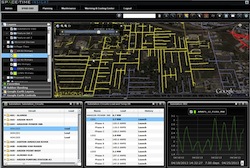 The situational intelligence solution was implemented as part of SMUD’s Situational Awareness and Visual Intelligence (SAVI) initiative which is designed to improve the speed and quality of data analysis and decision-making throughout the organization’s Grid Planning and Operations department and partially funded by a federal smart grid grant awarded by the Department of Energy (DOE).
SMUD is the nation’s sixth-largest community-owned electric utility, serving a population of 1.4 million across 900 square miles. For years, the company has relied on paper maps—including a 100 x 25 ft. wall map – and the experience and knowledge of its personnel to manage the electric grid.
But according to Space-Time Insight, the recent adoption of smart grid devices generated an exponential increase in the volume of data, making manual operations infeasible and creating opportunities for real-time insight into grid performance. Now, the Space-Time Insight system quickly synthesizes numerous streams of disparate data and provides on-the-fly assessments of grid and asset health, weather, wind and fire conditions, and power supply and demand among other features.The system helps managers and operators respond more quickly to outages, rapidly develop switching plans, and make more-informed decisions regarding equipment maintenance and investments.
“The volume of data generated by our smart assets made it clear that we had to continue to innovate to improve the reliability and safety of service to our customers,” said Paul Lau, Assistant General Manager, Power Supply and Grid Operations at SMUD. “With common operational views, personnel across our organization can now implement more cost-effective asset planning and maintenance practices, collaborate as one team to respond rapidly to emergency situations and outages, and more readily understand the real-time impact of weather and fires on our daily operations.”Read More