
 Frost & Sullivan has recognized Compagnie Industrielle de la Matiere Vegetale (CIMV) with Frost & Sullivan’s 2013 French Visionary Innovation Award. CIMV’s extensive research to find a viable substitute for petroleum has led to a biorefinery concept that focuses on second-generation biofuels and chemicals. These types of biofuels use only plant residuals (straws, forest residues, wood, miscanthus, and switch grass) and not the plant itself.
- BASF and Renmatix Inc. will jointly scale up the Renmatix Plantrose process for the production of industrial sugars based on lignocellulosic biomass. The two companies signed a non-exclusive joint development agreement. The collaboration follows BASF’s $30-million investment in Renmatix in January 2012. The Plantrose technology developed by Renmatix enables industrial sugar to be produced, at competitive costs, from a variety of non-edible biomass (lignocellulose) sources. The proprietary process breaks down lignocellulosic sources (e.g. wood, agricultural-residues or straw) into industrial sugars using supercritical water (water at high temperature and pressure).
- American Capital Energy & Infrastructure announced today that it has partnered with American Capital to create BMR Energy LLC (“BMR”), a new energy company focused on developing and investing in power and related energy infrastructure throughout Central America and the Caribbean. BMR’s first project is a 34 MW wind farm in Malvern, St. Elizabeth Parish, Jamaica. In September 2013, the Office of Utility Regulation in Jamaica selected BMR to build, own, and operate the wind project, which is expected to be operational in 2015.
- Lignol Energy Corporation, a technology company in the advanced biofuels and renewable chemicals sectors, announced that further to its press releases dated September 30, 2013 and November 6, 2013, it has completed a A$1,488,000 subscription for secured convertible notes in Territory Biofuels Limited.

GTL & QTI Partner to Develop NextGen FracTM
GTL Resources USA, Inc. (GTL), owner of Illinois River Energy, LLC (IRE), and Quality Technology International, Inc. (QTI), through its subsidiary, QTI-AMG LLC, have formed a partnership to collaborate on a new, transformative hybrid fractionation technology for corn, dubbed “NextGen FracTM”. According to the companies, this technology solves the serious starch loss and co-product purity problems of current standalone dry fractionation technologies without the complexity and cost of whole kernel wet milling, potentially a major financial boon for corn ethanol manufacturing.
 “We believe that the NextGen FracTM process will be a game-changer in the corn bio-refining space by substantially improving co-product values, reducing ethanol production costs, and opening-up the potential in corn bio-refining to produce next generation biochemicals and biofuels from differentiated corn fractions,” said Richard Ruebe, Group CEO of GTL and IRE.
In dry grind corn bio-refineries retrofitted with the NextGen FracTM process, the kernels are dry fractionated into separate endosperm, germ and bran fractions. The endosperm fraction goes directly into fermentation while the germ and bran fractions are separately wet milled to recover bound starch for fermentation, consequently purifying the germ fraction for food-grade corn oil recovery and the bran fraction for ruminant feed or potential use in biochemical or cellulosic ethanol production.
“This technology addresses the dilemma of producing either high quality food or transportation fuel by producing both, economically,” noted Dan Hammes, President of QTI. “We look forward to a successful collaboration with GTL to demonstrate our technology and to provide the human food and animal feed markets with demonstrably superior co-products.”
According to the partners: a retrofit of traditional dry grind corn biorefineries that produce ethanol and distillers grains to NextGen FracTM has several major advantages:Read More
Ecotech Institute Reveals Top Green Jobs for 2014
Green jobs are on the rise and 2014 is slated to be a great year for growth in the sustainable energy sector, according to Ecotech Institute. The Ecotech Institute Clean Jobs Index measures the reality of green jobs and other sustainability factors across the United States. The Index’s latest data reveals a bright outlook in 2014 for cleantech leaders, educators, political leaders, students and job seekers.
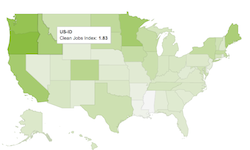 Within about the last 30 days, more than 72,000 green job positions with hundreds of job titles were available across the country correlating with trends seen all year. For example, the solar industry had almost 500 job listings since November 5, 2013-December 6, 2013 ranging from Installation Technicians to Sales Representatives and everything in between.
Jobs classified under the broad renewable energy umbrella had approximately 21,000 job listings offered in the last 30 days. This data includes many renewable energy sources with positions in the following areas: Energy Efficiency: 6,600; Electrical Engineering: more than 23,000; Power Utility: 744; and Facility Management: more than 6,470.
So what are Ecotech’s Sustainable Energy Job Predictions for 2014? Based on the last 30 days:
- Solar had just under 500 job listings: That trend will continue in 2014 as both commercial and residential solar development increases.
- Wind had less than 100 job listings: However, requests for wind resumes has been very high and we predict those numbers will increase in 2014.
- Energy Efficiency had about 6600 job listings: These include everything from medical jobs, to energy auditing, and many, many jobs in between. Most companies include energy efficiency in their job descriptions.
- Electrical Engineering jobs included over 23,000 listings: The largest demand is for fluid and control Field Service Technicians, a category that is exploding and will continue to be in high demand for 2014.
- Power Utility job listing were 744: With an aging workforce, the power utility industry will continue to have high job growth.
- Facility Management had over 6400 jobs listed: As companies look for energy savings, this area will have significant growth in 2014.
Ag, Biofuel Industries Dealt a Blow From EPA
The agriculture and biofuel industry has been dealt a blow according to Adam Nielsen, director of legislation and policy development for the Illinois Farm Bureau. Nielsen, who spends a significant amount of time promoting the agricultural industry in Washington, D.C., said the Environmental Protection Agency’s (EPA) proposed 2014 reduction of the amount of corn ethanol blended as part of the Renewable Fuel Standard (RFS) is of great concern.
 Nielsen expressed his concern to Representative Cheri Bustos (D-IL) during her recent visit to Patriot Renewable Fuels located in Annawan, Illinois. As Nielsen aptly points out, agriculture is the number one industry in the state of Illinois.
“We’re hoping to see an upward revision,” said Nielsen, “and we’re going to try to activate our members over the next couple of months and try to get as many comments as we can into the Federal Register.” He stressed that his organization is going to participate in as many forums and areas they can to try to get the proposed rule changed.
“It’s a blow to the renewable fuels industry and a blow to agriculture. There are so many things attached to the Renewable Fuel Standard,” explained Nielsen. “It’s been so significant in recent years that we need to do whatever we can to protect it.”
As a policy Nielsen said the RFS has done a lot to improve the lives of those in the agriculture industry and especially in the area around Patriot Renewable Fuels. He noted that biofuels and agriculture are completely intertwined. “It’s provided a market where there wasn’t one prior to the Renewable Fuels Standard,” he said.
“It is so intertwined right now that any time you make decisions like this it’s going to have wide ramifications. So that’s the message we need to get through to the U.S. EPA in the next couple of months,” added Nielsen.
Listen to my interview with Adam Nielsen here where he discusses both the RFS as well as the need for a Farm Bill and how the two bills are intertwined: Ag, Biofuel Industries Dealt a Blow from EPA
Check out the Patriot Renewable Fuels photo album.
Renewable Fuels Topic at Senate Primary Forum
 On the sixth anniversary of the signing of the expanded federal Renewable Fuel Standard (RFS2) into law, the Iowa Renewable Fuels Association (IRFA) hosted a renewable fuels forum for Iowa’s leading Republican candidates seeking the GOP nomination to run for U.S. Senate in 2014. The seat is currently held by U.S. Senator Tom Harkin who is retiring after this term.
Forum Moderator and IRFA President Rick Schwarck began the event by stating, “The goal of the [RFS] is to reduce petroleum imports, enhance consumer fueling choices at the pump, boost the rural economy, and reduce the environmental impacts of petroleum-based fuels.” Schwarck then asked both candidates, “If elected to the U.S. Senate, would you support maintaining the federal Renewable Fuel Standard (RFS) with no legislative changes?”
The legislation has spurred the growth of the biofuel industry and helped to reduce the use of foreign oil but is the industry in is jeopardy with the Environmental Protection Agency’s current proposed renewable fuel volumes under the 2014 RFS. For the first time in six years, volumes are proposed to decrease rather than increase as the statute stipulates.
The forum was held at the Western Iowa Tech Community College Cherokee Campus Auditorium. State Senator Joni Ernst, Matt Whitaker and David Young were also invited to participate in the forum, but all three candidates declined the opportunity.
E15 Arrives in Fort Dodge, Iowa
 E15, a blend of 15 percent ethanol and 85 percent ethanol, has arrived in Fort Dodge, Iowa. STAR Energy is the 14th E15 retailer in the state, offering the blend to drivers of cars manufactured in 2001 or later. STAR Energy also offers E20, E30, E85 and biodiesel.
“Fort Dodge-area residents are now able to benefit from E15, the lowest-cost fuel for most vehicles on the road today,” stated STAR Energy Manager of Retail Fuels Marketing and Business Development Jason Stauffer. “For motorists driving a 2001 or newer vehicle, E15 gives them another affordable renewable fuel option with the added benefit of higher octane.”
“The addition of STAR Energy in Fort Dodge grows Iowa’s list of registered E15 retailers to 14,” noted Iowa Renewable Fuels Association Managing Director Lucy Norton. “While Big Oil claims a reduction in federal Renewable Fuel Standard (RFS) levels is needed due to the imaginary blend wall, retailers in Iowa continue to successfully crumble this fictitious barrier.”
STAR Energy is located at 2 North 27th Street in Fort Dodge, Iowa.
Ethanol Celebrates Six Years of RFS
 Six years ago today, President George W. Bush signed into law the Energy Independence and Security Act of 2007 (EISA), which greatly expanded Renewable Fuel Standard (RFS) to become the RFS2. The goals of the new standard were to reduce our dependence on oil, confront global climate change, and expand production of renewable fuels for the security of future generations.
 “Just six years later, tremendous progress has been made toward achieving the original objectives of the expanded RFS,” said Renewable Fuels Association (RFA) president and CEO Bob Dinneen today in a conference call marking the anniversary. “Renewable fuel production and consumption has grown dramatically. Dependence on petroleum—particularly imports of refined products—is down significantly. Greenhouse gas emissions from the transportation sector have fallen. The value of agricultural products is up appreciably. And communities across the country have benefited from the job creation, increased tax revenue, and heightened household income that stems from the construction and operation of a biorefinery.”
RFA has released a report that compares today to six years ago in several areas, including renewable fuels production, economic activity, agricultural impacts, environmental issues, fuel prices, import dependence, and food prices. RFA Vice President of Research and Analysis Geoff Cooper outlined the findings during the conference call, concluding that “The RFS has indeed lived up to its promise in building out a renewable fuels industry, in reducing dependence on imported petroleum, in stimulating the agricultural economy – and at the same time the RFS has simply not had the impacts on the environment and food markets that detractors of the program have claimed.”
Among the more interesting points is the price of corn, a mere 20 cent difference from $4.20 season average in 2006 compared to $4.40 this year. Meanwhile, the price for a barrel of oil is up nearly 50% – up to over $108 compared to $72 in 2007.
Listen to or download opening comments and reporter questions below: RFA Celebrates Six Years of RFS RFA RFS anniversary call QandA
IL Sen. Todd Sieben “Retired To” Working for Ethanol

Left to right: Adam Nielsen, Illinois Farm Bureau and former IL State Senator Todd Sieben
A good friend once told Todd Sieben, Chairman Central Bank and retired state senator, that when you get ready to retire, don’t retire from something, but retire to something. After 21 years as a state legislator, Sieben did just that and he “retired to” working on projects in his local community including helping to bring the idea of Patriot Renewable Fuels to reality.
Sieben is currently working with the Illinois General Assembly on passing legislation that would incentivize the use of E15 in Illinois. He explained that for many years there has been a sales tax incentive for E10 that enables consumers to purchase the biofuel at a lower cost. Now, says Sieben, they would like to see that tax incentive shifted to E15 and use some of the funds to help retailers build the infrastructure, such as blender pumps, needed to offer consumers E15.
In addition to this work, he is also working with Patriot to get their story out to consumers so they have a better understanding of the positive benefits of ethanol. Sieben noted that there are two stories. One is the local story focused on the economic benefits – the benefits they provide to the local producer. The second is the national story.
 “There is a need to tell a national story to go up against the false claims that are made by Big Oil companies or the food industry that talks about the negative things they believe in an effort to hurt the industry,” said Sieben. “So we’ve got to talk about the value of ethanol or our economy. The value of ethanol to our environment. The value of ethanol in improving our national security by reducing our dependence on foreign oil. That’s the national picture – the big picture.”
He said that Patriot is now getting the message out in social media (Twitter, Facebook, website, etc.) and encourages other ethanol plants and biofuel plants and companies to do the same.
When asked how biofuels affects every single person in the country, he answered the number one positive effect is clean air. He said the second benefit is bringing the price of fuel down at the pump.
Sieben stressed, “We need everyone to step up and listen to this message and stand up for our agricultural industry. To stand up for corn. To stand up for ethanol. We need people to speak up and speak out.”
Listen to my interview with Todd Sieben here: IL State Sen. Todd Sieben 'Retired To' Working for Ethanol
Check out the Patriot Renewable Fuels photo album.
Largest Solar Plant in Texas Online
What is believed to be the largest solar farm in Texas has gone online in San Antonio. The 41MW Alamo I solar farm, comprised of more than 167,000 solar panels expanding 450 acres, is the first phase of the 400MW development. When completed, the state is expected to be one of the top solar producing states in the U.S. Alamo I will generate energy for 6,600 homes powered by CPS Energy.
“By 2020, 65 percent of our community’s electricity will come from resources that are low- or no-carbon emitting — reducing emissions in an amount that’s equal to removing more than  a million cars from local roads,” said CPS Energy CEO Doyle Beneby. “Reducing pollutants in the air we breathe is a no-brainer, and we’ve been pleased to partner with OCI Solar Power in our efforts to make that happen.”
The project partners say the project resulted in the largest economic development agreement between a municipal utility and private company. The partnership will bring manufacturing, 800 permanent jobs and an annual economic impact of $700 million to Texas. To date, the partnership is responsible for creating more than 150 permanent jobs and 600 temporary construction jobs in the area and the project has had the opportunity to hire several veterans.
“Alamo I is an interesting milestone because it’s now the largest solar farm in Texas, but it’s still a small part of what is to come,” said OCI Solar Power President and CEO Tony Dorazio. “Alamo I is only step one to Texas’ rise as a big player in solar.”
San Antonio Mayor Julian Castro added, “San Antonio is fast becoming a leader in the New Energy Economy by combining economic development with environmentally sound practices. This solar farm expands our clean energy portfolio while adding hundreds of 21st century manufacturing jobs to the local economy.”
Another solar project, Alamo II, will bring an additional 4.4MW to San Antonio upon completion in early 2014.
Sullivan Solar Power Using Glass
 Right after receiving my Glass I got a news alert from Sullivan Solar Power about their unique use of this new technology. What timing!
So I got in touch with Michael Chagala, Director of IT, and we talked about how they’re employing Glass in their field operations. In the photo Michael is “wearing.”
Sullivan Solar Power developed their own app for Glass and now places a set of Glass on the head of their field service technicians. This means that when the technicians go out to service a client they can basically carry all the data and information on all their products via Glass going hands free which means a lot for efficiency and safety, especially when you’re climbing ladders and working on a roof. Additionally, they can stream live video back to headquarters when they need to to share and get opinions and feedback from other technical support. It’s a fascinating step forward for a technology that some folks have at first made fun of but are now finding has many applications to businesses.
Listen to my interview with Michael to learn more: Sullivan Solar Power & Glass