A study done by researchers at the University of Illinois’ College of Agricultural, Consumer, and Environmental Sciences, has found that several factors will lower the need for land used to produced corn-based ethanol to as little as 11 percent of the corn acres by 2026 when adhering to the U.S. Environmental Protection Agency’s 15 billion gallon ceiling on domestic ethanol production.
The researchers note that a too common error made in reporting land used for domestic 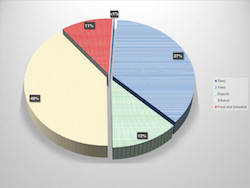 production is to measure the amount of grain shipped to ethanol manufacturers, compute the number of acres required to produce the grain and then end the analysis. However, the researchers say this is a gross oversimplification that leads to incorrectly concluding that 40 percent or more of U.S. corn acres are used for ethanol production. The real number, according to the research team is less than 25%. The reason is that most studies don’t account for the grain being used as high-value animal feed (distillers grains or DDGs).
The new study, conducted by Professors Rita H. Mumm, Peter D. Goldsmith, Kent D. Rausch and Hans H. Stein, explores the impact of technological improvements on corn grain production, ethanol production, and their interrelated effect on land use through a variety of scenarios over a 15 year period beginning in 2011, the year used to establish the base case. The researchers found that land area attributed to corn ethanol will consistently drop because plant breeding improvements and new technologies will result in significantly higher yields.
In addition, over the next decade, corn yields will improve significantly which will greatly reduce land use attributed to ethanol manufacturing. On the higher end of the spectrum, the study finds yields will increase by almost 100 bushels per acre, which represents 66 percent growth. The majority of this contribution will come from conventional breeding, with advanced breeding technology, biotechnology and agronomic improvements together contributing almost half.
“It’s no surprise to the agriculture industry that yield improvements will drive down land used for ethanol,” said Dr. Rita Mumm, coauthor of the study. “However, the mechanisms within the production complex, especially their effects on one another, were not fully understood. This work provides a clear picture on current land use and provides an approach for evaluating future land use.”Read More