Corn Growers Fight AAA Stance on Ethanol

Cindy Zimmerman

aaa-cancelThe Missouri Corn Growers Association (MCGA) is fighting back at AAA for disparaging the state’s recent action allowing the retail sale of 15% ethanol blended gasoline (E15).

MCGA CEO Gary Marshall took AAA to task in a letter to the organization’s president and canceled his longtime membership following public statements misrepresenting the benefits of E15. A St. Louis Post Dispatch article following approval of E15 sales in Missouri quoted AAA as saying that “90 percent of the cars on the road are not approved by automakers to use the fuel. That could void warranties and cause engine damage.” That quote is from a November 2013 statement by AAA president Roger Darbelnet.

In his letter to Darbelnet, Marshall corrected that statement with the facts.

Approximately 80 percent of the vehicles on the road today are 2001 or newer and approved by the EPA to use the ethanol blend. Add to that, more than 60 percent of 2014 vehicles sold this year will be explicitly warranted and approved by the manufacturer to operate on E15. In terms of possible engine damage, E15 is sold in 12 other states with no issues reported. We are unaware of AAA’s Roadside Assistance program picking up a single driver stranded alongside the road due to an engine issue caused by E15.

Marshall informed Darbelnet that he is canceling his 33-year AAA membership because he refuses “to support an organization so clearly aligned with the oil industry.”


corn, E15, Ethanol, Ethanol News

Airline Industry Looks to Renewable Diesel

John Davis

alaska-air-boeing1In an effort to become more green in the blue skies, the airline industry could turn to renewable diesel. This article in The Motley Fool says as the industry looks to lower its share of greenhouse gas emissions … about 2 percent of all greenhouse gas emissions currently comes from jet airliners … a more sustainable source of jet fuel is being sought.

Enter Boeing (NYSE: BA ) , which has been pushing global regulators to approve renewable diesel as a suitable blendstock for Jet A. While you may think the costs of renewable diesel would prohibit its use, the more sustainable fuel is actually cost-competitive with the petroleum-based incumbent with government incentives. The message appears to have gotten through: The global body responsible for approving and evaluating the specifications of new fuels is expected give the green light sometime in 2014. That could be a big development for the long-term success of the farnesene-based jet fuel being commercialized by synthetic biology pioneer Amyris (NASDAQ: AMRS ) and global energy powerhouse Total (NYSE: TOT ) , which is quickly moving through the approval process itself.

There are quite a few angles to digest, including sustainability features, costs of production, and selling prices. What are the opportunities for each company, and what roles will each play in making the global aviation industry more sustainable?

While renewable diesel does face some challenges, such as being cost competitive on its own and meeting international certification standards, the article does point out that it puts out half the carbon dioxide of fossil fuels over its life cycle and greatly reduces emissions of particulate matter and nitrogen oxide compounds, even at the lower 10 percent blends.

Biodiesel

Roads Could be Electrifying in Sweden

John Davis

volvoelectricbus1While the Swedish are known for some electrifying engines under the hoods of their reliable cars, the country’s most famous carmaker might be looking to electrify the roads, too… literally! This news release from the Volvo Group says the company, in cooperation with the Swedish Transport Administration, is studying the the potential for building electric roads that charge city buses while driving down the road.

“Vehicles capable of being charged directly from the road during operation could become the next pioneering step in the development towards reduced environmental impact, and this is fully in line with our vision of becoming the world leader in sustainable transport solutions. Close cooperation between society and industry is needed for such a development to be possible and we look forward to investigating the possibilities together with the City of Gothenburg,” says Niklas Gustavsson, Executive Vice President, Corporate Sustainability & Public Affairs of the Volvo Group.

With the use of an electric road, vehicle batteries would continuously be charged wirelessly during operation by transferring energy from the electricity grid to a vehicle, instead of charging the bus while it is standing still at charging stations. The technology being studied is called inductive charging, whereby the energy is transferred wirelessly to the underside of the vehicle by equipment built into the road.

A 300- to 500-meter electric road might be built for test operations in central Gothenburg in 2015.

Volvo has already been offering hybrid buses with traditional diesel engines, supplemented by an electrical engine to reduce CO2 emissions.

Electric Vehicles, International

Using Ethanol from Glycerol for Biodiesel

John Davis

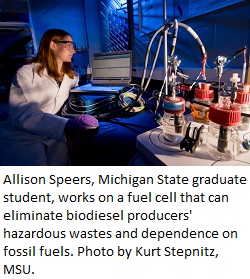
allison-speers1A new process that eliminates fossil fuels completely from the biodiesel equation could make the green fuel even more sustainable. Michigan State University reports Gemma Reguera, MSU microbiologist, has found a way that uses microbes to glean ethanol from glycerol and then use that green fuel to replace methanol to help brew the biodiesel.

“With a saturated glycerol market, traditional approaches see producers pay hefty fees to have toxic wastewater hauled off to treatment plants,” she said. “By cleaning the water with microbes on-site, we’ve come up with a way to allow producers to generate bioethanol, which replaces petrochemical methanol. At the same time, they are taking care of their hazardous waste problem.”

The results, which appear in the journal Environmental Science and Technology, show that the key to Reguera’s platform is her patented adaptive-engineered bacteria – Geobacter sulfurreducens.

Geobacter are naturally occurring microbes that have proved promising in cleaning up nuclear waste as well in improving other biofuel processes. Much of Reguera’s research with these bacteria focuses on engineering their conductive pili or nanowires. These hair-like appendages are the managers of electrical activity during a cleanup and biofuel production.

This promising process is already catching the attention of economic developers, who are working with a Michigan Translational Research and Commercialization grant to scale up the effort.

Biodiesel, Ethanol, Ethanol News, Research

Ethanol Stocks Down Despite Production Uptick

John Davis

eiaStocks of ethanol in the U.S. are down, despite increased production of the green fuel. This story in Platts says ethanol stocks on May 16 were down 312,000 barrels to a four-week low of 16.99 million barrels. This unexpected drop comes as production actually rose by 3,000 b/d to 925,000 b/d, according to U.S. Energy Information Administration information.

In immediate reaction to the data, US ethanol prices turned sharply bullish, with values adding 5-10 cents/gal in prompt markets, sources said.

The four-week rolling average of gasoline demand rose 186,000 b/d to a seven-month high of 8.944 million b/d, and the four-week rolling average of the refiner and blender net ethanol input rose 9,000 b/d to 872,000 b/d. The weekly refiner and blender net ethanol input, however, nudged down 4,000 b/d to 886,000 b/d.

US ethanol stocks fell in all but one region. East Coast ethanol stocks moved down 23,000 barrels to 6.354 million barrels, ending an eight-week rise after hitting a 10-month high the previous week.

Gulf Coast stocks fell 181,000 barrels to 2.789 million barrels, and West Coast stocks declined 140,000 barrels to 1.81 million barrels. Rocky Mountain stocks were 14,000 barrels lower at 288,000 barrels.

Midwest stocks, on the other hand, rose 46,000 barrels to 5.749 million barrels, rebounding from a five-month low.

Net ethanol input is just shy of the so-called 10 percent “blend wall” making up 9.75 percent of total gasoline and ethanol supplies.

Ethanol, Ethanol News

Researchers Look to Find Motivations Behind Solar

John Davis

KiranResearchers are trying to figure what motivates which consumers to buy solar equipment. This article from Sandia National Laboratories in California says they’re trying to better understand what persuades people to buy photovoltaic (PV) systems for their homes in hopes of increasing the amount of solar energy in the electricity market from its current share of less than .05 percent to at least 14 percent by 2030.

“If we can develop effective and accurate predictive models, we can help identify policy variables that could increase purchases of residential PV systems and ultimately help advance the mission of the SunShot Initiative,” said Kiran Lakkaraju, Sandia’s project lead. Specifically, he said, an effective model of solar purchase dynamics can be used to predict and even influence consumer purchasing decisions.

The modeling project, part of the Solar Energy Evolution and Diffusion Studies (SEEDS) program, is one of many activities in the Energy Department’s SunShot Initiative, which seeks to make solar energy cost-competitive with other forms of electricity. SEEDS projects are designed to investigate methods for transforming the operations of solar researchers, manufacturers, developers, installers and policymakers.

Meanwhile, another group of researchers at Sandia are using computer models to predict homeowners’ likelihood to buy and invest in PV systems. A group of 1,000 respondents who have bought PV systems and another 1,000 who have not are being surveyed about their choices with those results being examined by quantitative modeling experts and fed into modeling tools. Other research is looking at how messaging about solar can influence consumer demand.

Research, Solar

Fuels America Campaign Reminds Drivers of Savings

John Davis

fuels-americaJust as a good-sized portion of the country is hitting the road for Memorial Day weekend, Fuels America launches an ad campaign to remind drivers just how much they are saving at the pump, thanks to ethanol and biodiesel. The coalition of groups committed to protecting the Renewable Fuel Standard (RFS) and promoting alternative fuels is airing the campaign on Washington, D.C.’s WTOP Radio and on gas pump monitors in the D.C. area.

The advertisement playing on gas station monitors, conveniently positioned to highlight the gas prices consumers are paying just as the advertisement is playing, points out that “supporting clean energy production here in America is better for the environment, is better for your wallet, and because biofuel is higher octane, it’s actually even better for your engine.” The ad also celebrates the benefits that the RFS is already delivering to American consumers: “Thanks to America’s Renewable Fuel Standard, homegrown biofuels are cheaper than gasoline, saving you money every time you fill up… Tell President Obama: Support America’s Renewable Fuel Standard.”

“If you’re like a lot of folks, you’re probably getting ready to hit the road. And that means the oil companies are getting ready to hit you – because when you pay more, they make more,” says the WTOP spot. “So it’s no surprise Big Oil is fighting to eliminate something called the Renewable Fuel Standard, so they can lower the amount of renewable fuels in the gas supply.” The WTOP ad closes by observing that “Memorial Day is a great American Tradition,” while “getting hosed by Big Oil isn’t.”

Fuels America launched the robust inside-the-beltway advertising campaign this week and is encouraging Americans to ask the Obama Administration to protect the RFS.

Biodiesel, Ethanol, Ethanol News, Fuels America

What Features of MyNewHolland.com Do You Like

Jamie Johansen

New Holland ZimmPollOur latest ZimmPoll asked the question, “What is the best way to market to millennials? “

I think we all could have guessed that marketing online to millennials is used most often. Digital forms of media are easily in our grasp with smartphones, tablets and computers. However, I was surprised that radio beat TV.

Our poll results:

  • Online – 52%
  • Print – 7%
  • Television – 11%
  • Radio – 16%
  • Other – 14%

Our new ZimmPoll is now live and asks the question, “What features of MyNewHolland.com do you like?”

On April 22 New Holland North America launched MyNewHolland.com, an online destination for all things New Holland and open to all farmers. Current features include the ability to create an inventory of your equipment, a section on Precision Land Management, a Configurator tool to let you design your own configuration of new equipment you’d like to order, a topical discussion on ethanol which you are invited to read and comment on and more. More features will be rolled out in the future as the community grows. As the sponsor of our weekly ZimmPoll we’d like to get your feedback for New Holland on their newest announcement.

ZimmPoll

Ethanol Conference Themed Power by People

Cindy Zimmerman

ace-14-themeRegistration is now open for the American Coalition for Ethanol (ACE) 27th annual Ethanol Conference scheduled for August 4-6 in Minneapolis, Minnesota.

The theme of the event is “Power by People” and the agenda includes sessions on new innovations in the ethanol industry, the octane and high performance potential of ethanol, overseas opportunities for ethanol producers, rail regulations and possible long-term improvements of the domestic rail system, and much more. A Retailer Roundtable entitled “Power to the People” focusing on the sale and marketing of higher ethanol blends will also be featured.

Domestic Fuel will be covering the conference, thanks to the generous support of ACE and Patriot Renewable Fuels, so please be sure to join us. This conference is more important than ever before to the ethanol industry. Find out more and register today.

ACE, ACE Ethanol Conference, Ethanol, Ethanol News

Maryland Gov Vetoes Wind Turbine Moratorium

John Davis

omalleyA moratorium that would have stopped construction of wind turbines for more than a year near a U.S. military base in Maryland has been vetoed by that state’s governor. This article from the Star Democrat says Gov. Martin O’Malley vetoed the 13-month wind turbine moratorium that would have kept the structures from being put up within 56 miles of the U.S. Naval Air Station Patuxent River,calling the bill unnecessary and a chilling message to renewable energy developers.

The bill would have delayed construction on wind turbines to wait for a study on how they could affect radar use around the base. Supporters of the bill argued it was important to consider needs of the base, a big economic engine in southern Maryland. But opponents contended it sent a bad message to businesses and harms wind farm development in Maryland.

“There are already safeguards in place to ensure that no renewable energy projects conflict with military facilities — those safeguards render this bill unnecessary,” O’Malley said in a statement.

Opponents of the bill said it would have threatened development of a wind farm in Somerset County due to expiring federal tax credits.

The governor explained that the bill would have killed a $200 million investment in the county and said it was unfair because the developers had invested millions of dollars and played by every regulatory rule.

“If this moratorium were to take effect, it would send a chilling message to clean energy investors, developers, manufacturers, construction firms, engineers and sustainable businesses that the state can change the rules at the eleventh hour,” O’Malley wrote.

Wind