
 Amyris has announced a multi-year, Technology Investment Agreement (TIA) worth up to $35 million with the Defense Advanced Research Projects Agency’s (DARPA) Biological Technologies Office to create new research and development tools and technologies that will significantly reduce the time and cost of bringing new molecules to market. Amyris has chosen five specialized subcontractors to assist in achieving these innovations.
- The Association of Cleantech Incubators of New England (ACTION) has announced that the law firm of Posternak Blankstein & Lund LLP is a new Network Sponsor. ACTION’s mission is to accelerate the success of early-stage cleantech entrepreneurs supported by its membership of 12 cleantech incubators throughout New England and three international incubators located in the United Kingdom, Italy, and Canada.
- Ricardo will be a key partner in the European Commission’s Horizon 2020 Green Vehicle Initiative project ‘HDGAS’ – a project that aims to develop, demonstrate and optimize advanced powertrain concepts for dual-fuel and pure natural gas powered heavy duty vehicles. Particular areas of focus for the company will be the development of engine and aftertreatment systems that offer the prospect of delivering real driving emissions well below Euro VI limits for heavy duty vehicles.
- The 5th Solar Integration Workshop will take place in Brussels October 19-20, 2015. The spectrum of topics ranges from Photovoltaic (PV) power plants to Concentrated Solar Power (CSP) and from the integration of solar power in distribution networks to questions of supply security. Flexibility from conventional generators, insolation forecasts and grid code issues will also be intensively discussed.

Partnership Fosters Algae and Biodiesel Growth
 Michigan State University (MSU) and algae company PHYCO2 are developing algae technologies that cut greenhouse emissions and could eventually lead to more biodiesel. This article from MSU says PHYCO2’s revolutionary and patented concept promotes algae growth and sequesters, or captures, carbon dioxide from power plant emissions.
Under the collaborative research agreement, MSU and PHYCO2 – an algae growth and carbon dioxide sequestration company based in Santa Maria, California – will investigate the performance of PHYCO2’s algae growth and carbon dioxide absorption technology, as well as algae-processing technologies.
PHYCO2 will be testing its algae photo bioreactor, technology that continuously captures significant amounts of CO2 and grows algae with LED light, at MSU’s T.B. Simon Power Plant. MSU and PHYCO2 expect to be able to absorb up to 80 percent of captured CO2 emissions for the production of algae. MSU will be testing the growth of several algae strains and post processing of the algae that is grown.
The project’s goals are to cost-effectively grow algae while significantly absorbing CO2 for sequestration from the gas emissions at the power plant. The algae can then be sold into current markets for biofuels, bioplastics and other applications.
“MSU has always been on the forefront of cutting-edge research and development,” said Robert Ellerhorst, director of utilities at the MSU power plant. “Our collaborative work with developers fits MSU’s research agenda to solve the world’s problems – in this case, reducing greenhouse gas emissions.”
“We are confident that this partnership between MSU and PHYCO2 will meet and exceed the challenge issued by the White House,” said PHYCO2 CEO Bill Clary. “The PHYCO2 photobioreactor represents the future of cleaner emissions and the first CO2 capture technology that truly is market sustainable.”
VW’s Diesel Scandal Could Hurt Biodiesel
 A growing scandal that Volkswagen created software to let its diesel vehicles cheat some environmental tests could have implications for the even greener fuel biodiesel. This story from CBS News says VW cheating on diesel with possibly as many as 11 million vehicles doesn’t help the fuel’s greener cousin.
“It’s a shame when someone tries to cheat this test because it’s an important yardstick for us to make sure the car will provide cleaner driving,” [Andre Boehman, professor of mechanical engineering at University of Michigan and a self-described diesel-vehicle fan] said. “It would make me a little more careful in my shopping for which vehicle to purchase, although it may be hard for a consumer to know if vehicles are operating the way” the automaker states it should be.
For some diesel enthusiasts, the idea of driving a car that’s easier on the environment — diesel-engine fuel efficiency can be as much as 30 percent higher than gas-powered cars, and diesel cars can also use biodiesel fuel — is the main draw. The cars were not only billed as virtuous to drive, since they consume less fuel than gas-powered cars, but fun, too…
Current owners of Volkswagen diesel vehicles are feeling burned, with some saying that they bought their cars for their fuel efficiency and minimal impact on the environment, which now appears to be a lie.
“I am very disappointed that VW willfully decided to lie not only to the government, but to its customers,” one car owner wrote on Volkswagen’s Facebook page. “Many of us have been fans of the brand through thick and thin for entire lifetimes. I currently own two diesels and I feel betrayed and cheated.”
Meanwhile, Volkswagen is trying to regain that trust and issued the following statement:
Volkswagen does not tolerate any kind of violation of laws whatsoever. It is and remains the top priority of the Board of Management to win back lost trust and to avert damage to our customers. The Group will inform the public on the further progress of the investigations constantly and transparently.
Novozymes Launches Liquozyme LpH for Ethanol
 Novozymes has launched a new enzyme for ethanol producers who want to reduce their use of chemicals without sacrificing yield. Liquozyme LpH is an alpha-amylase effective at low pH that thins the mash by breaking down starch into shorter dextrin chains. A more fluid mash ensures more efficient operational performance for ethanol producers running their production at low pH. According to Novozymes, plant trials have shown improved viscosity levels and liquefaction, enabling customers to reduce their use of chemicals for pH adjustment.
“We were really pleased by our recent trials,” said Peter Halling, vice president for biofuels at Novozymes. “Ethanol producers can reduce dosing of both ammonia and sulphuric acid during the cook process. This saves costs and ensures a safer working environment.
Liquozyme LpH is the latest addition to Novozymes’ range of enzyme products for the ethanol industry, and there is more to come.
“Novozymes will continue to develop new technology for the ethanol industry,” Halling added. “We will expand our portfolio further towards the end of the year with significant new innovation.”
New Forest Waste-to-Energy Tech Debuts
G4 Insights has debuted a new technology to convert forest waste into renewable natural gas in Auburn, California. The process converts scraps and small trees from forest thinning projects into biomethane. In it first demonstration, G4 used gas produced onsite to fuel an unmodified Placer County truck.
 “G4 is pleased to have the opportunity to partner with Placer County, California Energy Commission, Southern California Gas Company, and U.S. Endowment for Forestry and Communities to make this project a great success,” said G4 Principal Matt Babicki. “This project demonstrates the potential for G4 PyroCatalytic Hydrogenation technology to transform forestry waste into high value, low carbon fuel, and support forestry communities with long term jobs to collect biomass and operate G4 renewable natural gas plants.”
Typically, forestry waste is burned where trees are felled to reduce wildfire hazards, increasing local air pollution. Converting the forestry residues it into natural gas instead would reduce air pollution and increase the supply renewable energy. In the Foresthill area of Placer County alone, there are an estimated 20,640 tons of forestry waste produced each year – enough to fuel 4,926 cars for a year. A single ton of forestry waste could produce enough natural gas to drive from Lake Tahoe to Anchorage, Alaska. In the United States, there is enough current available and sustainable tree thinning and forestry industry waste to fuel more than 40,000 natural gas fleets the size of Placer County’s.
“Forest waste is one of the largest sources of potential waste resources for biofuels and bioenergy in California,” said California Energy Commissioner Janea A. Scott. “Bringing more technologies like the G-4 Insight technology, which can sustainably convert waste materials from forest restoration activities into low carbon transportation fuels online, would be a significant achievement.”
The G4 technology uses raw, untreated forestry waste that otherwise has no commercial use. Competing technologies require clean wood chips, stripped of bark, from harvested trees that could be used for other purposes. The gas it produces is of the same quality as conventional gas, and can be used for any of its purposes. G4 says the natural gas gthey produce using this technology reduces fossil emissions by 86 percent compared to standard gasoline.
BioEnergy Bytes
- Lumenpulse Inc., a leading manufacturer of high performance, specification-grade LED lighting solutions, announced today that S&P Dow Jones Canadian Index Services has added Lumenpulse to the S&P/TSX Renewable Energy and Clean Technology Index. The Index measures the performance of companies listed on the TSX whose core business is the development of green technologies and sustainable infrastructure solutions.
- TerraForm Global, a globally diversified owner and operator of clean energy projects, has announced that it closed on the acquisition from Renova Energia of two operating wind energy projects that are part of the original TerraForm Global IPO portfolio. The Salvador and Bahia wind energy projects are located in Brazil and generate 294 megawatts (MW) AC of capacity in aggregate.
- NV Energy is seeking requests for proposals for up to 10 MW of solar photovoltaic resources to serve its newly proposed subscription solar pilot program that is pending Public Utilities Commission of Nevada approval. The company is specifically seeking proposals to secure between one and five megawatts of ground-mounted solar photovoltaic resources for northern Nevada and separate proposals for one to five megawatts of ground-mounted solar photovoltaic resources in southern Nevada. The submission deadline is October 21, 2015.
- At a dedication event in Coconino County, SunEdison celebrated the commissioning of 1.2 MW DC of solar carport and rooftop systems at four Coconino County, Ariz., government facilities. The buildings include the county’s King Street Community Services building, law enforcement administration facility, juvenile detention center and correctional facility. Coconino County is buying the solar power generated by the systems through a 25-year power purchase agreement, and estimates that they will save $2.7 million over the life of the agreement.
Companies Support Cali’s Low Carbon Fuel Standard
A group of major companies have come out in support of California’s Low Carbon Fuel Standard (LCFS). Thirty-six companies sent a letter to California Air Resources Board (CARB) Chairman Mary Nichols expressing their support for the re-adoption of the program. They cited the standard’s positive influence on the development of cleaner transportation fuels.
 “BICEP companies support a strong LCFS because it’s good for the economy and the environment,” said Anne Kelly, director of the Business for Innovative Climate & Energy Policy (BICEP), a project of the nonprofit sustainability advocacy organization, Ceres (BICEP). “In contrast to the oil industry, which has consistently opposed the LCFS and other efforts to reduce emissions from the transportation sector, BICEP companies are engaging in climate policy advocacy constructively, and recognize the value of the LCFS as a catalyst for innovation and investment in clean fuels.“
CARB approved the LCFS in 2009 to reduce greenhouse gas emissions by achieving a 10 percent reduction in the carbon intensity of transportation fuels used in California by 2020. The standard was the first-of-its-kind, market-based approach to lowering transportation fuel emissions, and is part of a larger effort in California to tackle climate change and build a clean energy economy. Since the bill was passed, other states have used it as a foundation for similar clean energy legislation.
According to BICEP, since its implementation, the LCFS has reduced carbon emissions by approximately 9 million metric tons, or the equivalent of removing nearly 2 million passenger cars from the road for one year. Further, a report by consulting firm ICF International finds the LCFS is driving investment in cleaner fuels, including low carbon ethanol, biodiesel, renewable diesel, and biogas, as well as cleaner production processes. The analysis also found that the LCFS will result in $1.4-$4.8 billion in societal benefits by 2020 from reduced air pollution and increased energy security.
The businesses stressed that standards such as LCFS give regulatory certainty needed for investors.
Molecular Swiss Army Knife Improves Algae-Fuel
A molecular Swiss Army knife may hold the key to making blue-green algae biofuel and biochemical production more viable. A research team from Michigan State University (MSU) fabricated a synthetic protein that both improves the assembly of the carbon-fixing factory of cyanobacteria while providing proof of concept for a device that could potentially improve plant photosynthesis or be used to install new metabolic pathways in bacteria. Study results were published this month in The Plant Cell journal.
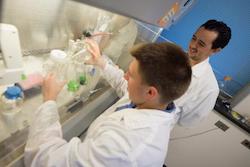
MSU scientists have built a molecular Swiss Army knife that makes biofuels and other green chemical production from algae more viable. Photo by G.L. Kohuth
“The multifunctional protein we’ve built can be compared to a Swiss Army knife,” explained Raul Gonzalez-Esquer, MSU doctoral researcher and the paper’s lead author. “From known, existing parts, we’ve built a new protein that does several essential functions.”
For this research, Gonzalez-Esquer worked with Cheryl Kerfeld, the Hannah Distinguished Professor of Structural Bioengineering in MSU’s-DOE Plant Research Lab, and Tyler Shubitowski, MSU undergraduate student. Kerfield’s lab studies bacterial microcompartments, or BMCs. These are self-assembling cellular organs that perform myriad metabolic functions. In other words, they can be though of as molecular factories with many different pieces of machinery.
The research team modernized the factory by creating, in essence, a hybrid protein in cyanobacteria, organisms that have many potential uses for making green chemicals or biofuels. Basically the protein speeds up the process of taking CO2 out of the athmosphere and converting it to sugars.
“It’s comparable to making coffee. Rather than getting an oven to roast the coffee beans, a grinder to process them and a brewing machine, we’ve built a single coffeemaker where it all happens in one place,” Gonzalez-Esquer said. “The new tool takes raw material and produces the finished product with a smaller investment.”
However, this altered cyanobacterial species won’t be taking over any ponds near you just yet. While the improved organisms excel at photosynthesis in a lab setting, the researchers said they are still ill prepared to compete with other bacteria. Hopefully, this will change as the team continues to develop and refine the photosynthesis process in algae.
Cup of Joe Provides Biomass for London Homes
 While England might be better known for its tea, Londoners certainly have a taste for coffee. And the waste grounds will soon be heating home’s in the United Kingdom’s capital. This article from the London Evening Standard says Bio-bean is collecting waste coffee grounds to be turned into biomass pellets.
Although only a couple of hundred tonnes will be collected each week at first, Bio-bean spokesman Daniel Crockett expects the firm to be processing the equivalent of 50,000 tonnes a year by 2016.
“We wanted to build it inside London,” Mr Crockett told the Standard, “but we aren’t at that stage yet.
“We’re collecting from cafes, office blocks and transport hubs – we’re filling up the Monopoly board!”
While Bio-bean does not pay the coffee shops – which include cafes in big-name firms and all seven of London’s biggest rail stations – its collection service saves them coughing up potentially costly landfill fees.
At peak production, the Southwark business will be producing enough pellets to heat 15,000 homes. The pellets will be burnt in efficient biomass boilers to produce energy.
Bio-bean is also looking at turning the oil in the coffee grounds into biodiesel.
As Temps Cool, Propane Supplies Hit Record
Just in time for winter heating and agriculture crop drying seasons, the supplies of propane hit record levels in the U.S. This U.S. Energy Information Administration report says inventories of propane and propylene reached 97.7 million barrels as of September 11, the highest level in the 22 years.

During the first six months of 2015, production of propane at natural gas plants was 31.3 million barrels, or 172,000 barrels per day (b/d), higher than during the first half of 2014. Exports increased by 33.3 million barrels (182,000 b/d) over the same period.
In the United States, propane is mainly used for space heating and as a feedstock for petrochemical plants, as well as for drying agricultural crops. Relatively small amounts of propane are also used for fueling vehicles. Its heating and agricultural uses make propane consumption highly seasonal and weather dependent, rising in the fall and peaking in the winter. In addition to heating and agricultural use, propane is used by petrochemical plants to produce ethylene and propylene, key building blocks for the manufacturing of chemicals and plastics. Petrochemical propane consumption has little seasonality but can vary significantly based on plant operations.
Traditionally, propane and propylene stocks increase from the start of April to the end of September, and they are drawn down from October to March, when agricultural and heating demands increase. In 2015, inventories began increasing in mid-February, more than six weeks earlier than the historical average.
EIA expects propane and propylene inventories to begin the October heating season at record levels, reaching a high of 99.1 million barrels at the end of September.