
 According to the new global aviation fuel market 2016-2020 research report, the growing use of biofuels across the globe is one of the key factors spurring growth in the aviation fuel market. Countries are introducing mandates and policies to encourage the use of biofuels in the aviation industry to deal with GHGs. China, the U.S., and Brazil are some of the prominent countries promoting biofuels besides the EU countries, which are projected to drive the demand for biofuels. During 2015, the Americas dominated the global aviation fuel market with a 65% share of the market.
- Evonik Corporation has recently completed a significant capacity expansion at its sodium methylate plant in Mobile, Alabama. The company has increased capacity to 72,000 metric tons per year through operational excellence, as well as infrastructure investments. Sodium methylate has become the catalyst of choice for modern large-scale biodiesel production accounting for more than 80 percent of the biodiesel produced in North America.
- Mark your calendars for ABLCNext taking placing November 2-4, 2016 in San Francisco, California. The advanced bioeconomy is changing fast. New tech, market sectors, investors, and strategic partners are appearing every day. Staying abreast of the trends is essential. More than half the speakers this year have never appeared on an ABLC stage. They represent new ideas and technologies. They see the opportunities, just as you do. And they want to find partners to bring molecules to markets. Early bird registration is open now. Click here for more information, the agenda and to register.

DTC Opens #Propane Fuel Station, Increases Fleet
The Delaware Transit Corporation (DTC) has opened a new propane fuel station in New Castle. The station goes along with the agency’s plans to increase its fleet of propane-powered paratransit buses. By FY18 the agency will operate 130 propane buses within it’s DART paratransit service. The decision was made following a two-year pilot program that tested five buses. DTC then purchased an additional 50 propane powered paratransit buses. By 2018, after adding another 75 buses, half of DTC’s fleet will run on propane autogas.
 “Our first five propane-fueled buses collectively traveled 450,000 miles with no fuel system-related failures, and saved $15,000 in fuel costs alone,” said John T. Sisson, chief executive officer of Delaware Transit Corporation during a ribbon cutting ceremony. “That, combined with the reduction in greenhouse gas emissions, made it an easy decision to expand the propane program with our new private fuel stations and 130 buses by 2018.”
Today DTC pays $.78 per gallon for propane autogas compared with $1.75 per gallon for gasoline.
The entire propane paratransit bus fleet is built on the Ford E-450 chassis with 6.8L V10 engine, and equipped with a ROUSH CleanTech propane autogas fuel system. To date, the company has deployed almost 11,000 propane autogas vehicles to fleets across the country with nearly 800 operating in the transit industry.
“This event celebrates the private / public partnership between Delaware Transit Corporation and ROUSH CleanTech,” added Todd Mouw, vice president of sales and marketing at ROUSH CleanTech. “The agency has chosen a clean-burning, American-made and abundant fuel to power its paratransit buses.”
What Will Play Biggest Role in Future of Ag?
 Our latest ZimmPoll asked the question, “Is the Clinton-Kaine Democratic ticket good for agriculture and/or energy?”
I am not quite sure this week’s pollers have anymore confidence in the Clinton-Kaine team when it come to agricultural and energy issues. Clinton has backed biotech, the Farm Bill, animal welfare, climate and the Renewable Fuel Standard (RFS). And Kaine seems somewhere in the middle. However, our poll shows a split. I suppose time will tell all.
Here are the poll results:
- Good for ag & biofuels – 43%
- Good for ag but not for biofuels – 0%
- Good for biofuels but not for ag – 5%
- Not good for ag & biofuels – 33%
- Could go either way – 19%
- Other – 0%
Our new ZimmPoll is live and asks the question, What will play the biggest role in the future of agriculture?
The 2016 InfoAg Conference is a wrap, yet we still have a bunch of precision technology info to share with you in the coming week. Jack Uldrich, acclaimed global futurist, speaker and best-selling author keynoted this year’s ag techfest sharing thoughts on what the world may look like in just a few short years. So, what do you feel will play the largest role in the future of agriculture…biotech, big data, social media? Share your thoughts.
.@EthanolRFA Offers Online #Ethanol Emergency Course
For first responders unable to attend in-person training courses, the Renewable Fuels Association (RFA) is now offering an online version of its Ethanol Emergency Response course. Offered in partnership with the International Association of Fire Chiefs and TRANSCAER, the two-hour training course covers content from the recently updated “Training Guide to Ethanol Emergency Response.”
 Although targeted to emergency responders, the course is available to anyone interested in ethanol emergency response. Those who take the course will come away with knowledge related to ethanol and ethanol-blended fuels, including the use, chemical and physical characteristics, transportation modes, transfer operations, basics of foam, suggested responder tactics and strategies and environmental issues.
“The International Association of Fire Chiefs is very proud and pleased to continue our partnership with the Ethanol Emergency Response Coalition and their online Ethanol Emergency Response Training program,” said Bob Royall, chair of the IAFC Hazardous Materials Committee. “This valuable program provides excellent ethanol training. Topics include vital information about ethanol and ethanol-blended fuels, including chemical and physical fuels, storage and transportation, and health and safety considerations. The site is also a great place to find resources such as training videos, DVD extras, and a training toolkit all aimed at helping keep America’s first responders safe.”
The training course is being co-funded under an Assistance for Local Emergency Response Training (ALERT) grant received by RFA and IAFC.
RFA President and CEO Bob Dinneen, added, “Safety remains one of RFA’s top priorities. Since 2010, we have hosted more than 170 ethanol safety seminars in 29 states, training emergency responders how to proper respond to ethanol incidences. However, there is still a need to reach a broader audience for ethanol emergency response training, which is why we are offering this online training course. It is important that those responsible for the safety of their communities are well prepared and trained to respond to ethanol-related emergencies.”
The training can be found on the IAFC Academy website by clicking here. For more information on the EERC and the training being offered click here.
Turning CO2 Into #Biofuels
Scientists from the University of Toronto (U of T) have discovered a way to turn carbon dioxide (CO2) into renewable fuels and chemicals through nanoengineering. Led by Professional Ted Sargent, Min Liu, PhD. and Yuanjie Pang, PhD, along with a team of graduate students and post-doctoral fellows in U of T Engineering, have developed a technique powered by renewable energies such as solar or wind. The catalyst takes CO2 and converts it to carbon-monoxide (CO). From there, the gas can be used to create carbon-based chemical fuels, such as methanol, ethanol and diesel. Their work is published in the journal Nature.
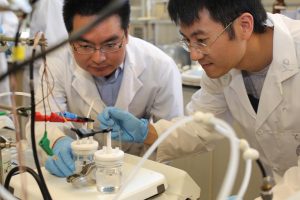
U of T Engineering researchers Min Liu (left), Yuanjie Pang and their team designed a way to efficiently reduce climate-warming carbon dioxide into carbon monoxide, a useful chemical building block for fuels such as methanol, ethanol and diesel. Photo Credit: MARIT MITCHELL, U OF T ENGINEERING
CO2 reduction is an important challenge due to the inertness of the molecule.”We were looking for the best way to both address mounting global energy needs and help the environment,” said Pang. “If we take CO2 from industrial flue emissions or from the atmosphere, and use it as a reagent for fuels, which provide long-term storage for green energy, we’re killing two birds with one stone.”
The process begins with the fabrication of extremely small gold “nanoneedles” — the tip of each needle is 10,000 times smaller than a human hair. The nanoneedles act like lightning rods for catalyzing the reaction. When the research team applied a small electrical bias to the array of nanoneedles, they produced a high electric field at the sharp tips of the needles. This helps attract CO2, speeding up the reduction to CO, with a rate faster than any catalyst previously reported. According to Liu and Pang, this represents a breakthrough in selectivity and efficiency which brings CO2 reduction closer to the realm of commercial electrolysers. The team is now working on the next step: skipping the CO and producing more conventional fuels directly.
“The field of water-splitting for energy storage has seen rapid advances, especially in the intensity with which these reactions can be performed on a heterogeneous catalyst at low overpotential — now, analogous breakthroughs in the rate of CO2 reduction using renewable electricity are urgently needed,” said Michael Graetzel, a professor of physical chemistry at École Polytechnique Fédérale de Lausanne and a world leader in this field. “The University of Toronto team’s breakthrough was achieved using a new concept of field-induced reagent concentration.”
The research represents not only a new solution to a longstanding problem of CO2 reduction but opens the possibilities for storage of alternative energies such as solar and wind.
New #Ethanol Blends Study Shows #Biofuels Benefits
A new report, “Summary of High Octane, Mid-Level Ethanol Blends Study,” released by the DOE’s Oak Ridge National Laboratory and Argonne National Lab finds multiple benefits if using high-octane mid-level ethanol blends in future optimized engines. The study found benefits ranging from increased vehicle efficiency to increased acceleration to significant reductions in greenhouse gas emissions (GHGs). Specifically, these mid-level blends, including E25 and E40 have more octane that allows automakers to manufacture more efficient engines without compromising performance.
 The authors of the report write, “The experimental and analytical results of this study considered together show that high octane fuels (HOF), specifically mid-level ethanol blends (E25-E40), could offer significant benefits for the United States. These benefits include an improvement in vehicle fuel efficiency in vehicles designed and dedicated to use the increased octane…Furthermore, dedicated HOF vehicles would provide lower well-to-wheel GHG emissions from a combination of improved vehicle efficiency and increased use of ethanol.”
Growth Energy Director of Regulatory Affairs, Chris Bliley of the study, “This report reinforces what consumers know today – more ethanol means more consumer savings at the pump and less pollutants in the air we breathe. I am pleased that this report recognizes and confirms what we’ve said for a number of years – automakers can take advantage of ethanol’s high octane properties to achieve the administration’s ambitious climate goals. As the Environmental Protection Agency, the National Highway Traffic Safety Administration, and the California Air Resources Board undertake their mid-term review, they should appropriately recognize the ability of high-octane, mid-level ethanol blends to meet the future greenhouse gas and fuel economy standards.”
.@EthanolRFA Heads to Sturgis
 The 76th annual Sturgis Motorcycle Rally is right around the corner and once again the Renewable Fuels Association (RFA) is partnering with the Buffalo Chip Campground August 8-14, 2016. The Sturgis, South Dakota event is a good way, says RFA, to promote the benefits of high-octane, low-cost ethanol to the motorcycle community. This year also marks the 35th anniversary of the Buffalo Chip Campground rally.
RFA will again sponsor Free Fuel Happy Hours during the rally, providing a free tank of 93 octane E10 for motorcycles. The Free Fuel Happy Hours will take place August 8-10 from 1-4 MT each day at the crossroads, located just outside the main gate of the Buffalo Chip Campground. RFA Vice President of Industry Relations Robert White, who is an eight-year veteran of the rally, will be on hand to answer any questions as motorcycle riders fill up on the high-octane fuel.
“I am always excited to attend the Sturgis Motorcycle Rally,” said White. “It’s a great opportunity to educate the motorcycle community on the benefits of ethanol. E10 is a safe and reliable fuel blend that millions of motorcycle riders use every day and it’s covered under warranty by every major motorcycle manufacturer in the market. However, there continues to be misinformation about E15 and other higher level blends. There is no push for an E15 mandate, and no motorcycles should use it. The RFA looks forward to educating riders on the benefits of ethanol, while providing them with a free tank of fuel.”
At the rally, RFA will also sponsor the ninth annual Legends Ride on Aug. 8, which has raised more than $400,000 for charity since its inception, and will have banners throughout the campground and jumbotrons, as well as giveaways, including a free t-shirt. RFA board members will also be present. Chuck Zimmerman will also be covering the Sturgis Motorcycle Rally. Watch for live updates from his Twitter account and here on Energy.
BioEnergy Bytes
- Attendees for this year’s Export Exchange have less than a week to take advantage of early registration, which ends this Friday, Aug. 5, 2016. The event is taking place in Detroit, Michigan October 24-25, 2016 with more than 500 attendees expected representing 30 countries. #ExEx16 takes place every two years and is hosted by the Renewable Fuels Association and the U.S. Grains Council. Click here to register.
- Alliance BioEnergy Plus has announced that following discussions with the U.S. DOE, the company has submitted an application responsive to the DOE’s Office of Energy Efficiency and Renewable Energy (EERE) Funding Opportunity Announcement (FOA) for the design and construction of a Demonstration Scale Manufacturing Plant for the production of Aviation Biofuels (JP-8) from cellulosic biomass such as yard waste, agriculture leftovers and woodchips, capable of being used in commercial jet aviation as well as military applications.
- Tehran Times is reporting that he Italian private sector will invest $450 million to build a bioethanol fuel production plant in the Amirabad Special Economic Zone (ASEZ), north of Iran using inedible wheat.
- Blossman Services has announced the offering of an Autogas LPG Evacuation Pump, designed to remove propane from autogas tank when service of repairs are required. The propane can be transfered from the vehicle fuel tank being serviced to another autogas vehicle, a refueling station or a separate LPG storage tank. The system can empty a Gen 3 OEM, fuel pump equipped LPI vehicle tank filled with 44 gallons of propane in 1.5 hours to zero PSI tank pressure without venting any propane into the atmosphere.
UPS Drives 1 Billion Miles with Alternative Fuels
 One year earlier than expected, UPS has driven over 1 billion miles using its various alternative fueled fleet. It’s “Rolling Laboratory” included more than 7,200 vehicles ranging from pedal power and electric-assisted bicycles, to electric and hybrid vehicles to natural gas, renewable natural gas, propane and renewable diesel. The “fuel” option is tailored for the geography from dense urban areas to rural countryside.
“We had a big sustainability goal as we set out to make the most of our rolling laboratory by driving 1 billion clean miles in alternative fuel vehicles – that’s the equivalent of well over 4,000 trips to the moon,” said David Abney, Chairman and CEO, UPS. “While attaining this goal is new, our commitment to seeking out alternative fuels actually dates back to the 1930s when UPS tested electric vehicles. With more than 100,000 drivers logging more than 3 billion miles per year, our future depends on our ability to meet the growing demand for global trade while reducing our impact on the environment.”
The move to sustainable delivery options kicked off in earnest in 2012 with a goal of driving 1 billion miles with alternative fuels by the end of 2017. With approximately 12 percent of its fleet converted to alternative powered vehicles, UPS hit that goal more than one year early.
 “The question wasn’t should we make alternative fuels work?” said Mike Whitlatch, UPS’s vice president of global energy and procurement. “Instead, it was ’What’s the best way to make alternative fuels work for UPS, and for the environment?’ After more than a decade of focus, we are now driving more than 1 million miles globally each business day in our alternative fuel and advanced technology fleet.”
Abney added, “Many congested cities around the world are implementing zero tailpipe emissions zones, and UPS is keeping ahead of the curve by investing in advanced technologies and creating the commercial delivery fleet of the future.”
By the end of 2016, UPS will have invested more than $750 million in alternative fuel and advanced technology vehicles and fueling stations globally since 2009. That continued investment, combined with supportive government policies, and a collaborative set of partners has helped to expand development and utilization of alternative fuels, vehicles and infrastructure throughout the world.
Al-Corn Clean Fuel Celebrates 20th Anniversary
 Al-Corn Clean Fuel in Claremont, Minnesota celebrated its 20th anniversary this week with members of the ethanol industry. The farmer-owned cooperative began operations in 1996 and now produces 50 million gallons of ethanol per year with plans to expand to 120 million gallons per year.
“It took courage and energy to create the organization that stands today as Al-Corn Clean Fuel; everyone played a significant role,” said Randall Doyal, CEO of Al-Corn and chairman of the Renewable Fuels Association (RFA). He added that Al-Corn was established in 1994 by local farmers who were looking for new opportunities to add value to their corn corp, starting operation in 1996 with 10 million gallons per year and growing steadily since then.
“Al-Corn Clean Fuel has been a leader within the U.S. ethanol industry and at RFA,” said Renewable Fuels Association President and CEO Bob Dinneen, who attended the celebration. “The company has been a local economic engine, providing jobs and investment opportunities to the area. Even today, some twenty years since it began, almost all of the farmer coop members live within 20 miles of Claremont.”
Even some of its board members like its current chairman, Rodney Jorgenson, have been with Al-Corn since 1994.
“When I think back over the last 20 years, I’m reminded of what can be accomplished when people band together with common purpose. As farmers, our goal was to increase the price of our corn through processing. I doubt any of us could have imagined the success we would have,” Jorgenson said.
The Al-Corn Clean Fuel ethanol plant also produces 132,000 tons of high protein livestock feed, 12 million pounds of corn oil and 70,000 tons of beverage grade carbon dioxide per year.