The House Agriculture Subcommittee on Livestock, Dairy, and Poultry held a hearing on Thursday to review the impact of increased biofuels production and higher feed costs on the livestock industry. Congressmen heard from one high-ranking USDA official, six livestock industry representatives and the country’s leading expert on the ethanol co-product known as dried distillers grains which is used as a livestock feed.
 Virtually every livestock representative testifying had a statement similar to Joy Philippi of Nebraska, immediate past president of the National Pork Producers Council – that they “support the development and the use of alternative and renewable fuels as a way to reduce America’s dependence on foreign oil, but we continue to have the jitters over the rapid rise of corn ethanol production in our country.”
The livestock and poultry producers also were united in their call for reducing or eliminating incentives for biofuels production. “This means we are calling for sunsetting the existing blenders tax credit and the ethanol import tariff as scheduled in 2010 and 2009 respectively,” said Ernie Morales, a cattle feeder and rancher from southwest Texas, who spoke for the National Cattlemen’s Beef Association.
 However, in separate press conferences Thursday, the chairmen of the House and Senate Agriculture Committees disagreed.
Senate Ag Committee Chairman Tom Harkin of Iowa, always a strong advocate for livestock producers, said, “I understand maybe where they’re coming from, but I think these things have a way of leveling out.” He believes the anticipated increase in corn acreage this year will help bring prices down to more manageable levels.
 House Ag Committee Chairman Collin Peterson of Minnesota pointed out that grain producers are finally getting a fair price for their crop. “What people fail to recognize is that over the last number of years, corn prices have been substantially below the cost of production and the livestock industry has benefited from this,” said Peterson.
Several of the livestock industry witnesses at the hearing admitted that the situation is likely short term and that much of the current concern is due to the unprecedented rapid growth in ethanol production. As Iowa dairy producer Rob Wonderlich, testifying on behalf of Dairy Farmers of America, told the committee, “This biofuels revolution occurred very quickly and did not allow … the livestock industries to properly adapt, which has sent a shock across the industries in the form of increased operating costs.”


 Last year I covered what was then known as the Clean Cities Congress here on Domestic Fuel. This year it has a new name and we’re seeking a sponsor for our coverage. I know it’s coming up fast but we thought we had a sponsor for this and that didn’t work out.
 “We have an opportunity to really bring about an economic renaissance to rural Illinois by the increased use of ethanol and biodiesel,” Boland said. “We know there are a number of new (ethanol and biodiesel) plants that are being constructed around the state. … What this does is, it brings hundreds of construction workers to small towns … and a permanent work force of anywhere from 35 to 75 workers.”
  Those are the words of Will Steger, famed Arctic explorer, now on a four-month-long, 1200-mile expedition across the Canadian Arctic’s Baffin Island.
  So what is Steger trying to prove as today he and his sleddog team approach Iqaluit, Canada through -50 degree wind chills? Ironically enough, global warming.
  The ethanol industry, through the
  California-based Oryxe Energy International has announced that Texas has approved the company’s biodiesel fuel additive, ORYXE LED for Biodiesel, for use in the state.
  The
The 
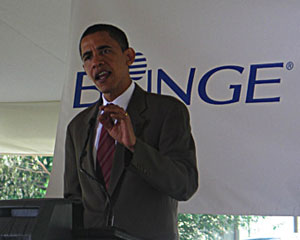 Presidential candidate Barak Obama visited the nation’s number one ethanol producing state over the weekend. During his visit to Davenport, Iowa, he did an interview with local television station
  Lawmakers and special interests have been chiming in with reaction to the US-Brazil biofuels agreement announced last week.
 During a press conference Friday with Brazilian President Luiz Inacio Lula da Silva, President Bush said, “I hope the citizens of Brazil, like the citizens of the United States, are as optimistic about the future as these two Presidents are. And one reason we’re optimistic is because we see the bright and real potential for our citizens being able to use alternative sources of energy that will promote the common good.”
  Leaders from a broad alliance of agricultural, energy, environmental, business and labor groups recently rolled out a set of specific recommendations for reaching an ambitious renewable energy goal: 25 percent of the nation’s energy supply from renewable sources by 2025. Members of the
  The Action Plan, which was presented to Congressional leaders, contains 35 specific recommendations that “would cost just five percent of what America spent on imported oil in 2006 and would result in a dramatic increase in new jobs and economic activity, along with significant reductions in oil consumption and global warming emissions.”