

The corn shortage earlier this year, brought on by the unprecedented increase in interest in ethanol, seems to be easing a bit.
This story from Forbes says an expected giant corn crop this year should make up for all the corn going into ethanol production:
Ethanol producers have been squeezed by rising costs lately. Corn prices skyrocketed as demand from ethanol and food producers outstripped supply. But prices now look likely to abate because of ramped-up production. The Department of Agriculture reported last month that farmers planted 19% more corn than they did a year ago.
(Citi Investment Research analyst David) Driscoll said falling corn prices should boost margins at a time when the sector also enjoys strong political support. “Bipartisan political support for ethanol continues with all signs pointing to increased mandates for ethanol,” he said.
The news is so good Driscoll has been telling clients to buy some ethanol producers’ stocks… including VeraSun Energy and BioFuel Energy.
Shares of VeraSun Energy, which is headquartered in Brookings, S.D., gained 3.3%, or 46 cents, to $14.54. Shares of BioFuel, which is headquartered in Denver, Colo., gained 1.1%, or 10 cents to $9.19. Both are pure-play ethanol producers.

 US Steel is expanding its use of biodiesel, first at its Gary, Indiana plant and then at other US Steel facilities across the country.
 The Renewable Fuels Association has released a video to help first responders in case they have to fight an ethanol-fueled fire. The educational video, titled “Responding to Ethanol Incidents,” gives firefighters and ethanol plant operators important information on proper materials needed to fight potential ethanol incidents.
 “A dedication to safety has always been the foremost concern of the U.S. ethanol industry,” said RFA President Bob Dinneen. “With the industry growing at such a rapid rate, it is imperative that our nations’ first responders have the proper education and training to assist in an emergency at a moment’s notice. By making the video available to view on our website, we hope to communicate this message to first responders who have ethanol plants in their communities. On behalf of the RFA, I am confident that the availability of this DVD will help to combat any ethanol-related emergencies in the future.”
  The
The  The Consumer Federation of America, a consumer watchdog group, says big oil companies are trying to stop the growth of the ethanol industry… and Big Oil is using consumers’ pocketbooks in the fight.
 Add Sen. Hillary Rodham Clinton to the list of folks who suddenly seem to be a friend of ethanol. Just like in
  The National Biodiesel Board today called for passage of the U.S. House’s version of the Farm Bill – H.R. 2419, the Farm, Nutrition, and Bioenergy Act of 2007 – especially the parts referring to biodiesel.
  “The NBB believes these energy initiatives are critical in continuing to make biodiesel an important part of a diverse energy portfolio,” said Joe Jobe, NBB CEO. “As the bill moves forward, we will continue to work with our partners in Congress to ensure that necessary funding is provided for these programs, and that the Bioenergy Program is ultimately structured in a manner that will best help the U.S. biodiesel industry reduce America’s reliance on foreign oil.”
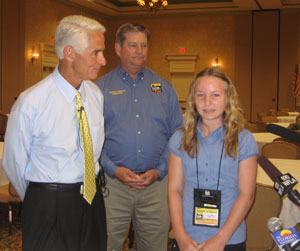 A middle school student from Merritt Island was in the spotlight at the 2007 Florida Farm to Fuel Summit last week in St. Petersburg for her work in making biofuels.