

 The National Ethanol Vehicle Coalition (NEVC) will be holding their 2008 Annual Board of Director and Membership Meeting at the Renaissance St. Louis Airport on January 26-27, 2009. The NEVC invites all to join automakers, marketers, commodity organizations, retailers, equipment manufacturers and MORE to discuss how to further the use of higher blends of ethanol throughout the country.
A schedule of events will be as follows:
Monday, January 26:
12 p.m. – 5 p.m.: Executive Session for NEVC Board Members
6 – 9 p.m.: Reception (ALL Welcome)
Tuesday, January 27:
8:30 a.m. – 12 p.m.: Executive Session for NEVC Board Members
1 – 5 p.m.: Continuation of business meeting (ALL Welcome)
Guest speakers expected to attend on the afternoon of January 27 include representatives from the Department of Energy, Underwriters Laboratory, Renewable Fuels Association, Flex Fuel U.S., American Coalition for Ethanol, and more. Cost to attend the meeting is $50 per person. Contact Rhonda Beul, rbeul@e85fuel.com, or the NEVC office, (573) 635-8445, to register by Wednesday, January 21, 2009.
Sponsors for the event are: Ohio Corn Grower Assn., Dresser Wayne, Siouxland Energy and Livestock, Kansas Corn Growers Assn, Missouri Corn Growers Assn., John Deere, and Minnesota Corn Growers Assn.
 A conference titled “The Growing Role of Biofuels for Today, Tomorrow and Beyond,” featured Brooke Coleman, executive director of the
  2008 was a year that for the most part everyone would like to forget – including those in the ethanol industry. Now that 2009 is underway,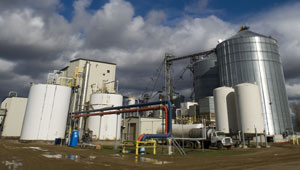
 Jim Sullivan of Informa Economics in Washington, D.C. told a crop outlook seminar at the
  This week’s major economic speech from President-elect Barack Obama pointed out how ethanol and biodiesel, as well as other alternatives to conventional energy sources, will be key to the nation’s economic recovery.
 In an effort to quell skepticism over the renewable energy industry’s chances to meet the 10.5-billion Renewable Fuels Standard in 2009, the National Biodiesel Board has reaffirmed its industry’s ability to hold up its end of the deal… and then some.
 “The U.S. biodiesel industry’s contribution to the nation’s fuel supply will help ensure that the RFS targets for 2009 will be met,” said Manning Feraci, NBB’s Vice President of Federal Affairs. “In 2008 alone, the U.S. biodiesel industry produced nearly 700 million gallons of biodiesel, which equates to 1.05 billion ethanol equivalent gallons for purposes of the RFS.”
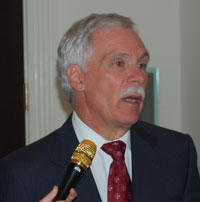 Speaking to reporters this week, Secretary Ed Schafer noted that growth in ethanol and biodiesel production have helped create “remarkable prosperity and growth in the agriculture economy” during the Bush administration.
  Less than two weeks after Air New Zealand took to the air in a flight powered by jatropha-based biodiesel, American carrier Continental Airlines has used a combination of the the weed and algae to fuel one of its 737s.
 U.S. Sen. Christopher “Kit” Bond, a longtime friend of renewable and clean energy efforts, has announced he will not seek re-election in 2010.