

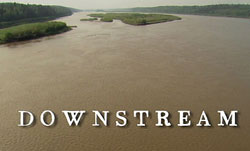
 Hey – in case you haven’t heard, tar sands are going to save the world. They are a renewable fuel you know. Wrong and wrong. Today, a new documentary focusing on the controversy surrounding the development of Alberta’s oil sands, “Downstream”, will be entering the US TV market, just in time to fire people up for Earth Day. Downstream is a modern day re-telling of “David vs. Goliath” or the tiny town of Fort Chipewyan versus Big Oil.
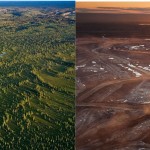
Tar Sands Before and After
The film was produced by academy award nominated filmmaker Leslie Iwerks and is available to watch on Babelgum’s online TV site, Our Earth. It has premiered at film festivals around the world and already been shortlisted for an Oscar. The film takes you on a journey through a town negatively affected by the environmental impacts of oil development. Mutated fish and fowl live alongside a disproportionately large number of people suffering from a multitude of cancers. Naturally, the oil companies and local government officials vehemently deny the correlation between oil sand production and environmental and health issues. During a demonstration, one sign summed it up, “Upstream Oil for the States, Downstream Death for Alberta.”
Ironically, this film is causing more controversy than of the environmental kind. The film has vexed Alberta’s government due to the fact the Alberta Film Development Fund subsidized $67,000 of the film. An intense national discourse and debate over future arts funding and freedom of artistic expression has ensued.
For those of you renewable fuel supporters, this is a film not to miss. Check out the trailer here.


 “We were really pleased to see the quantified reduction of CO2 and other pollutants,” said Ryan Donovan, VP of Operations and Business Development of States Logistics. “This is something that we can take to our customers, like Clif Bar & Company, and they can show their customers. We all benefit from having this information available to show the efforts being made to reduce carbon footprint throughout the supply chain.”
 “This information is valuable to any fleet using biodiesel,” said Tom Verry, Director of Outreach and Development for NBB. “We picture eventually offering this as a value-add report for BioTrucker Fuel Card holders.”
 Gulf Ethanol Corporation has annouced the change of its name to Gulf Alternative Energy Corporation. The name change encompasses the added focus of the company’s biomass processing technology.
 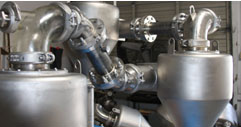 With their main office in Houston, Texas, Gulf Alternative Energy develops cellulosic ethanol pre-processing and production technologies for the ethanol producers in North America. The Company plans to use its patented, exclusive technology to retrofit existing corn-based ethanol plants for cellulosic ethanol production and also for use in the design and construction of its own cellulosic ethanol production facility.
  This edition of the “Ethanol Report” discusses the critical decisions being made regarding renewable fuels and indirect land use on both the federal and state level. Comments are from
  Chuck Woodside, chief executive officer of
  “There is a wealth of information and research on climate change that we need to gather and communicate to our members and policymakers,” said Steve Ruh, chairman of the task force and a farmer in Sugar Grove, Ill. “We also know there is a need for more research to fill the gaps for policy and legislative initiatives that will help us maintain economic and environmental sustainability.”
 California-based
  Merrick provides engineering and architectural design-build, procurement, construction management, and geospatial services.
  A new biodiesel plant is set to open in the Myrtle Beach area of South Carolina.