While large-scale infrastructure projects grab the headlines, the recently passed gargantuan-sized $787 billion economic stimulus bill might end up helping a small, emerging, renewable energy business in the United States.
This story from CNN says the American Recovery and Reinvestment Act of 2009… with its 30 percent investment tax credit for those who buy wind turbines for homes or small businesses… could give a real kick to the small wind turbine industry:
 Even amid a recession, this tax credit “is going to blow the top off the market,” said Ron Stimmel, a “small-wind” advocate with the American Wind Energy Association.
The association predicts the federal subsidy could help the small-turbine market grow by 40 to 50 percent annually, a boost that would parallel the growth of the U.S. solar photovoltaic industry after a similar 2005 initiative.
Unlike the towering windmills sprouting en masse from the Western Plains, small wind turbines have a capacity of 100 kilowatts or less and are designed to operate on the consumer side of the power grid, often in combination with solar panels.
According to the American Wind Energy Association, the United States is already the world’s leading manufacturer of small-wind technologies, holding roughly two-thirds of the world’s market share. Last year, American companies made 98 percent of the small wind turbines sold in the United States.
To conservation-minded home or business owners, the turbines are an investment in clean energy and one way to ease America’s dependence on foreign oil. In the right location, a 10-kilowatt turbine could supply the entire electricity needs of an average American household. The newly subsidized larger models can help power small businesses, farms and schools.
Of course, there are some limitations to where these wind turbines can go up. Most of them need to have at least an acre of open ground around them, without trees or buildings to dampen the wind. But new technologies are being developed to have more rooftop wind turbines with either corkscrew or paddle-wheel designs put up on buildings in some of those urban areas. The potential sure seems to be there.


 The drive toward higher blends of ethanol in gasoline is accelerating and the Renewable Fuels Association (RFA) is working to ensure that the blend wall is just another bump in the road for ethanol to ride over.
 According to the report, “U.S. corn ending stocks for 2008/09 are projected 50 million bushels lower this month as higher ethanol use more than offsets a reduction in exports. Corn use for ethanol is projected 100 million bushels higher on indications of improving blender incentives and higher ethanol use. Blender margins have become increasingly favorable since late February as gasoline prices have risen relative to those for ethanol. A continuing recovery in weekly production of gasoline blends with ethanol is also supportive of ethanol demand as are the latest data on ethanol production, imports, and stocks which indicate record use in December.”
 A Kansas biodiesel and ethanol seller has been recognized for its efforts to sell the green fuels in a station that reflects that commitment to a better environment.
 Many fuel retailers have begun offering blends between 10 percent and 85 percent ethanol for flexible fuel vehicles. The
 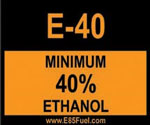 These labels are offered at a member rate and non-member rate. The coalition also offers the mandatory pump labeling for these blends. Besides blend pump labels, the NEVC offers a complete “pump imaging package” for E85 fueling stations. A listing of all items offered for pump labeling can be found by clicking
  An Illinois-based technology services company recently unveiled a new set of “2nd Generation” technologies aimed at increasing the sustainability and profitability of corn-based ethanol plants.
  In addition,
  “Our view is that we can get to 12 to 13 percent by just simply understanding that it’s significantly not much different than 10 percent, it’s an insignificant difference, and under the rules and regulations EPA could do that,” Vilsack said Monday. “If you get to 15 percent or higher, there may be more review required, and we appreciate that. But the help is needed now.”
  You may not have heard about Phibro Ethanol Performance Group but what they offer is what they believe is the top performing
  As margins continue to be tight in the ethanol industry, I asked Slunecka to give the industry some advice when it comes to choosing products and services for their plants. “Just like how consumers purchase automobiles, the time is right to be selective in the products they choose and the services they ask for,” answered Slunecka. “It’s vital that all inputs be maximized in order to generate the greatest return on investment.”
 And according to