

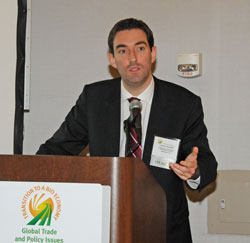
 Speaking on behalf of the European Commission To The United States here at the Transition To A Bio Economy Conference was Laurent Javaudin.
His comments focused on the impact of EU mandates for renewable energy. To start with, in the EU they don’t have a mandate of a certain number of gallons of biofuels. Instead they are looking at requiring alternative energy sources like biofuels be a percentage of the fuel consumed and achieve it by 2020. He says that they don’t consider just biofuels but also other alternative sources of energy. The biofuels that are considered must be produced in a sustainable way. They also expect these fuels to obtain at least a 35 percent decrease in green house gas emissions.
He says that the mandate across the EU is still a work in progress and they hope to have it agreed to by the second quarter of 2010.
You can listen to my interview with Laurent here: [audio:http://www.zimmcomm.biz/farm-foundation/ff-global-09-javaudin.mp3]
You can download the interview with this link (mp3).
You can find photos from the conference here:
Transition To A Bio Economy Conference: Global & Trade Issues Photo Album
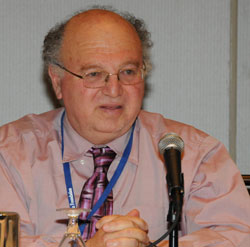 We know that OPEC has had a monopoly control over the price of oil on the world market and we hope that the increase of more environmentally friendly biofuels will force that to change. However, David Zilberman, University of California, Berkeley, has created a model to measure how much impact we’re having.
 A Colorado company is getting ready to debut a biodiesel hybrid officials claim will get 100 miles per gallon… if they can get it finished for an upcoming auto show.
 A high school science project has turned into a way for a North Carolina school to save money, save the environment and comply with a state law requiring biodiesel use.
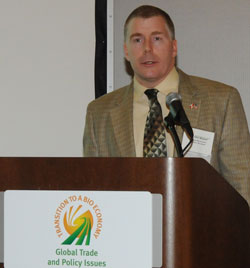 Biofuels production in Canada will impact meat trading patterns according to research by Al Mussell, George Morris Centre, University of Guelph. He says that the increase in biofuels production will turn the country into an importer of grains instead of an exporter. Al was one of the speakers at the Transition To A Bio Economy Conference.
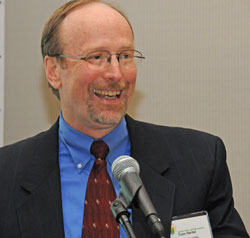 A very interesting presentation at our Farm Foundation Global Trade and Policy Issues conference had to do with the impact on poverty. Tom Hertel, Purdue University, was our presenter.
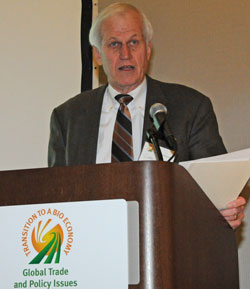 Former Texas Congressman Charles Stenholm was the moderator for our second session here at the Farm Foundation Global Trade & Policy Issues conference. I don’t think you’ll find anyone more knowledgeable about the policy side of this discussion.
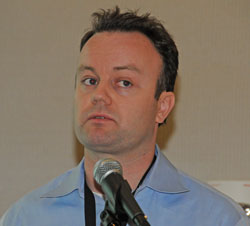 Providing us with a “Technical Global Biofuels Analysis” here at the Farm Foundation Global Trade & Policy Issues conference was Thomas Alfstad, Brookhaven National Laboratory.
 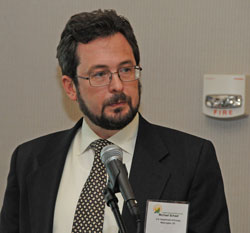 Michael Schaal is with the Energy Information Administration which is part of the U. S. Dept. of Energy. He spoke early on the program at the Farm Foundation conference about the global outlook for energy.