

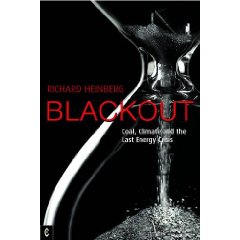
 Coal. Under the surface we seem to have a lot of it. It’s fairly inexpensive but this is changing as demand rises to meet increased energy needs especially in countries like China. So we have a lot, its cheap, let’s use it, what’s the problem? Right? Wrong!
Author Richard Heinberg writes in Blackout: Coal, Climate and the Last Energy Crisis, “In short: two of the defining trends of the emerging century–the development of the Asian economies and climate change–both center on coal. But coal is finite non-renewable resource. Thus, a discussion of the future of coal must also intersect with a third great trend of the new century: resource depletion.”
In the first part of the book, Heinberg takes the reader through a deep analysis of just how much coal is available throughout the world. Keep in mind, forecasts assume that current energy use stays the same, but it is increasing each year, making coal available for a shorter amount of time. Best estimates are that the world will see Peak Coal by 2025 and many believe that the world has already witnessed Peak Oil.
Now, you’re just waiting for me to say there is no such thing as clean coal. So there, it’s out in the open. In the second section of the book, Heinberg talks about the link between coal and greenhouse gas emissions and discusses the technologies to create “clean coal”. They are all challenged to say the least.
At the end of Blackout, Heinberg details three scenarios that involve coal, climate and energy. They are all very disturbing, but Heinberg has a way of tackling issues head on.
 The good news is, we are becoming less dependent on foreign sources of oil for our transportation fuel needs. According to the
  In what’s being touted as a first of its kind for the country, a city in Georgia says it will use its wastewater to grow algae to make into biodiesel.
 Update your passport and book your ticket for Green Power’s 5th
  The World Bank received a failing grade this week for its lack of support to developing countries trying to implement biofuels project. The “F” comes from the
  Tom Buis, CEO of
  The blunder occurred when Rep. Aaron Schock (R-IL) asked Ms. Oge, who is responsible for regulating all emissions within the United States, about the indirect land use issue. “It’s my understanding that the EPA’s Renewable Fuels Standard 2 methodology assumes that for every acre of soybean crop that is used to produce biofuel, an equal acre of ground is used in the Brazilian rainforest to replace that acreage, is that correct?” asked Schock.
 In one of three recent videos posted by the ethanol organization, RFA Vice President of Research Geoff Cooper says the 2009 corn crop is going to be another huge crop. “Probably the second or third largest crop in history,” Cooper says. “Which will be more than sufficient to meet very strong demand for livestock feed, for exports and what will likely be record demand for ethanol production. All of those demands will be met and there will still be a healthy surplus of corn left.”
 Two Arizona State University researchers working on biodiesel projects have been nominated for the 2009 World Technology Award, which recognizes individuals and corporations from 20 technology-related sectors.
 Scientists Qiang Hu and Milton Sommerfeld in the College of Technology and Innovation at ASU’s Polytechnic campus, have been selected as nominees for the award for their work with algal feedstocks and biodiesel fuel. In November 2008, TIME magazine selected the researchers’ work as one of the top 10 best innovations for 2008.