

Conab has released the results of its national crop survey and reported that the Brazilian sugar and alcohol sector will grind a record-breaking volume of sugarcane this year. Total harvest is expected to reach an estimated 629 million tons, a 10 percent increase over 2008. The increase in production is attributed to both good rains and expanded planted area, which reached 7.74 million hectares.
 Approximately 55 percent of the crop, or 438.56 million tons, is intended for ethanol production, which will generate 9.13 billion liters of anhydrous-type fuel (to be added to gasoline) and 18.68 billion liters of hydrated alcohol (to be sold as fuel at the pumps). These figures represent respectively a reduction of 9.30 percent and an increase of 12.41 percent In total, there will be 27.80 billion gallons of ethanol, or 4.22 percent more than the 26.68 billion gallons produced last season.
“Most Brazilian mills are capable of producing both ethanol and sugar, which gives the industry flexibility to opt for production of one or the other,” said Conab’s Agribusiness Information Superintendent Airton Camargo. He said the favorable price on the international market has led industries to prefer the food production.
Last week, the Energy Information Administration released the ethanol production numbers for June 2009 (for U.S. only) noting that U.S. production is on the rise with record setting production. With record ethanol production in both the U.S. and Brazil, Growth Energy announced a campaign last week during the Farm Progess Show to label ethanol’s country of origin in an attempt to gain consumer support for the fuel to be American made.

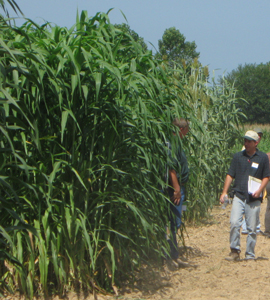
 Senator Chuck Grassley (R-IA) hosted officials from the Environmental Protection Agency last week for a tour of agriculture and biofuels in Iowa. Gina McCarthy, Assistant Administrator for the Office of Air and Radiation, and Margo Oge, Director of the Office of Transportation and Air Quality, represented EPA on the visit that included the BioCentury Research Farm in Boone, an Iowa family farm and the
  An Iowa-based energy company is claiming that its one-of-a-kind technology is a solution America needs as the country looks to reduce greenhouse emissions and lower energy costs, while helping put people back to work.
 A group that touts its efforts to promote “the sustainable production and equitable distribution of energy and food in communities across Minnesota” has issued a report on the renewable fuels used for transportation in this country.
 [W]e do intend for Transportation Biofuels in the United States to act as a tool to provide an overview of the current status of major developments in the biofuels industry. We highlight recent changes in biofuels production processes, biomass development, and federal level policies such as the Biomass Crop Assistance Program. We also review unavoidable issues including the food versus fuel debate and the difficult indirect land use change debate. Our intention is not to criticize, cheerlead, or otherwise deny or approve particular results or arguments. Instead, our purpose is to provide information, pose questions, and seek objective analysis of the information that is currently available. Only through an open discussion may we most effectively find root problems and appropriate solutions. We believe that through honest evaluation and analysis, this wave of biofuels will not only stay together, but carry us all in the right direction.
 According to the Corn Marketing Program of Michigan (CMPM), CMPM andTravel Michigan have renewed their commitment to partner for a second year to furnish all Michigan Welcome Centers with corn-based plastic bags for visitors to fill up with helpful Michigan travel information.
  “We have the safeguards and controls in place to prevent fraudulent acts like this for producers,” says Clayton McMartin, President of
  The USDA is handing out another $13 million in loans and grants for 233 renewable energy projects in rural areas of 38 different states.