

The “World’s Largest Urban Farm and Research Test Facility” is studying a wide variety of new feedstocks that hold promise for future sources of both ethanol and biodiesel.
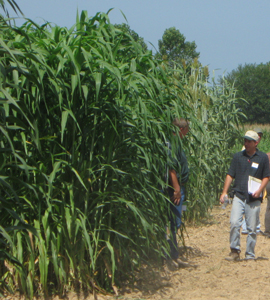 Agricenter International recently offered a closer look at the new crops being grown there by the Memphis Bioworks Foundation AgBioworks program and BioDimensions, Inc. Among the crops that were planted this season were sweet sorghum (pictured), switchgrass, castor, pearl millet and sunflowers.
“Our intent with hosting this new crops field day was to educate people on the opportunities for these crops in the region by inviting a range of speakers to talk about crops from the field to the factory and also showcase these crops in the field, “ says Hillary Spain, AgBioworks 25Farmer Network Coordinator.
Spain says about 50 farmers and other interested individuals from throughout the region attended the field day on August 15 to learn about each crop, ask questions and see the crop under actual growing conditions in the field.
 Senator Chuck Grassley (R-IA) hosted officials from the Environmental Protection Agency last week for a tour of agriculture and biofuels in Iowa. Gina McCarthy, Assistant Administrator for the Office of Air and Radiation, and Margo Oge, Director of the Office of Transportation and Air Quality, represented EPA on the visit that included the BioCentury Research Farm in Boone, an Iowa family farm and the
  An Iowa-based energy company is claiming that its one-of-a-kind technology is a solution America needs as the country looks to reduce greenhouse emissions and lower energy costs, while helping put people back to work.
 A group that touts its efforts to promote “the sustainable production and equitable distribution of energy and food in communities across Minnesota” has issued a report on the renewable fuels used for transportation in this country.
 [W]e do intend for Transportation Biofuels in the United States to act as a tool to provide an overview of the current status of major developments in the biofuels industry. We highlight recent changes in biofuels production processes, biomass development, and federal level policies such as the Biomass Crop Assistance Program. We also review unavoidable issues including the food versus fuel debate and the difficult indirect land use change debate. Our intention is not to criticize, cheerlead, or otherwise deny or approve particular results or arguments. Instead, our purpose is to provide information, pose questions, and seek objective analysis of the information that is currently available. Only through an open discussion may we most effectively find root problems and appropriate solutions. We believe that through honest evaluation and analysis, this wave of biofuels will not only stay together, but carry us all in the right direction.
 According to the Corn Marketing Program of Michigan (CMPM), CMPM andTravel Michigan have renewed their commitment to partner for a second year to furnish all Michigan Welcome Centers with corn-based plastic bags for visitors to fill up with helpful Michigan travel information.
  “We have the safeguards and controls in place to prevent fraudulent acts like this for producers,” says Clayton McMartin, President of
  The USDA is handing out another $13 million in loans and grants for 233 renewable energy projects in rural areas of 38 different states.
 On a warm, clear summer evening in Central Missouri, the night air practically thunders to life as 3,000 horsepower of tractor-pulling power is started and modified machines of farm implement heritage rumble down a dirt track. While the behemoths of the National Tractor Pullers Association Midwest Extreme Truck and Tractor Pull are pushed to the limits of what an engine will do, they are doing it with a green blend of soybean-based B20 biodiesel.
 This United Soybean Board (USB) and soybean checkoff sponsored event is a chance to highlight the great performance of the green fuel in these extreme conditions.
 “While overall it may only be a couple of dozen jobs on a statewide basis, it is an important signal because we were in a period of real economic turmoil in the ethanol sector, but yet we didn’t see layoffs in those plants, even the ones that went through bankruptcies, and in a couple of cases we saw companies use this time to modify their plants to create addition production capabilities, such as corn oil extraction,” Sneller said.