RFS2 Confusion Clouds Mass. Biodiesel Mandate

John Davis

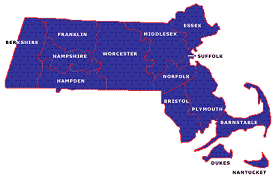
MassMap1A 2 percent biodiesel mandate beginning next year and increasing to 5 percent in 2013 in Massachusetts has hit some glitches … thanks to confusion over what the next Renewable Fuels Standard (RFS2) might bring …. but it could now be moving forward.

Biodiesel Magazine reports
the measure has come under fire because it only allows waste-derived biodiesel, a provision put into the mandate thanks to what lawmakers thought the EPA would allow under RFS2. But despite a pronouncement by the Massachusetts Oilheat Council (MOC) in its Nov. 13 newsletter that the requirement has had a “spell of relative silence,” some progress could be at hand:

On Sept. 30, MOC president Michael Ferrante sent an email to Dwayne Bregger, director of renewable and alternative energy development in the Massachusetts Department of Energy Resources, asking specifics regarding the mandate, to which Bregger replied, “Do know that we are moving forward with the Early Action Year beginning July 2010. We anticipate the EPA RFS2 protocol for greenhouse gas reductions to be available by the end of this year and that we will find it acceptable for adoption for [the Massachusetts] program. At that time, DOER will be able to qualify all biofuels (regardless of feedstock) that can demonstrate the 50 percent GHG reduction.”

The state’s exclusion of soy and other virgin oil biodiesel in its mandate was based on EPA’s proposed RFS2 rule, which was flawed in methodology used to calculate GHG emissions from crop-based biodiesels. In Bregger’s response to Ferrante, he wrote, “The eligibility of biofuels from agricultural feedstocks will depend on whether they meet the 50 percent GHG reduction criterion as per the Protocol, which we will adopt (most likely EPA RFS2 protocol).”

Bregger also said, “Tracking the biofuels (and differentiating “advanced”/qualified biofuels from others) into [Massachusetts] and then through the [Massachusetts] market is an area that we are much engaged in now. We will need to complete those procedures and then move into draft regulations.”

It’s another example of how the flawed thinking the EPA put into RFS2 is causing some anxiety in the green fuels sector. Let’s hope someone can get this mess straightened out before it starts to hit more mandates across the country.

Biodiesel, Government

Biodiesel Board Selects Leadership

John Davis

NBB-logoMembers of the National Biodiesel have chosen who will represent the trade association on its governing board and leadership committee.


In this NBB press release, NBB vice chair Gary Haer of Iowa-based Renewable Energy Group said the green fuel “is one of our nation’s valuable tools to fight greenhouse gas and enhance energy security,” and the the board’s leadership reflects the diversity and wide spread benefits of the association:

Officers elected to lead the board are:

* Ed Hegland, chairman, Minnesota Soybean Promotion and Research Council (farmer)
* Gary Haer, vice chair, Renewable Energy Group, Inc. (producer)
* Ed Ulch, secretary, Iowa Soybean Association, (at large)
* Jim Conway, treasurer, Griffin Industries (renderer/producer)

Biodiesel board members also voted to fill eight board member spots. Board members elected to the Governing Board include officers and:

* Darryl Brinkmann, American Soybean Association (at large)
* Kris Kappenman, ADM (producer)
* Bob Metz, South Dakota Soybean Research and Promotion Council (at large)
* Ron Marr, Minnesota Soybean Processors (at large)

Greg Anderson, Denny Mauser, David Womack, Robert Stobaugh, Greg Hopkins, Doug Smith and Dave Lyons also serve on the Governing Board.

Biodiesel, NBB

Chief Ethanol Celebrates 25 Years

chief_ethanol_fuelsChief Ethanol Fuels is celebrating their 25th anniversary this month in Hastings, Nebraska. An open house will be held on Monday, November 23 at the plant and will include keynote speaker, Senator Ben Nelson.

The site was originally constructed by American Diversified Corporation and then bought by Chief Industries in 1990. It was the first production facility in the state. In the past 25 years, production has increased from 10 million gallons per year to approximately 70 million gallons per year today, thanks to several expansions that began in 1993 and continuous improvements today.

Todd Sneller, administrator of the Nebraska Ethanol Board, said that the Chief Ethanol Fuels plant was Nebraska’s initial stake in the ground in terms of declaring ethanol as a major economic development initiative for the state. “Nebraska has a unique combination of corn, cattle and ethanol,” said Todd Sneller, administrator of the Nebraska Ethanol Board. “Agriculture is the economic engine that drives Nebraska, and ethanol is adding value in very powerful ways that reverberate throughout our state. It is important that we continue to support and develop this industry for the good of Nebraska and for the good of our nation. Chief Ethanol Fuels has been a pioneer and leader in the state’s ethanol industry.”

Sneller added that the outlook for the sustainability of the ethanol industry is good. “Corn producers continue to grow more corn on less land and with less water—and ethanol producers continue to squeeze more ethanol out of a bushel of corn with less energy and less water,” he said. “Efficiency will improve profitability and will continue to position ethanol as a key component in America’s energy and economic future.”

Senator Nelson’s remarks will begin at 1:00 p.m. on November 23 followed by Bob Eihusen, president of Chief Industries and Duane Kristensen, general manager of Chief Ethanol Fuels. Tours of the plant will then follow.

corn, Ethanol, Ethanol News, News

Cellulosic Biorefinery Begins Construction

zeachemZeaChem, Inc. has announced that they will work with Hazen Research, Inc. out of Golden, Colorado to construct a new cellulosic biorefinery.

According to their press release, ZeaChem is meeting its deployment milestones and moving forward to advanced biofuels and bio-based chemicals production,” said Jim Imbler, president and chief executive officer of ZeaChem. “We have a dedicated energy feedstock supplier, we have raised necessary capital, we have completed the initial design package and are finalizing the detailed engineering and design package. Initiating construction of this front-end fermentation unit operation demonstrates that ZeaChem is accelerating deployment of its unique hybrid biorefining technology.”

hazenThe front-end fermentation unit scales up production of the naturally occurring bacteria, called an acetogen, which ZeaChem uses in its fermentation process. Acetogens are highly robust and, unlike yeast, produce no carbon dioxide (CO2) during the fermentation process, allowing ZeaChem to realize a significant efficiency and yield advantage. ZeaChem has successfully produced acetogens at the lab scale for over 1,000 fermentation trials of sugars as well as hydrolyzate derived from cellulosic biomass. The facility will have capacity to produce 250,000 gallons of biofuel per year.

Cellulosic, Ethanol, Ethanol News, News

Algenol, Linde Partner On CO2 Management Technology

Joanna Schroeder

DSalgaeAlgenol Biofuels, in partnership with The Linde Group, have agreed to collaborate in a joint project that will attempt to identify the optimum management of carbon dioxide (CO2) and oxygen for Algenol’s algae and photobioreactor technology. The goal is to develop cost-efficient technologies that capture, store, transport, and supply CO2 for the production of third-generation biofuels out of carbon dioxide, salt water and algae as well as remove oxygen from the photobioreactor.

“Producing fuels or chemicals from algae is a promising way of reducing greenhouse gas emissions,” said Dr Aldo Belloni, member of the Executive Board of Linde AG. “A cost-efficient supply of CO2 is a key factor in this biofuel chain. As a pioneer and leading company in CO2 capture, transport and supply we are delighted to be a key player in major projects in the algae-to-biofuel area.”

The technology will serve two purposes: to reduce atmospheric concentrations of C02 and to deliver sustainable low-cost alternative biofuels. Algenol has developed proprietary technology to produce advanced biofuels using algae, CO2, salt water and sunlight. One of the major benefits of producing biofuels from algae is that the algae consumes CO2 from fossil fuel sources, such as combustion flue gases from coal-fired power plants.

In other news, earlier this month, The Linde Group, in partnership with Waste Management, commissioned the largest landfill gas (LFG) to liquefied natural gas (LNG) plant in the U.S. in Livermore, Cali.

algae, Environment, News

Biodiesel Board Asks Congress to Extend Tax Incentive

John Davis

NBB-logoAn important tax incentive on biodiesel is about to expire, and the National Biodiesel Board is scrambling to get it renewed.

Biodiesel Magazine reports that the NBB is lobbying lawmakers to renew the $1-per-gallon biodiesel tax incentive, which encourages biodiesel use by making it competitive with petroleum diesel fuel. NBB argues that if the incentive is allowed to expire on December 31, 2009, biodiesel will become cost prohibitive, and domestic production and use of the green fuel will end:

“The biodiesel tax incentive is working. Since its enactment in 2004, U.S. biodiesel production has reached commercial scale, and the nation has realized the job creation, environmental and energy security benefits that come with the expanded production and use of biodiesel,” stated Manning Feraci, NBB’s vice president of federal affairs. “These benefits will simply be lost if the credit lapses.”

During visits with lawmakers, biodiesel industry leaders expressed strong support for S. 1589, the Biodiesel Tax Incentive Reform and Extension of Act, introduced by Senators Maria Cantwell (D-WA) and Charles Grassley (R-IA), and H.R. 4070, companion legislation introduced yesterday by Representatives Earl Pomeroy (D-ND) and John Shimkus (R-IL). This legislation would reform the biodiesel tax incentive by changing the current blenders excise tax credit to a production excise tax credit. This will improve administration of the incentive, eliminate potential abuses and improve tax compliance. The proposals would also extend the biodiesel tax incentive for five years, providing the certainty entrepreneurs need to create jobs and expand the use of biodiesel.

The NBB also points out that biodiesel fits with the Obama Administration’s policy of creating green jobs, while cutting carbon emissions.

Biodiesel, Government, Legislation, NBB

Hydrogen Company Offers $1 Mil Scholarship Program

John Davis

ProtonEnergyHigh school seniors who are looking to further their education in the fields of science or technology will get some help from a world leader in hydrogen energy.

Proton Energy Systems has announced the $1 million Proton Energy Scholarship program aimed at recognizing outstanding achievement, excellence and promise in science or technology:

The scholarship program is supported and funded by Tom Sullivan, owner of Proton Energy and founder of the national chain Lumber Liquidators. The scholarship will award four-year undergraduate scholarship prizes with a total value of up to $100,000 each. Honorable Mentions, Proton Energy Achievers, will be awarded $500 prizes. Sullivan has committed $1 million to the Hydrogen Education Foundation (HEF), who is administering the scholarship program.

“Proton Energy is committed to innovation and creativity, and it is our hope that through this scholarship, we can help inspire young people with an interest in science and technology,” said Sullivan. “The cost of college can sometimes be overwhelming – especially in this economy – and we are proud to help alleviate this burden, while also encouraging new ideas among some of America’s most promising high school students in a field that holds tremendous importance for the future.”

Proton Energy is the world’s leading supplier of onsite hydrogen generators utilizing PEM (proton exchange membrane) technology, which creates high purity hydrogen from de-mineralized water and electricity. The company has been developing and manufacturing world-class electrolysis systems since 1996, with more than 1200 units deployed world-wide, on every continent. Proton Energy has also been involved in more than a dozen hydrogen fueling stations currently in operation around the nation, and its commitment to innovation has been recognized with contracts from the Department of Defense and the Department of Energy.

This scholarship is aimed at being a complement to the Hydrogen Education Foundation’s Hydrogen Student Design Contest and the H-Prize, which respectively hold competitions for university-level students and innovators seeking excellence beyond higher education.

Applications are due February 10, 2010 with winners announced on April 15, 2010. More information is available here.

Hydrogen

Largest Offshore Wind Farm in New England Cranks Up

John Davis

FoxIslandsThe largest community-owned wind facility on the East Coast and the largest off-shore wind farm in New England is now open for business.


This press release
says the Fox Islands Wind Project in Maine features three large-scale wind turbines that will generate 4.5 megawatts of electricity for the islands of Vinalhaven and North Haven, providing cheap, clean energy to the islands’ residents, who currently pay twice the national average for their power, for decades to come:

Governor [John] Baldacci and Maine House Speaker Hannah Pingree joined leaders of the Fox Islands project to dedicate the wind energy project, a model for communities up and down the Eastern Seaboard.

“The Fox Islands community wind project demonstrates that a local community can harness the power of a local, renewable resource and become an example to the rest of the State and the nation,” said Gov. Baldacci. “This new wind installation puts Maine at the cutting edge of renewable energy development, and proves that coastal wind is a viable, low-cost energy source.”
FoxIslands2c
The turbines’ dedication is the result of strong support from the entire Fox Islands community since the project’s inception. In a nearly unanimous vote in July 2008, island residents ushered in a new era of renewable power in Maine by approving the project, and the arrival of the turbines earlier this summer was hailed by local residents. Several other island and coastal communities are now looking at community wind power as a viable alternative to traditional energy sources.

The GE Power & Water-supplied turbines can generate about 11,600 megawatt hours of electricity per year and reduce carbon emissions by a total of 5,400 tons.

Several New England-based companies and organizations, including the Island Institute, Cianbro Corporation, EOS Ventures, Diversified Communications and Fox Islands Electric Cooperative, collaborated on the effort.

More information is available here.

And more cool pictures of the project are available here.

Wind

American Coalition for Ethanol Elects New Officers

Cindy Zimmerman

ACEThe American Coalition for Ethanol (ACE) has elected new officers for the upcoming year.

The new president for the ethanol advocacy organization is Lars Herseth, a family farmer from South Dakota and father of Rep. Stephanie Herseth Sandlin (D-SD). He is also a politician himself, having served in the South Dakota state legislature for nearly 20 years. In addition to being a farmer, Herseth is an investor in locally-owned ethanol plants in South Dakota and Minnesota.

Herseth takes the reins from Brian Wilcox of Nebraska Public Power District who became Acting President earlier this year when the position was vacated by Bob Scott, whose company, POET Ethanol Products, resigned from the Board. Wilcox was re-elected to serve as Vice President while Owen Jones of 4 Seasons Co-op was re-elected as Treasurer. Jones is a farmer / rancher from Britton, South Dakota. Duane Kristensen of Chief Ethanol in Hastings, NE was newly elected as the organization’s Secretary.

ACE, Ethanol

Gloucester County Unveils Propane School Bus Fleet

Joanna Schroeder

Gloucester County Virginia recently unveiled the states first propane school bus fleet during an event attended by the state’s Department of Environmental Quality, Congressman Robert Wittman and Delegate Harvey Morgan. Five diesel school buses were replaced with propane power during an event at Page Middle School in Gloucester County designed to celebrates the school district’s commitment to environmental sustainability, energy independence and economic security.

DFBusPhotoRoger Kelly, Director of Transportation for Gloucester County Public Schools said during the ceremony, “Using propane-powered school buses is a step in the right direction to significantly decrease vehicle emissions and improve the air quality for our students. We are excited to be involved in this clean school bus initiative.”

The decision to switch to propane over other alternative fuels was due to several benefits including the estimation that the school will save $1.50 per gallon in fuel costs, propane reduces greenhouse gas emissions by nearly 18 percent, the flammability range of the fuel is lower than other alternative fuels, and the majority of propane is produced domestically.

A $221,355 grant from the American Recovery and Reinvestment Act $221,355 funded a portion of the project, the EPA’s National Clean Diesel Program funded another portion and the Gloucester County Public Schools funded the remaining amount.

News, Propane