

 It could become the next great fuel source from the agricultural community. A Nebraska-based biomass supplier and manufacturer has debuted a product it touts as “Coal from the Farm.”
Next Step Biofuels, Inc. has launched PowerPellets, a green fuel made from corn stover – all the leaves, cobs and stalks leftover after the corn is harvested – that burns like coal and will help with that state’s Renewable Portfolio Standard laws that require utilities to generate more of their power from renewable sources:
 Next Step COO Russ Zeeck explained that PowerPellets solve the logistical and operational problems that have thus far prevented wide-scale use of biomass to generate electricity. “Utilities have long been aware of the environmental benefits of burning biomass, but they’ve had a hard time adopting it,” said Zeeck.
“PowerPellets overcome the three major problems that utilities have had with biomass. First, unlike raw biomass, PowerPellets are easy and affordable to ship and store. Second, unlike other pelletized biomass, PowerPellets are hard and friable which means they pulverize and feed just like coal; PowerPellets can be folded into a coal-fired plant’s operations with little or no additional capital.
And, third, because Next Step makes PowerPellets from corn stover – America’s most abundant source of renewable biomass – there is a deep, reliable and price-stable supply.”
Next Step Biofuels says the PowerPellets were recently tested and found to do what was claimed of them during rigorous testing conducted at the Energy & Environmental Research Center at the University of North Dakota.
Next Step plans to negotiate with several utilities to supply PowerPellets starting next year.
 Representatives of the
  At the climate summit in Copenhagen, U.S. Agriculture Secretary Tom Vilsack
 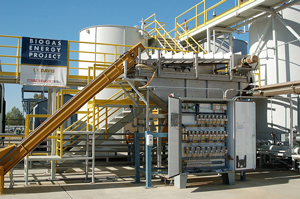 Under the agreement, USDA intends to increase the number of anaerobic digesters supported by USDA programs. Beyond promoting the digesters, the agreement will encourage research, and development of new technologies to help dairies reduce greenhouse gas emissions. Anaerobic digester technology is a proven method of converting waste products, such as manure, into electricity. The technology utilizes generators that are fueled by methane captured from the animal manure. Currently, only about 2 percent of U.S. dairies that are candidates for a profitable digester are utilizing the technology. Dairy operations with anaerobic digesters routinely generate enough electricity to power 200 homes.
  Fourteen major airlines from the United States, Mexico, Canada and Germany, led by the Air Transport Association (ATA), have agreed to buy up to 750 million gallons of renewable jet fuel and diesel derived from camelina and produced by Seattle-based
 Moscow Mills, Missouri is the site of the state’s first ethanol blender pump.
  According to the
  Canadian-based Wind Works Power Corp. has acquired half interest in six wind energy projects in Ontario with a total capacity of 80 megawatts.
  If you’ve been a reader of Domestic Fuel for any amount of time, you know how big of a supporter of biodiesel our friends at New Holland have been.