

Roadsides and median strips may turn out to be the perfect place to grow crops for biodiesel.
 “It’s a very non-traditional approach to utilizing some public lands that are not being utilized as well as they could be,” says Utah State University researcher Dallas Hanks. It is estimated that there are some 10 million available acres of land in roadsides, airports, military bases, railroad areas and more that currently require significant maintenance cost that could be used for producing biofuel crops such as safflower and canola which could be harvested a couple times a year. The benefits include a new source for biofuel feedstocks, as well as improved aesthetics and reduced roadside maintenance costs.
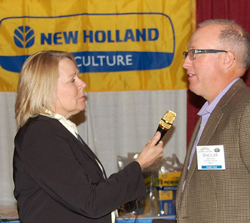 “We’ve been lucky enough to get a national coalition with an executive committee and land grant universities all around the country involved in this,” Hanks said during a recent interview at the National Association of Farm Broadcasting annual meeting. “We are excited about their interest and we are excited to put some seeds in the ground.”
Other partners in the project include the National Biodiesel Board (NBB) and New Holland Ag. “New Holland has been wonderful from the get-go on this,” said Hanks. “They were very gracious in giving us some equipment to help us with our research costs and further this project.” NBB has been the main source of funding for the project, for which Hanks says they are very grateful.
Some of the states already moving on the project include Tennessee, Michigan, North Carolina and Washington.
Find out more about this initiative from biodieselsustainability.com and freewaystofuel.org. Listen to or download my interview with Dallas Hanks below.



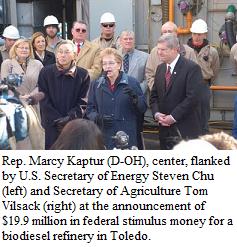 An Ohio biodiesel plant is among those
  This coming Friday, Dec. 11 is the deadline for Iowa schools to get in their application for two, $2,500 grants from the Iowa Renewable Fuels Association’s (IRFA) Biodiesel Backer Award Program.
  Big emitters of carbon dioxide are faced with a big problem. Industries and utilities will soon have to capture that CO2 and store it … somewhere. That’s where
  In this edition of the Domestic Fuel Cast, we talk to Carbon Sciences President and CEO Byron Elton, who explains how this process works. Basically, it’s the exact same process that changed carbon dioxide into hydrocarbons all those eons ago far beneath the surface of the Earth. But this is much more efficient and faster and could be the solution for those CO2 emitters looking for something to do with their newly sequestered product and a planet hungry for energy.
 According to a press release from the U.S. Department of Energy (DOE), DOE Secretary Steven Chu and Agriculture Secretary Tom Vilsack announced the selection of 19 integrated biorefinery projects to receive up to $564 million from the American Recovery and Reinvestment Act to accelerate the construction and operation of pilot, demonstration, and commercial scale facilities. Fifteen states will house these projects and help lay the foundation for full commercial-scale development of a biomass industry in the United States.
  Joining Secretary Chu, Agriculture Secretary Vilsack noted that USDA Rural Development has selected San Diego, California based Sapphire Energy to receive a loan guarantee for up to $54.5 million through the Biorefinery Assistance Program to demonstrate an integrated algal biorefinery process that will cultivate algae in ponds, and will use dewatering and oil extraction technology to produce an intermediate that will then be processed into drop-in green fuels such as jet fuel and diesel. The actual project will be constructed in Columbus, New Mexico.
 Some workers are back on the job after a large explosion at a Seattle, Washington-area biodiesel plant.